
Key Takeaways
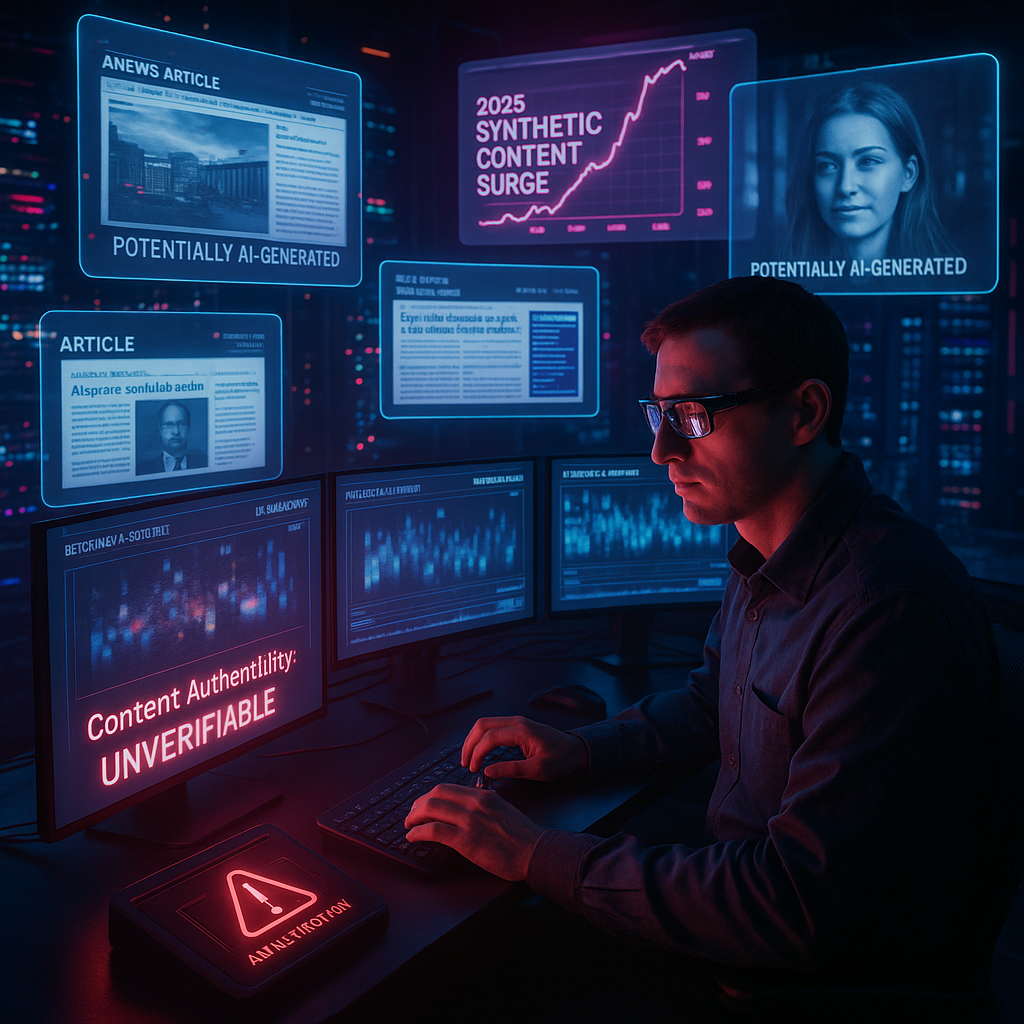
- As 2025 ends, the AI press review 2025 reports a surge of AI-generated content (“slop”) overwhelming digital platforms and eroding the line between genuine and synthetic experiences.
- Major shifts in global innovation and AI capabilities are generating both opportunities and challenges for those engaged in technology.
- Top story: AI-generated content floods platforms, making fact and fabrication nearly indistinguishable, which raises concerns over digital authenticity.
- China’s AI patents have risen 67.7 times to 1.8 million, signaling a new phase in the global innovation landscape.
- Benchmarks: Advanced frontier models have achieved 75% on the ARC-AGI test suite, doubling their problem-solving flexibility.
- Tesla’s FSD v14 navigates real-world traffic and passes physical Turing tests, redefining boundaries between human and machine judgment.
- AI press review 2025: Expanding algorithmic creativity forces platform operators, users, and regulators to reconsider established boundaries.
Introduction
On 25 December 2025, the AI press review 2025 examines a digital environment saturated by AI-generated content. The increasingly blurred boundaries between authentic material and deepfake fabrication spark new debates on online reality. At the same time, a dramatic rise in China’s AI patent filings is reshaping the global innovation map, foregrounding the complex intersection of creativity and control at the core of artificial intelligence.
Top Story: AI-Generated Content Flood Overwhelms Online Platforms
Unprecedented Volume Raises Alarm
Major online platforms reported record volumes of AI-generated content straining their moderation systems in late 2025. Meta stated that synthetic content now makes up about 30% of all new submissions, and YouTube observed that suspected AI-generated videos have doubled each month since October 2025.
The influx covers all categories, including news, opinion, images, and video. Platform representatives indicated that detection systems are failing to keep pace with evolving generation methods that circumvent traditional watermarking and fingerprinting.
This trend intensified as several new open-source large language and diffusion models released this month further lowered barriers to producing high-quality synthetic content. Sam Altman, CEO of OpenAI, said, “We are entering a phase where the line between human and machine-created content is functionally invisible to both users and our systems.”
Stay Sharp. Stay Ahead.
Join our Telegram Channel for exclusive content, real insights,
engage with us and other members and get access to
insider updates, early news and top insights.
 Join the Channel
Blurring Reality Boundaries
The surge raises concerns about society’s ability to agree on shared truths when the source of information becomes obscure. Researchers at Stanford’s Center for AI Safety documented cases where purely synthetic news stories generated engagement metrics equal to or exceeding traditional journalism.
Debates have intensified around the notion of authenticity in digital spaces. Professor Emma Chang of MIT’s Media Lab noted, “When the artificial becomes indistinguishable from the authentic, we must reconsider what authenticity even means.”
A growing number of social media users report problems distinguishing between human- and AI-created content, which leads to rising concerns about public trust. Recent surveys found that 62% of Americans now regularly question whether the information they consume online might be AI-generated.
Industry Rethinking Safeguards
In response, leading AI firms are accelerating efforts to implement new authentication protocols. A consortium including Microsoft, Anthropic, and Google has proposed a universal content provenance standard that would embed tamper-proof origin data within all AI-generated media.
Platform companies are increasing resources dedicated to behavioral detection, moving beyond content signatures alone. Twitter recently formed a “Synthetic Content Response Team” tasked with developing new approaches to content authentication.
Global regulators have signaled enhanced scrutiny. The EU’s Digital Services coordinator has called an emergency meeting for January 2026 to consider whether additional legislative measures beyond the AI Act are warranted.
Also Today: AI Research and Development
China’s Patent Dominance Grows
China has outpaced all other countries in AI patent filings during the fourth quarter of 2025, according to data from the World Intellectual Property Organization. With 18,342 patents filed (a 47% increase year over year), the bulk of activity is concentrated in computer vision, natural language processing, and autonomous systems.
Tsinghua University leads Chinese academia’s surge, filing more patents than the entire European Union combined. The Beijing AI Research Institute now holds the world’s largest foundation model patent portfolio, surpassing OpenAI and Anthropic.
The rapid increase reflects China’s national AI strategy, which prioritizes intellectual property protection. Dr. Wei Zhang, director of the China AI Governance Initiative, explained during a technology briefing, “We’re seeing the results of a decade of strategic planning around AI sovereignty.”
Western technology firms are voicing concern about possible licensing hurdles. Sundar Pichai, CEO of Google, observed at the Global Tech Summit in Singapore, “The innovation landscape becomes considerably more complex when core AI technologies are subject to proprietary claims across jurisdictional boundaries.”
New AI Capabilities Breach Theoretical Barriers
DeepMind researchers recently provided evidence of emergent reasoning abilities in large, multimodal AI models. Published in Nature, these findings show the systems spontaneously developed problem-solving strategies not present in their training data.
Researchers described the models’ capabilities as “cognitive bootstrapping” (the formation of new conceptual frameworks when facing unfamiliar problems). Dr. Mira Murati, lead researcher, described the phenomenon as resembling “the birth of genuine abstract reasoning.”
These developments prompt new philosophical questions about the nature of intelligence. Some philosophers are reconsidering established assumptions on consciousness and understanding. Dr. Thomas Nagel commented, “When a machine demonstrates what appears to be genuine insight, we must ask whether our definitions of understanding need revision.”
Observers note that performance on major AI reasoning benchmarks has increased between 300% and 500% in just six months, which suggests exponential progress across various domains.
What to Watch: Key Dates and Events
- Greater China AI Patent Symposium, 12 January 2026, Beijing Convention Center. Focused on strategic intellectual property protection.
- ARC-AGI Benchmark Symposium, 15–17 January 2026, San Francisco. Unveiling new standards for measuring advanced AI capabilities.
- Tesla Optimus General Intelligence demonstration, 2 February 2026. Showcasing reported breakthroughs in robotic reasoning and adaptation.
- Digital Reality Summit, 10–12 February 2026, Amsterdam. Dedicated to authentication technologies and synthetic content management.
Conclusion
The AI press review 2025 reveals an environment where synthetic content dominates digital platforms, challenging efforts to determine authenticity and reality. Rapid growth in AI patent filings and capabilities highlights intensifying global competition and prompts renewed philosophical inquiry. As international events address patents, benchmarking, and content authentication in early 2026, their outcomes will help shape the regulatory and technological contours of the coming year.




Leave a Reply