
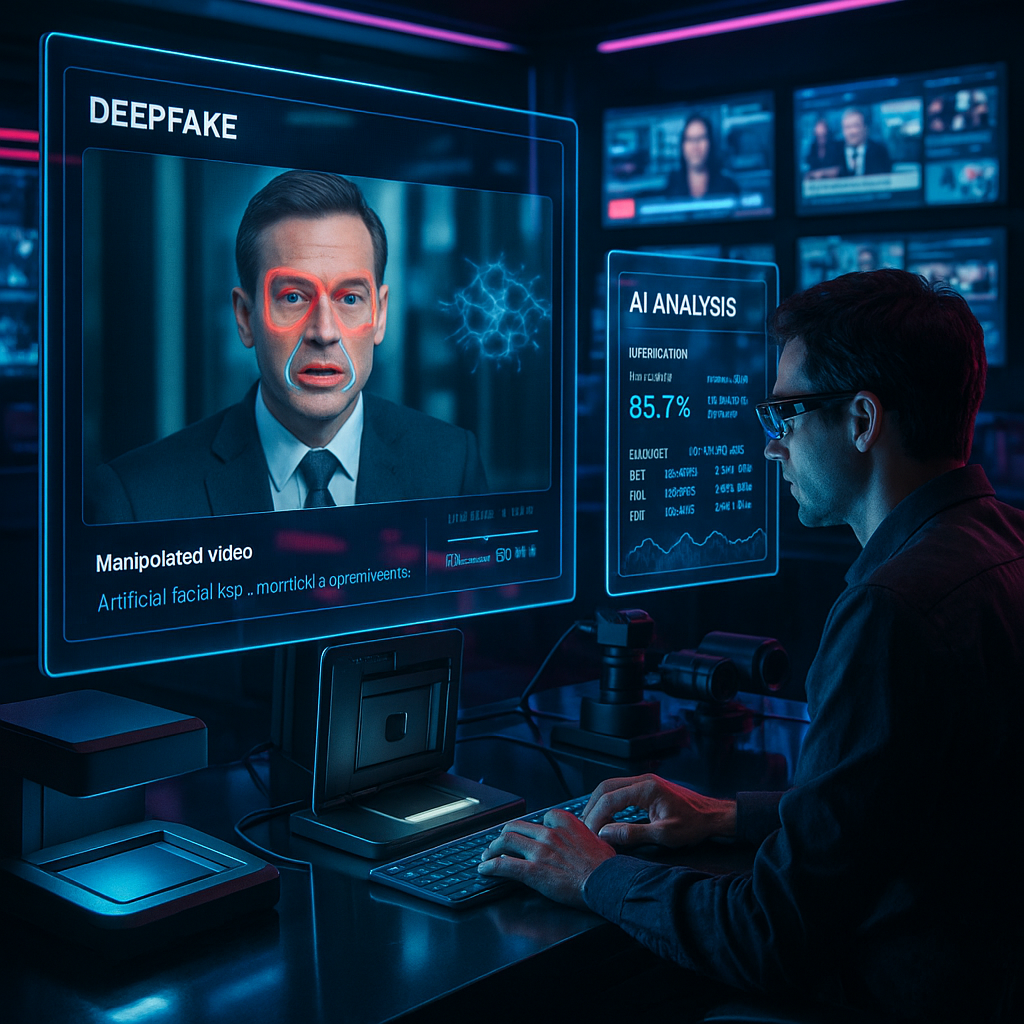
Key Takeaways
AI’s rapid evolution is fundamentally reshaping journalistic integrity. With synthetic content and manipulated media proliferating at unprecedented rates, journalists are compelled to adapt, harnessing AI not only to uncover truth but to preserve public trust in news. Below are key insights into how advanced AI-driven fact-checking and deepfake detection are becoming embedded, indispensable components of newsroom workflows. They are redefining verification in the digital era.
- AI is transforming fact-checking from painstaking manual effort to forensic-grade precision. Innovative systems use computer vision and machine learning to verify claims, spot inconsistencies, and scrutinize digital evidence at a scale far beyond traditional approaches.
- Integrated verification is the new norm. AI tools are no longer isolated utilities; they are now woven directly into content management and editorial workflows, enabling real-time content authentication as a routine editorial practice instead of a separate checkpoint.
- Cross-modal detection uncovers fakes that evade traditional filters. By jointly analyzing images, video, and audio, leading solutions expose manipulated or AI-generated content that slips past single-modality checks. This approach is setting new standards for authenticating multimodal media.
- Real-time verification empowers journalists to answer misinformation at its own pace. Advanced platforms can instantly flag manipulated or AI-generated data, giving newsrooms the ability to maintain accuracy while responding swiftly to breaking stories across all platforms.
- Ethical use and transparency define responsible AI fact-checking. To uphold credibility, journalists must balance the speed and accuracy of forensic AI with a commitment to transparent disclosure, clearly communicating when and how AI tools vet information for their audiences.
- AI-powered verification is now essential to sustaining media integrity. In a world inundated with synthetic media, deploying robust AI verification has become foundational. It is no longer optional to fortify public trust and safeguard democratic dialogue.
Understanding and adopting these AI-powered verification paradigms equips journalists to confidently navigate the modern complexities of content authentication. In the following sections, we’ll explore the technologies, strategic implementations, and ethical frameworks empowering journalism to maintain vigilance in an ever-evolving landscape of digital deception.
Introduction
The modern newsroom faces a relentless onslaught of satirical memes, synthetic news anchors, and manipulated videos. These forms of misinformation travel faster and mutate more cleverly than ever—often leaving even the best-trained journalists struggling to discern fact from fiction. In such an environment, the central question becomes clear: how can journalism uphold its commitment to truth when the very notion of reality is up for grabs?
AI-powered fact-checking and deepfake detection have emerged as the profession’s new sentinels. Far from being optional add-ons, these tools deliver forensic precision and real-time assessment, scrutinizing images, audio, and video across all digital channels. By verifying content at the speed of breaking news, AI-driven solutions not only bolster accuracy but also reinforce credibility in an era plagued by skepticism and misinformation.
Stay Sharp. Stay Ahead.
Join our Telegram Channel for exclusive content, real insights,
engage with us and other members and get access to
insider updates, early news and top insights.
 Join the Channel
As we move forward, it’s crucial to understand how the seamless integration of AI fact-checking and deepfake detection is transforming verification practices, equipping today’s news professionals to defend journalistic integrity against the escalating complexity of digital deception.
Current State of AI in Journalism Fact-Checking
Evolution of AI Verification Tools
Since 2018, AI verification tools have accelerated from basic image analyzers to multi-modal powerhouses that tackle manipulation across text, image, audio, and video. This evolution mirrors the increasing sophistication of misinformation tactics themselves.
No longer confined to single-purpose functions, today’s verification ecosystems blend multiple approaches. Early leaders like Truepic focused on image authentication using cryptographic protocols at the point of capture. By 2020, Sensity AI was deploying neural networks capable of spotting GAN-generated images with over 96% accuracy. Now, platforms like Microsoft’s Video Authenticator and Jigsaw’s Assembler employ transformer-based models that can assess multiple content types in parallel, pushing accuracy and speed to new heights.
A defining characteristic of current systems is their dual-layer strategy: combining forensic analysis (examining digital artifacts and inconsistencies) with semantic scrutiny (cross-referencing content plausibility with trusted data sources). This synergy is crucial as deepfake creators continually find ways to evade purely forensic detection.
Investment in AI verification has surged alongside these technical advancements. Venture capital in this sector topped $450 million in 2022, while industry giants provide open-source models and invaluable datasets. Facebook’s DeepFake Detection Challenge dataset, with over 100,000 synthetic videos, stands as a benchmark resource driving industry-wide algorithmic training and improvement.
Leading AI Fact-Checking Platforms
Several platforms now set the pace for AI-powered verification in newsrooms, each with unique technological strengths and methodologies. Their widespread adoption underscores their growing importance.
- ClaimBuster, developed at the University of Texas-Arlington, uses natural language processing to gauge the verifiability of statements, rapidly matching them against a database of over 40,000 fact-checked claims. Integrated into workflows at organizations like the Associated Press, it streamlines verification as journalists craft their stories.
- Content Authenticity Initiative (CAI), spearheaded by Adobe alongside partners like The New York Times and Twitter, focuses on content provenance. By embedding cryptographic signatures at creation, CAI enables immutable tracking of origin and edit history. Leading agencies such as Reuters and Getty Images have leveraged CAI to boost transparency across their media outlets.
- Sensity AI applies computer vision and deep learning techniques to detect deepfakes in video content, achieving nearly 97.3% detection accuracy on standard datasets. Newsrooms at Le Monde and Der Spiegel use Sensity as a frontline filter for user-generated video submissions.
- Factmata takes a hybrid route, harnessing machine intelligence and domain expert validation to analyze content on multiple axes—credibility, bias, and narrative toxicity. Outlets such as BBC News and Al Jazeera credit Factmata for their dramatic reduction in time to verify fast-spreading claims during critical reporting cycles.
Implementation varies by newsroom capacity and focus. Global giants like Reuters and the Associated Press often have custom solutions with in-house verification teams, while small and regional outlets access AI capabilities via collective networks or third-party APIs, such as those offered through the International Fact-Checking Network.
Real-World Applications in Newsrooms
AI verification tools are no longer experimental; they are operational mainstays in journalism worldwide, with deployment strategies tailored to fit diverse organizational needs and resources.
The Washington Post’s “Truth Teller” initiative is an example of deep newsroom integration. By blending computer vision, speech-to-text, and natural language processing, it enabled near-instant analysis of political debates in 2020, slashing verification turnaround from hours to minutes and expanding factual output by 67%. All this occurred while reducing staff burden.
France’s AFP employs a distributed, AI-assisted model. Its “Vigil” system continuously monitors global social media for viral content, automatically flagging suspicious images or footage. Human fact-checkers then validate flagged items, allowing the agency to operate in over 80 languages and debunk thousands of misinformation narratives annually.
For local and resource-limited newsrooms, collaboration is key. The “VerifyThis” network unites more than 140 regional outlets in the U.S., offering API access to advanced verification tools and a shared database of vetted claims. This collective approach has proved invaluable during natural disasters and health crises, when rumor and misinformation spread rapidly at the community level.
Integration patterns are revealing. News organizations that embed AI directly into their content management systems see far greater adoption and quicker verification, compared to those relying on separate, stand-alone tools. The Financial Times, for instance, reported a 218% jump in verification tool usage once Factmata was built directly into its CMS, demonstrating a clear shift toward frictionless, in-line verification.
Yet challenges endure. Journalist training remains a hurdle; many still struggle to interpret algorithmic confidence scores accurately, with some studies showing almost half of practitioners misjudging verification certainty. Technical integration with legacy systems is another persistent hurdle. Nonetheless, the trend is unmistakable: verification tools are rapidly transitioning from optional aides to central platforms in the pursuit of trustworthy journalism.
Technical Foundations of Deepfake Detection
How AI Detection Algorithms Work
Deepfake detection technology has become a relentless arms race, continuously evolving to outpace the sophistication of synthetic content creation. Current detection algorithms employ a multi-layer architecture targeting media artifacts at various analytical depths.
At the initial level, convolutional neural networks (CNNs) scrutinize visual data for subtle pixel irregularities, such as color dispersion in facial regions, unnatural boundary edges, or inconsistent eye reflection. For example, Microsoft’s Video Authenticator uses the EfficientNet-B7 architecture, running images through hundreds of layers to extract nuanced digital signatures of authenticity or deception.
Temporal analysis is another foundational strategy, particularly for video. By leveraging recurrent neural networks (RNNs) and long short-term memory networks (LSTMs), these systems evaluate frame sequences for physiologically implausible patterns—such as unnatural blinks, micro-expression disruptions, or misaligned head movements. This technique, highlighted in Facebook’s DeepFake Detection Challenge, excels at detecting manipulations that single-image analysis can’t catch.
Stay Sharp. Stay Ahead.
Join our Telegram Channel for exclusive content, real insights,
engage with us and other members and get access to
insider updates, early news and top insights.
Join the Channel
Diving deeper, frequency domain analysis utilizes mathematical transforms to examine the media for patterns invisible in the spatial domain. Discrete cosine transforms and wavelet decomposition can isolate regularities inherent to GAN-generated fakes, providing an additional layer of scrutiny when spatial clues have been intentionally masked.
Emerging at the forefront, multimodal inconsistency detection cross-references correlations between content channels. It ensures, for example, that a speaker’s lip movements match the supplied audio or that lighting changes are physically coherent across a scene. Text-based solutions like Google’s GLTR spot improbable wording patterns in AI-generated text, while video solutions such as TrueMedia analyze millisecond-level alignment between spoken words and facial movements. These cross-checks bring a comprehensive scrutiny that single-modality tools simply cannot match.
Finally, it is important to understand that these detection systems operate probabilistically, not absolutely. They offer confidence levels alongside visual highlights of suspicious regions, enabling journalists to make informed decisions in the absence of total certainty. This probabilistic foundation reflects the unending contest between fake generation and detection. The best tools adapt as quickly as new threats emerge.
For those interested in the philosophical implications of AI’s ability to perceive, judge, and evaluate complex audio-visual content—parallel to deepfake detection’s cross-modal approach—see AI perception of beauty.
Cross-Modal Detection Techniques
The future of content authentication lies in cross-modal detection, where AI systems evaluate consistency not just within individual media but across text, image, audio, and video simultaneously. This layered approach is effective in exposing sophisticated fakes that might evade detection when analyzed in isolation.
In practice, cross-modal detection empowers newsrooms to uncover synthetic media by analyzing signaling mismatches: a voice revelation that does not fit the physical attributes in a video, a facial expression out of sync with speech, or lighting inconsistencies that betray digital tampering. Cross-modal approaches have also extended to industries beyond journalism. In healthcare, for example, similar technologies help verify the authenticity of telemedicine consultations; in education, they are used to certify the provenance of instructional videos; in marketing, cross-modal AI tools detect manipulated influencer content to preserve brand credibility.
As deepfakes grow not just more prevalent but more persuasive, the sophistication of cross-modal detection is becoming a linchpin in a variety of sectors that depend on trust, accuracy, and reputational integrity.
To explore how multimodal AI systems might intersect with or even drive emergent cognitive phenomena, see multimodal AI emergent consciousness.
Conclusion
The continuous evolution of AI-driven verification technologies is fundamentally redefining how journalism and other fields confront the avalanche of digital misinformation. The ever-closer integration of fact-checking platforms and deepfake detection engines has transformed these systems from peripheral tools into essential guardians of credibility, speed, and public trust.
Yet, the sophistication of generative AI means that detection alone cannot win the war against digital deception. The future belongs to organizations that pair forensic-grade algorithms with thoughtful human oversight, transparent editorial practices, and persistent investments in journalist education. The adoption of cross-modal detection and real-time, probabilistic analysis across industries—including finance, healthcare, legal compliance, and consumer protection—demonstrates that the defense of authenticity is a collective and universal challenge.
Looking forward, the central question facing journalism and society at large is not just whether to adopt AI-powered verification, but how to wield these “alien minds” with wisdom and purpose. The leaders of tomorrow will be those who not only deploy cutting-edge technology, but who also anticipate and shape the shifting landscape of digital authenticity. The challenge is to build systems that are both technologically agile and ethically anchored. In the end, turning the pursuit of truth from a solitary struggle into a collaborative, future-ready movement.
For a broader conversation about how algorithmic decision-making and feedback systems create new forms of digital consequence and accountability, see algorithmic karma.
If you are interested in the extension of cross-modal and verification technologies to biological or digital notions of sentience and identity, further discussion can be found at digital suffering.




Leave a Reply