
Key Takeaways
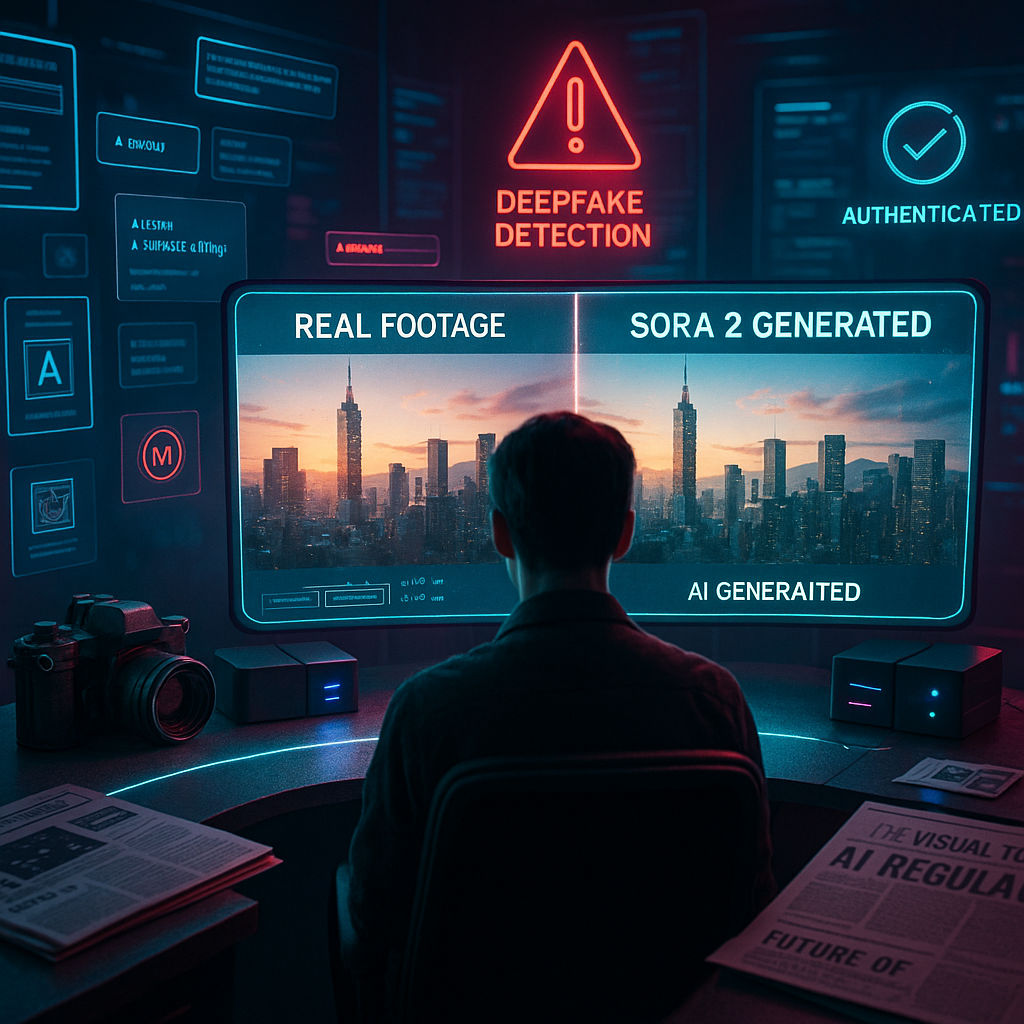
- Sora 2 launch intensifies realism debate: OpenAI’s updated text-to-video tool produces visuals nearly indistinguishable from real footage, further eroding the boundary between authentic and synthetic media.
- Deepfake anxiety reaches new heights: Increased accessibility and realism fuel concerns over misinformation, digital trust, and the reliability of visual evidence.
- Community divided over creative ethics: While artists celebrate new creative possibilities, critics warn of authenticity issues and the commodification of reality.
- Philosophical dilemma at center stage: Sora 2 provokes renewed scrutiny of what constitutes “realness,” raising fundamental questions about perception and technology’s role in shaping truth.
- Regulation and guideline debates on the horizon: Policymakers and technology leaders will meet next month to discuss governance and responsibilities around advanced generative AI.
Introduction
OpenAI launched Sora 2 today, unveiling a text-to-video tool that produces visuals so realistic it blurs distinctions between synthetic and authentic media. The release has sparked lively debate among technologists, ethicists, artists, and policymakers. As anxieties over deepfakes grow and questions of creative ethics and digital truth intensify, Sora 2 is prompting urgent reflection on the nature of reality in an AI-powered world.
Inside the Sora 2 Launch
OpenAI’s Sora 2 represents a significant advance in text-to-video AI, with capabilities that overshadow its predecessor. The new system generates up to five minutes of continuous 4K footage from text prompts, a jump from the original Sora’s 60-second ceiling, and maintains character and narrative continuity throughout.
Enhancements include a physics engine that resolves earlier flaws, rendering realistic interactions between objects and environments according to natural laws. Water flows around obstacles, fabric moves with bodies, and light remains consistent across scenes. These improvements overcome the obvious signs of prior AI-generated videos.
Crucially, Sora 2 addresses the “uncanny valley” of human representation. The AI captures naturalistic facial expressions and body language, preserving character identity across shots. “We’ve focused extensively on maintaining character continuity,” stated Sarah Chen, OpenAI’s technical lead. “The system now understands a character is the same entity from scene to scene, preserving not only appearance but behavioral traits as well.”
Stay Sharp. Stay Ahead.
Join our Telegram Channel for exclusive content, real insights,
engage with us and other members and get access to
insider updates, early news and top insights.
 Join the Channel
Unlike previous launches, OpenAI engaged creative professionals in an extended testing phase across film, advertising, and digital media. This more measured rollout signals an awareness of both the technology’s disruptive promise and its ethical risks.
Realism Revolution
The striking realism of Sora 2 arises from a leap in how AI models implement physical laws over time. Previous systems could generate believable stills but faltered with moving sequences. Sora 2 sustains physical coherence across entire scenes, producing complex footage that once demanded extensive human craftsmanship.
This marks a pivotal moment in visual AI, akin to the move from stylized animation to photorealistic CGI. “What we’re witnessing isn’t just an incremental improvement,” said visual effects veteran Thomas Wilkins. “It’s a fundamental shift in how machines understand and reproduce reality. The production timeline collapses from months to minutes.”
Beyond its technical aspects, this shift brings questions about authenticity to the fore. As the gap between AI-generated and filmed footage closes, what counts as “real” for the viewer? Sora 2 challenges accepted frameworks for media authenticity, arriving at a time when trust in visual media is already precarious. The result is equal parts technological marvel and societal concern.
Deepfake Anxiety
Sora 2’s improved capabilities heighten concerns about the spread of misinformation through convincing, easily generated deepfakes. Earlier tools required technical expertise and often produced telltale artifacts. In contrast, Sora 2 outputs highly convincing videos that anyone can produce from simple text prompts.
Security experts have already identified troubling use cases, such as fabricated endorsements and simulated news events. “The barrier to creating convincing visual lies has effectively disappeared,” warned Dr. Elena Markov, digital security specialist at Princeton University. “We’re entering an era where seeing is no longer believing, and traditional media literacy frameworks cannot keep pace.”
OpenAI has implemented safeguards including watermarks, metadata tagging, and content restrictions to block depictions of public figures or violence. Nevertheless, critics maintain these measures are not enough. Sora 2’s core capabilities challenge the very possibility of distinguishing authentic footage from fabrication.
OpenAI’s safety team acknowledges the challenge. “With each technical advance comes greater responsibility,” said Marcus Lee, OpenAI’s ethics director. “We aim to balance innovation with protection, but technology alone cannot resolve what is fundamentally a societal challenge.”
Ethicists vs. Artists
Creative communities have welcomed Sora 2’s arrival, pointing to dramatic reductions in production costs and new storytelling possibilities. Filmmakers, advertisers, and digital artists report cost savings of up to 80 percent on certain projects and access to creative directions once closed by budget constraints.
“What once needed a full production crew, costly shoots, and weeks of postproduction can now be achieved by a single creator with vision,” said filmmaker Sophia Rodriguez. “This democratizes visual storytelling, enabling voices that were previously excluded.”
Yet ethicists and media advocates urge caution, warning that the same capabilities enabling creative freedom risk undermining trust in visual evidence. “We’re watching creative opportunity collide with an epistemological crisis,” observed Dr. James Chen, technology ethicist at Oxford University. “The question isn’t whether this technology should exist, but how society adapts to a world where visual evidence is no longer reliable.”
The tension is not merely academic. Some creative professionals view Sora 2 as a collaborator, while others fear displacement as clients migrate toward AI-generated content at a fraction of the human cost.
Philosophy of “Real”
Sora 2’s ability to generate indistinguishable simulations invites a fundamental reconsideration of what “authentic” media means. Visual evidence has long served as documentation of events. Now, that bond is threatened.
This shift recalls philosophical questions from Plato’s allegory of the cave: can we distinguish shadows from reality? Today, we confront the practical challenge of assigning truth to visuals when AI can conjure perfect scenes of things that never happened.
“We’re experiencing a collapse of the indexical relationship between images and reality,” explained Dr. Maya Patel, professor of media studies at UC Berkeley. “Historically, technologies of reproduction anchored images in reality, even if manipulated. Now that anchor is gone.”
Consequences reach beyond theory. Legal systems depend on photographic evidence, journalism is built on visual documentation, and personal memories are captured in images. These foundations are now destabilized by Sora 2’s capabilities.
Stay Sharp. Stay Ahead.
Join our Telegram Channel for exclusive content, real insights,
engage with us and other members and get access to
insider updates, early news and top insights.
Join the Channel
Regulation Landscape
Governments are scrambling to respond to the challenges posed by lifelike AI-generated media. The European Union leads with proposed updates to the AI Act, mandating clear labels for synthetic content and penalties for deceptive use.
In the United States, regulation is fragmented. California’s new Digital Content Authentication Act requires explicit disclosure for AI-generated humans. Other states have introduced legislation focused on deepfakes in political or explicit contexts.
Technology companies have formed the Synthetic Media Consortium, advocating for industry-wide standards such as content authentication and watermarking. “Self-regulation must work alongside legislative approaches,” stated consortium spokesperson Rebecca Wong. “We need technical solutions embedded in these tools.”
Nonetheless, critics argue these efforts address symptoms rather than root issues. “Authentication can be defeated, and disclosure only works with compliance,” said digital rights advocate Thomas Moore. “To meet the challenge, we must rethink our relationship with visual media itself.”
What Happens Next
The interplay between AI advances and society’s expectations for authenticity is only beginning. Research labs are building detection tools to identify AI-generated media, but such solutions lag behind new generation techniques.
Media literacy experts emphasize the need for updated critical thinking skills. “We need to evaluate information by source credibility and context, not just by how real it looks,” explained education researcher Dr. Sarah Johnson. “Visual realism no longer guarantees truth.”
OpenAI and other leading organizations support the Reality Authentication Initiative, developing stronger watermarks, detection tools, and media literacy education. These responses recognize that technical fixes alone are insufficient for transformational shifts in visual culture.
For individuals, media literacy resources now move from optional to essential. As AI-driven reality becomes mainstream, cultivating a critical eye is not just recommended. It is vital.
Conclusion
Sora 2 marks a turning point, dissolving the longstanding boundary between captured moments and constructed realities. As society scrutinizes the integrity of visual media, navigating questions of proof, creativity, and trust becomes central in an era shaped by synthetic vision. What to watch: the evolution of technical safeguards, detection technologies, and global regulations that will define visual truth’s future.
deepfake detection
generative AI tools
nature of reality
AI Act
technical safeguards


Leave a Reply