
Key Takeaways
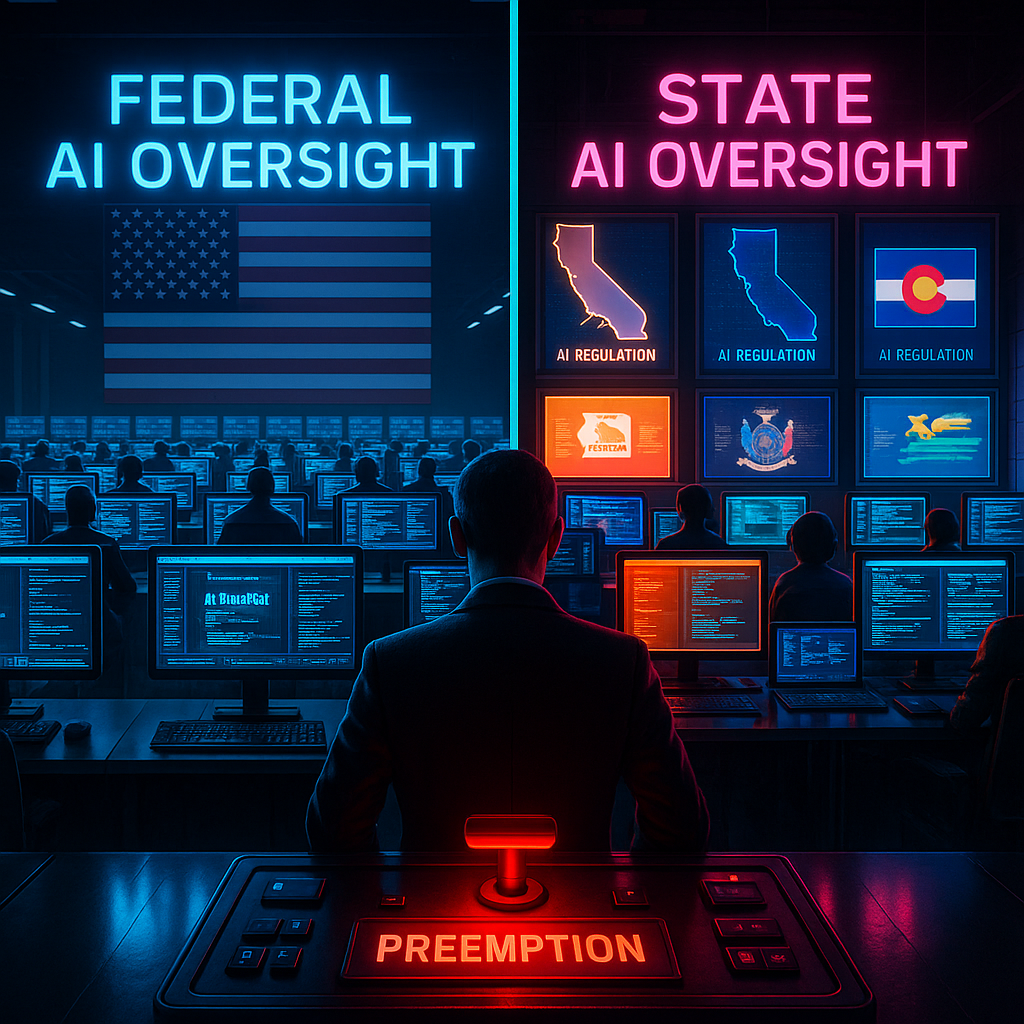
- Federal authority overrides state AI laws: Trump’s proposal would prevent states from enacting independent AI regulations, placing oversight in Washington.
- States lose experimental edge: Local efforts in AI governance, from ethical guidelines to transparency mandates, would be blocked under the plan.
- National standards prioritized over diversity: The policy aims for business-friendly uniformity but limits regionally tailored responses reflecting cultural and social differences.
- Business leaders divided on approach: Some tech industry figures welcome regulatory clarity, while others fear it could stifle innovation and silence grassroots ethical debates.
- Next steps: Policy draft due before election: The plan’s details will be released ahead of the November 2024 vote, setting the stage for a national reckoning over AI’s social contract.
Introduction
Former President Donald Trump unveiled a bold plan to centralize oversight of artificial intelligence in the United States. He has proposed federal preemption of state-level AI regulations and aims to stop local experiments in ethical governance. As the nation awaits a detailed policy draft ahead of the November 2024 election, debate escalates over whether a uniform national framework can truly steward society’s encounter with these unprecedented “alien minds.”
What Trump’s Centralized AI Oversight Plan Proposes
Trump’s proposed AI regulatory framework would grant federal powers that override state-level AI regulations, establishing a single nationwide governance system. The proposal specifically targets state frameworks in California, New York, and Colorado, each of which has recently introduced differing transparency and safety requirements for AI systems.
If enacted, primary oversight authority would move to the federal Commerce Department, with the Departments of Defense and Homeland Security taking secondary roles when national security is involved. This marks a deliberate shift from the current state-led landscape that has developed due to the absence of comprehensive federal legislation.
The Trump campaign confirmed a detailed policy draft will appear in September, positioning the plan as a cornerstone technology platform ahead of the November presidential election. This timing makes it likely that AI regulation will become a prominent campaign issue as both candidates put forward competing approaches to governing emerging technologies.
Stay Sharp. Stay Ahead.
Join our Telegram Channel for exclusive content, real insights,
engage with us and other members and get access to
insider updates, early news and top insights.
 Join the Channel
The End of State-Led AI Experimentation
Trump’s federal preemption proposal would override California’s algorithmic transparency requirements, which currently compel disclosures about how AI systems affect consumers. Likewise, New York City’s notable AI hiring law, mandating audits of automated employment decision tools for bias, would likely be subsumed under federal authority.
Colorado’s recent consumer protection safeguards and Colorado State University’s AI research governance incubator, recognized as a model for public-private partnerships, would also lose their regulatory teeth. Such state-level initiatives have operated as practical laboratories for different regulatory approaches, encouraging experimentation with varying levels of oversight.
With centralization, what experts called the “regulatory sandbox” environment (a landscape where different states test approaches to managing AI risks and benefits) would effectively disappear. This environment has provided valuable early data on policy effectiveness that a uniform federal system might not capture.
Push for Uniformity in AI Development
The plan’s backers emphasize business benefits, arguing that one national standard would lower compliance costs and speed AI development by eliminating patchwork state requirements. The proposal cites industry estimates showing that technology companies currently face more than a dozen distinct frameworks, creating legal and technical obstacles.
However, critics warn that such standardization may neglect the varied cultural and regional priorities that local governance addresses. Communities differ in their expectations for algorithmic fairness, transparency, and appropriate use of automated decisions. State-level responses have typically been more agile in addressing these local values.
The federal framework instead prioritizes technological progress metrics over what governance experts call “cultural compatibility” (the degree to which AI systems align with local norms and values). The core challenge: balancing the efficiency of standardization with the responsiveness of localization, a debate the proposal aims to resolve in favor of uniformity.
Business Community Split on Centralization
Large tech platforms including Microsoft, Google, and Amazon have expressed cautious support for regulatory uniformity. Representatives for these firms argue that navigating 50 sets of state rules amounts to “unsustainable compliance burdens,” and have pressed for a preemptive federal structure that brings greater predictability to product development.
Smaller startups and mid-sized AI companies show less consensus. While some welcome the simplicity of a single standard, others raise concerns that rigid federal rules could stifle competition. The AI Startup Alliance, representing over 200 emerging companies, noted that while clarity is helpful, “a one-size-fits-all approach risks creating barriers to entry that only the largest companies can navigate.”
Ethics advocates and civil liberties groups remain staunchly opposed to centralization. The Electronic Privacy Information Center stated that erasing state efforts would “wipe out years of thoughtful regulatory work in states that have led on AI governance while Congress remained deadlocked.”
Philosophical Questions of Central Control
The proposal also invites deeper reflection on whether centralized oversight is suitable for technologies that may one day act outside of familiar human reasoning. AI ethicists have argued that regulatory diversity might better address the full range of human values as societies confront systems with potentially superhuman capacities.
Tension between efficiency and pluralism in AI policy echoes age-old philosophical disputes about how best to govern transformative technologies. Some theorists liken regulatory diversity in AI to biodiversity in ecosystems, contending that resilient governance emerges from multiple perspectives rather than a single authority.
Whether AI regulation follows a centralized or distributed model ultimately taps into the American debate over federalism in technology policy. As AI permeates employment, healthcare, and civic life, deciding who sets the boundaries becomes increasingly consequential for democratic self-governance.
What Happens Next for AI Regulation
The Trump campaign has announced that a detailed policy paper will be released in September, including specific legislative recommendations and possible executive actions for implementing federal preemption. This document is expected to clarify departmental responsibilities and outline mechanisms in further detail.
Meanwhile, regulatory agencies such as the National Institute of Standards and Technology and the Federal Trade Commission continue work on AI guidelines under current authorities. These agencies have not yet commented on how they would adapt to a federally centralized model.
With both major presidential candidates presenting contrasting governance frameworks, technology policy experts expect a widening public debate as the election approaches. Industry associations are preparing a series of policy forums for September and October to discuss the trade-offs between centralized and decentralized models of AI oversight.
Conclusion
Trump’s plan to centralize AI oversight marks a turning point in America’s negotiation between efficiency, equity, and the richness of local values in technology governance. As experimental, state-led regulation yields to federal standardization, the question intensifies: who should determine AI’s impact, and on what terms? What to watch: The campaign’s policy paper and upcoming industry forums in September and October will bring sharper focus to the federal preemption debate.
Stay Sharp. Stay Ahead.
Join our Telegram Channel for exclusive content, real insights,
engage with us and other members and get access to
insider updates, early news and top insights.
Join the Channel
AI regulation has taken many forms globally, with the EU offering a contrasting example focused on risk categorization and compliance frameworks. As the United States considers a shift toward a national regulatory model, the conversation reflects long-standing philosophical debates about the governance of transformative technologies and the importance of philosophical perspectives on AI in shaping policy. The coming months will determine whether the U.S. continues to allow regional experimentation or adopts a unified approach, fundamentally influencing digital rights and algorithmic governance for years to come.




Leave a Reply