
Key Takeaways
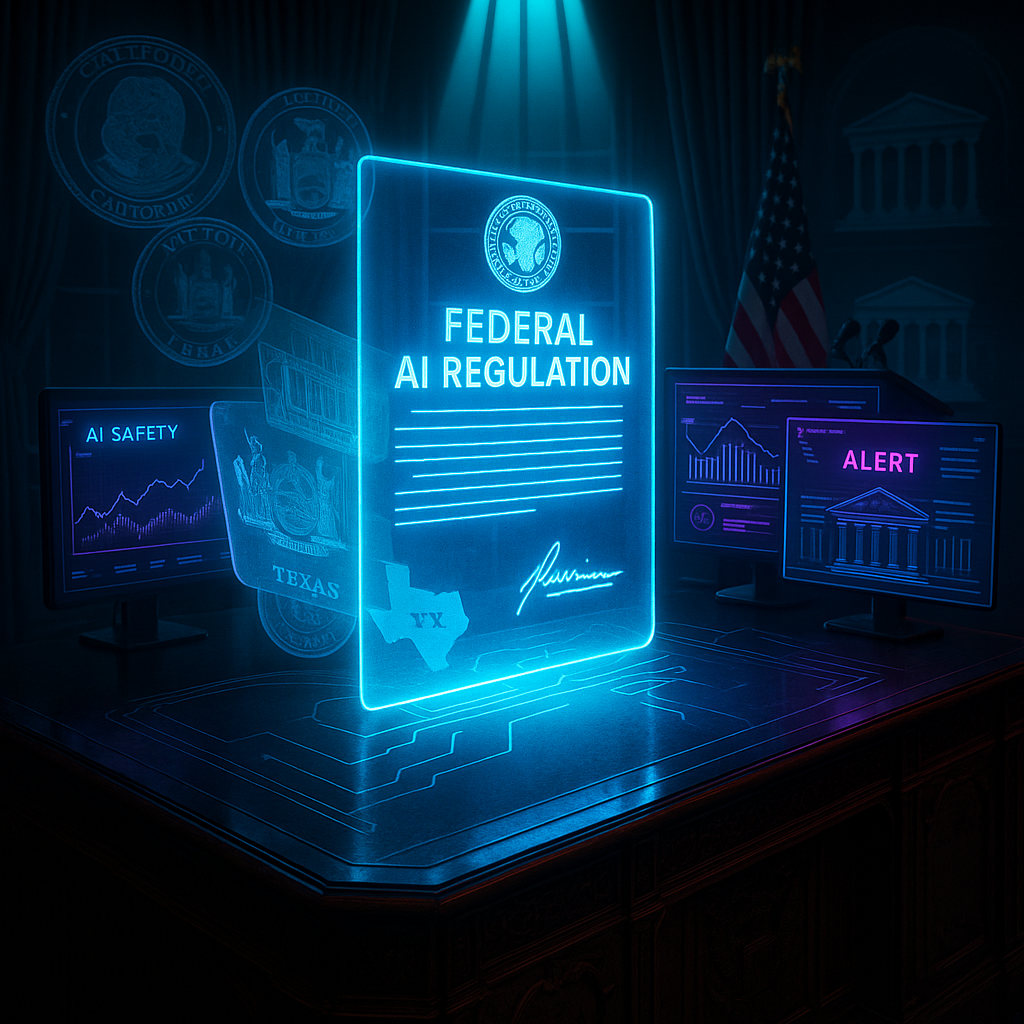
- Top story: Trump halts state AI regulations with a sweeping federal executive order, raising questions about local autonomy and national oversight in AI governance.
- One in ten newspaper articles is now authored by AI, making automation an invisible hand in media narratives and public opinion.
- Militants employ AI tools for recruitment and cyberattacks, reshaping digital battlegrounds and challenging conventional security frameworks.
- OpenAI’s Sora 2 puts deepfake video creation within reach of any smartphone user, testing the limits between authenticity and illusion in citizen media.
- The line between technical innovation and social disruption blurs as AI’s reach grows more personal and unpredictable.
Introduction
On 16 December 2025, Trump’s sweeping executive order halting state AI regulations spotlights the evolving contest between national authority and local control over AI governance. At the same time, militants are turning to AI for recruitment and cyberattacks. Today’s roundup examines how AI and society are increasingly intertwined, challenging assumptions about power, agency, and the fabric of the digital world.
Top Story
President Trump has signed a comprehensive executive order establishing federal guardrails for artificial intelligence development and deployment across the United States. The order creates a national AI safety framework that requires certification for high-risk AI systems and establishes a federal AI oversight office with enforcement authority.
The executive order directly challenges the patchwork of state-level AI regulations that has emerged over the past two years. California, New York, and Texas had previously enacted their own distinct AI governance approaches, creating compliance challenges for technology companies operating nationwide. The administration cited “critical national security and economic interests” as justification for federal preemption.
State attorneys general from seven states immediately criticized the move as federal overreach. New York Attorney General Sophia Rodriguez stated, “This executive order undermines state sovereignty and our ability to protect citizens according to local values and priorities.” Meanwhile, major tech industry associations, including TechFuture and the AI Consortium, expressed support for the unified federal approach.
Stay Sharp. Stay Ahead.
Join our Telegram Channel for exclusive content, real insights,
engage with us and other members and get access to
insider updates, early news and top insights.
 Join the Channel
Legal challenges are expected within days, with multiple states preparing to file lawsuits questioning the constitutional basis for federal preemption in AI governance. The Supreme Court could ultimately decide the balance of power between state and federal AI regulation.
Also Today
UN Report Warns of AI-Enhanced Disinformation Threats to Elections
The United Nations has published a comprehensive report highlighting the growing threat of AI-generated disinformation to democratic processes worldwide. The study documented a 340% increase in sophisticated AI-generated political content across 27 countries that held elections in the past year.
Researchers found that AI-generated deepfakes and synthetic audio were particularly effective at spreading misinformation, with detection rates by ordinary citizens below 30%. Electoral officials in these countries reported unprecedented challenges in combating the volume and sophistication of false content.
The report recommends mandatory content authentication systems and international cooperation on AI-generated content standards. UN Secretary-General Maria Gómez stated, “We’re witnessing an arms race between disinformation creators and detection technologies. Without coordinated action, the integrity of democratic processes is at serious risk.“
Open Source AI Models Achieve Performance Parity with Commercial Systems
The latest generation of open-source large language models has achieved performance parity with leading commercial AI systems in standardized benchmarks. The Phoenix-7B and OpenMind-20B models, both released under permissive licenses, matched or exceeded proprietary systems from leading AI companies on reasoning, coding, and domain expertise evaluations.
These models represent a significant democratization of advanced AI capabilities. Smaller organizations and independent researchers can now deploy sophisticated AI systems without dependency on major tech platforms. The models also require substantially less computing resources than previous generations, making deployment feasible on consumer-grade hardware.
Critics have raised concerns about potential misuse, noting that reduced barriers to powerful AI could enable harmful applications. The Open Source AI Foundation responded by incorporating additional safety measures, including built-in content filtering capabilities and enhanced toxicity detection systems.
AI Ethics Board Members Resign from Major Healthcare Provider
Three members of HealthFirst’s AI ethics advisory board have resigned in protest over the company’s deployment of a patient triage algorithm without addressing documented bias concerns. The algorithm, which helps determine treatment prioritization in emergency departments, reportedly assigned lower urgency scores to certain demographic groups despite similar medical presentations.
Internal documents obtained by TechAccountability indicate that board members repeatedly flagged the disparity in test data but were overruled by executives concerned about deployment timelines. In their joint letter, the resigning members stated, “When ethical guidance becomes merely a checkbox exercise, we cannot in good conscience remain associated with the process.“
HealthFirst issued a statement defending the system and claimed that post-deployment monitoring showed improved overall patient outcomes. The company promised an independent audit while continuing to use the algorithm in 217 hospitals nationwide. Healthcare equity advocates have called for immediate suspension of the system pending further review.
What to Watch
- Federal AI Governance Forum in Washington DC, 18-19 December 2025
- Congressional hearings on AI regulatory framework, 7 January 2026
- Deadline for industry comments on new AI certification requirements, 15 January 2026
- International AI Governance Summit in Geneva, 3-5 February 2026
- Q4 earnings reports from major AI companies begin 20 January 2026
Conclusion
The federal move to override state AI regulations highlights intensifying debates around power, responsibility, and the evolving relationship between AI and society. With concerns rising over disinformation, ethics in critical sectors, and advances in open-source models, the interplay between federal authority and grassroots oversight will influence how AI reshapes democracy and daily life. What to watch: legal challenges, policy forums, and congressional hearings are set to define the next phase of AI governance.




Leave a Reply