
Key Takeaways
- Deepfakes proliferate across platforms: AI-generated videos and audio are increasingly indistinguishable from authentic content, circulating widely on social and news media.
- Truth becomes negotiable in the digital arena: Sophisticated synthetic media raise questions about whose version of reality gains traction, and at what cost to collective trust.
- Political and social manipulation risks intensify: Deepfakes are already fueling disinformation campaigns, targeting elections, public figures, and grassroots activism worldwide.
- Ethics and accountability remain unresolved: As creators of “alien minds,” society confronts profound dilemmas over agency, responsibility, and shifting boundaries of consent.
- Next phase: global efforts to detect and regulate: Policymakers, technologists, and educators push for innovative detection tools and public awareness as AI-generated realities evolve.
Introduction
AI-generated deepfakes are advancing rapidly beyond digital novelties, blurring the line between fact and fabrication across social media, politics, and daily life. As these synthetic creations shape public narratives in real time, distinguishing reality from fiction becomes urgent. This challenge raises deep ethical questions and prompts global efforts to reconsider our relationship with truth in the digital age.
The New Face of Deception
Deepfake technology has swiftly evolved from novelty to a reality-altering force, with AI-generated media now capable of deceiving even discerning viewers. The term “deepfake,” coined in 2017, has moved from internet slang to a widespread cultural reference as synthetic media becomes increasingly sophisticated and accessible.
Recent incidents underscore this shift. In March 2023, a fabricated video of Pentagon explosions briefly caused stock markets to react before the footage was debunked. Even more invasive, non-consensual deepfake videos of Taylor Swift gathered over 47 million views on X (formerly Twitter) before the platform intervened in January 2024.
The underlying technology, including generative adversarial networks (GANs) and diffusion models, can now be leveraged via user-friendly apps, allowing anyone with a smartphone to create convincing replicas of faces, voices, and movements. What once required specialized skills and powerful hardware has become a tool for the masses.
Stay Sharp. Stay Ahead.
Join our Telegram Channel for exclusive content, real insights,
engage with us and other members and get access to
insider updates, early news and top insights.
 Join the Channel
This democratization introduces an asymmetrical threat landscape. Professor Hany Farid, digital forensics expert at UC Berkeley, has noted that deepfake technology is advancing more quickly than detection methods. In this environment, the concept of objective visual evidence is increasingly under threat.
The Philosophical Battleground
Truth has become a contested battleground, where seeing is no longer believing. The age-old philosophical dilemma of distinguishing appearance from reality reemerges, now embodied by algorithms capable of manufacturing evidence indistinguishable from authentic experience.
This technological leap challenges epistemological foundations that have guided understanding for centuries. When visual and auditory evidence (long trusted as reliable) can be synthesized with near-perfect accuracy, we face what philosopher David Chalmers frames as a new kind of skeptical scenario, enabled by technology rather than supernatural forces.
The notion of epistemic pollution takes on new meaning as synthetic content enters the information ecosystem. Deepfakes do not merely deceive; they undermine the mechanisms by which we discern what is real, exploiting our cognitive reliance on sight and sound as truth markers.
This disruption extends from individual perception to collective understanding. Media theorist Zeynep Tufekci argues the deepest risk is not specific deceptions, but a world where nothing needs to be true because everything might be false. Such uncertainty fuels an “epistemic crisis,” a breakdown in society’s process for establishing shared truth.
Beyond Individual Images: Synthetic Reality
Moving beyond isolated images and videos, deepfakes now represent the leading edge of a broader transformation: the construction of synthetic realities through coordinated AI-generated elements. This capability enables the weaving of entire alternative narratives capable of steering public discourse.
The technology already supports full digital impersonation. In February 2023, scammers used AI to mimic a company CFO in a video call, authorizing a $25 million fraudulent transfer. Synthetic identities now operate across platforms, building consistent personas that interact with real humans in increasingly seamless ways.
Researchers refer to this phenomenon as “reality laundering“, where fabricated events are introduced into discourse, then gain legitimacy through repetition and amplification. As falsehoods spread from fringe channels to mainstream outlets, their origins are obscured and fabrications begin to resemble accepted truths.
The implications reach beyond singular hoaxes. Dr. Joan Donovan, research director at Harvard’s Shorenstein Center, states that the most impactful deepfakes are not always the most realistic, but those that reinforce existing beliefs, making them less likely to be questioned even when verification is technically possible.
The Ethics of Synthetic Minds
The creation of convincing deepfakes requires AIs to replicate not only appearance but behavior and context. This represents a form of synthetic cognition that mimics human perception, pushing ethical questions about the boundary between human and machine intelligence to the forefront.
Synthesizing human likeness appropriates identity without consent. AI systems that capture and reproduce someone’s face, voice, and mannerisms challenge ideas of identity ownership and personal rights. Philosopher Regina Rini’s question is especially relevant: Who owns your face, your voice, your digital presence, and who controls its synthetic versions?
Deepfake creation raises complex questions about agency and responsibility. Harmful content can arise from the interplay of human prompts and AI generation, but accountability is diffused. The system itself lacks moral agency, yet it plays a direct role in crafting persuasive human replicas.
This diffusion of responsibility poses new ethical dilemmas. Dr. Kate Darling of the MIT Media Lab explains that power imbalances emerge between those who understand the technology and those who are affected by it, demanding new ethical frameworks. Such frameworks must address not only individual harm, but also the broader erosion of collective trust.
Defense Mechanisms: Technical and Social
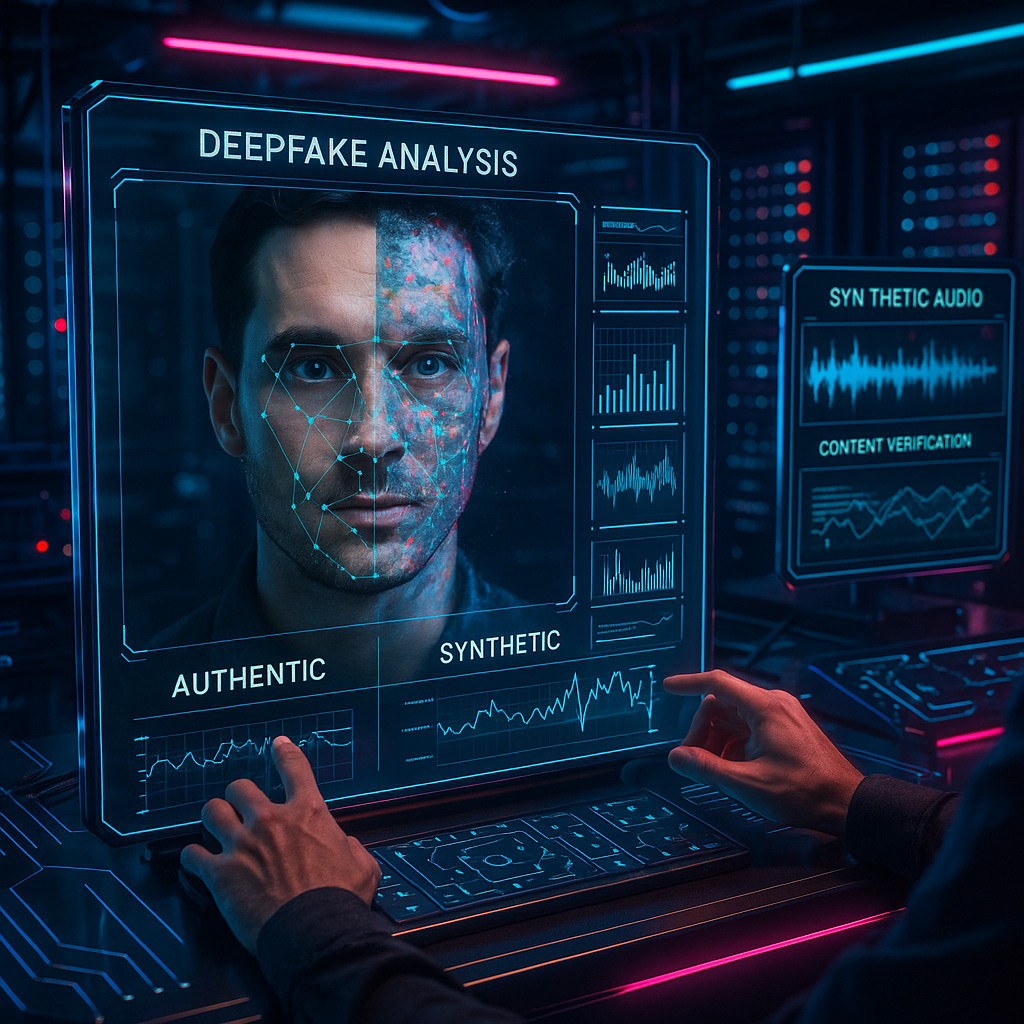
Technical countermeasures to deepfakes are evolving in tandem with generative technologies. Detection algorithms now look for subtle anomalies such as irregular blinking, unnatural facial movements, or mismatched audio and video, which can indicate synthetic origins.
Another approach is content provenance. The Coalition for Content Authenticity and Provenance (C2PA) has introduced standards for “content credentials” (digital watermarks and metadata tracing a media item’s source, creation date, and edits). Companies like Adobe and Microsoft have applied these measures to build chains of authenticity.
Yet technical solutions alone are insufficient. Media literacy education has become a vital partner to detection tools. Organizations such as MediaWise and the News Literacy Project now offer curricula specifically about synthetic media, providing citizens with critical evaluation skills for navigating a complex information landscape.
Stay Sharp. Stay Ahead.
Join our Telegram Channel for exclusive content, real insights,
engage with us and other members and get access to
insider updates, early news and top insights.
Join the Channel
Regulatory approaches are emerging worldwide, though with significant variation. The EU’s Digital Services Act, for example, mandates labeling of deepfakes and action against harmful synthetic content. Several U.S. states have criminalized specific types of malicious deepfakes. Privacy law expert Dr. Danielle Citron notes that effective regulation must carefully balance harm prevention and legitimate expressive uses.
AI-powered fact-checking and deepfake detection have become essential tools for modern journalism, illustrating how the media industry is responding to the challenge of verifying synthetic media circulating during breaking news events.
Living in Post-Reality
Adapting to a world where synthetic and authentic content intermingle requires a fundamental rethink of information processing. The legal idea of “reasonable doubt” now applies to everyday media consumption, necessitating a more tentative trust in visual evidence.
This uncertainty sparks “reality apathy,” as described by researchers (a reluctance to trust any information, regardless of source). Such disengagement threatens the foundations of democracy, which rely on shared facts for collective action. Social psychologist Dr. Sander van der Linden warns that as certainty breaks down, manipulation thrives among those benefiting from confusion.
Communities and institutions are responding with new verification protocols. Collaborative fact-checking networks, involving multiple independent observers, have emerged to establish trust through consensus rather than central authority.
Consequently, our primary method for determining truth may need to shift—from evaluating surface realism to seeking contextual coherence. Instead of asking “Does this look real?” the new question becomes, “Does this make sense in context?” This represents a significant cognitive change, requiring a shift from reflexive trust to critical, contextual understanding.
Forensic and digital integrity specialists are increasingly turning to innovations in deepfake detection and digital forensics to ensure content authenticity and support confidence in digital evidence.
Reclaiming Reality: The Path Forward
Addressing the deepfake challenge requires both technical innovation and cultural adaptation. Safeguarding shared reality will depend on tackling immediate risks while fostering longer-term resilience.
Robust authentication infrastructure is a critical foundation. Developing secure, accessible content provenance systems will require cooperation among technology companies, media outlets, and public agencies. Initiatives like Project Origin, which provides cryptographic signatures for news content, show how technology can protect information integrity.
Education must go beyond detection, focusing on deeper epistemological understanding. Teaching how knowledge is constructed and validated equips citizens with intellectual immunity against manipulation, promoting skepticism that avoids nihilism.
Emerging ethical frameworks are taking shape through collaborative efforts. Organizations such as Partnership on AI have released guidelines addressing the responsible disclosure, use, and distribution of synthetic human representations. These aim to balance creative and educational uses against potential risks.
The blurring of reality and simulation ultimately raises profound questions about the philosophical underpinnings of intelligence and truth, urging society to reconsider longstanding assumptions about evidence, perception, and authenticity.
Ultimately, the deepfake problem reflects enduring philosophical concerns about reality and appearance. Philosopher Luciano Floridi observes that humanity is witnessing a shift from a world where reality was relatively fixed to one where it is increasingly malleable. Navigating this unfolding landscape will require not only new tools, but new ways of understanding.
Conclusion
AI-powered deepfakes are redefining not only our standards of evidence, but the very landscape of trust and shared truth. Adapting to this evolving environment will demand flexible verification tools, thoughtful ethical cooperation, and a cultural shift toward context-based judgment. What to watch: the ongoing development of robust content authentication standards and new ethical guidelines as institutions, technologists, and educators rise to meet the challenge.


Leave a Reply