
Key Takeaways
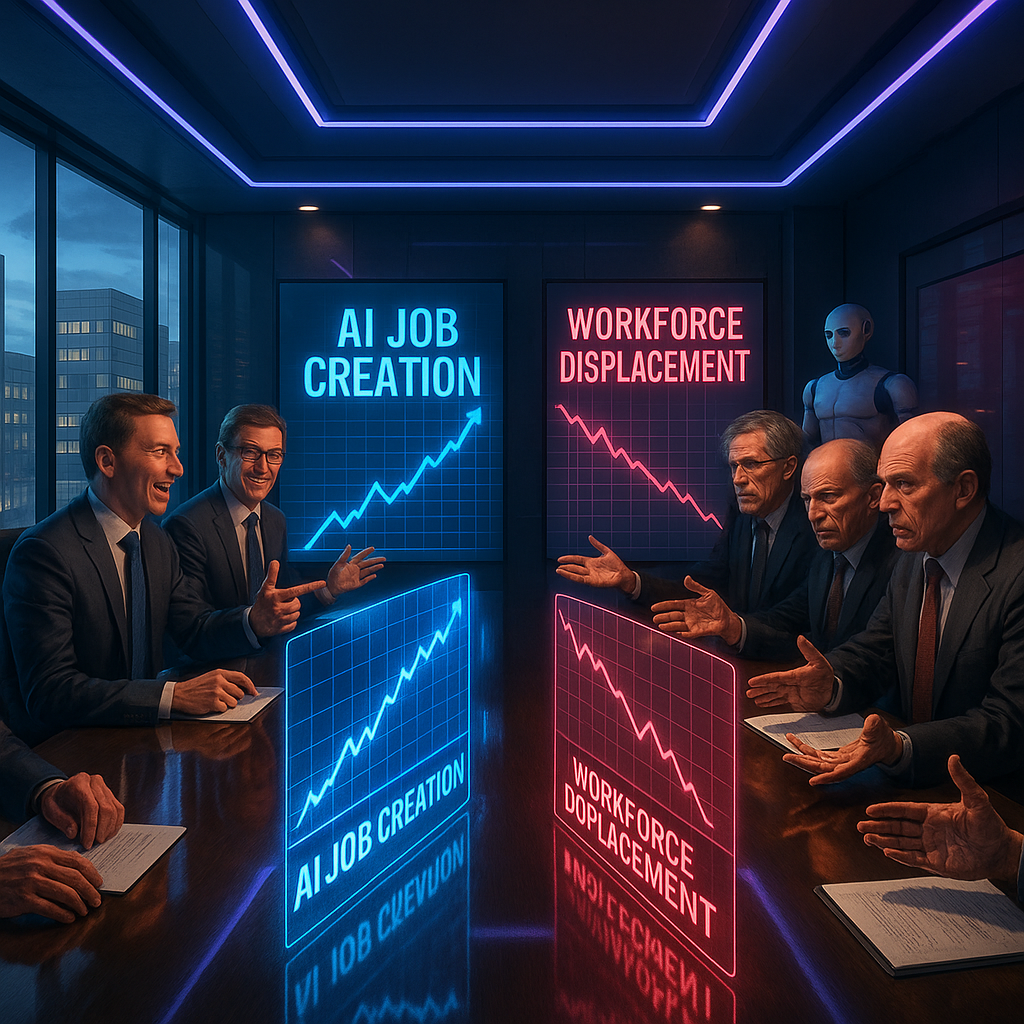
- Top story: Silicon Valley leaders downplay job displacement warnings from AI, sparking debate amid 2026 uncertainties.
- A surge in “AI slop” content accelerates exhaustion and muddles political discussion, highlighting the AI societal impact in 2025.
- Geopolitics: Trump freezes high-level tech trade talks with the UK and EU as disagreements over AI regulation deepen.
- The SEC increases scrutiny of “AI washing,” challenging firms that overstate automation’s real capabilities.
- Growing debate reveals a widening gap between technological optimism and anxieties over AI’s cultural and ethical implications.
Introduction
On 24 December 2025, Silicon Valley figures dismissed warnings of AI-driven job displacement as concerns over 2026 uncertainties and rising AI exhaustion intensified across the political landscape. This roundup examines how the AI societal impact in 2025 shapes debates on technological promises, regulatory standoffs, and the increasingly turbulent intersection of automation, culture, and power.
Notizia principale
Tech Leaders Reject Automation Fears
Silicon Valley executives are increasingly dismissing concerns about AI-driven job displacement. Several high-profile CEOs claimed this week that artificial intelligence will create more jobs than it eliminates. OpenAI’s Sam Altman stated at the Technology Forward conference that “history shows us technological revolutions ultimately expand human potential and economic opportunity, not diminish it.”
These optimistic declarations emerge as AI integration accelerates across industries. Recent McKinsey data indicates that 78% of large corporations have implemented some form of generative AI since mid-2024. Google’s DeepMind division published research suggesting that AI adoption could create 97 million new roles globally by 2028 while displacing approximately 83 million existing positions.
Labor economists have challenged these assertions. MIT’s Daron Acemoglu pointed out that “previous technological revolutions occurred over decades, allowing for gradual workforce adaptation, whereas AI transformation is happening at unprecedented speed.” Recent protests at tech campuses in San Francisco and Boston highlight public anxiety about job security as automation increases.
Stay Sharp. Stay Ahead.
Join our Telegram Channel for exclusive content, real insights,
engage with us and other members and get access to
insider updates, early news and top insights.
 Join the Channel
Contrasting Data on Workforce Impacts
New Bureau of Labor Statistics data released yesterday shows mixed signals regarding AI’s current impact on the workforce. While technology sector hiring rose 7.3% year-over-year, traditional white-collar sectors such as legal services, accounting, and administrative support saw their first employment contractions in 18 months, totaling a loss of 23,000 jobs since September.
The Federal Reserve Bank of San Francisco released a working paper analyzing early impacts of AI on the workforce. The report found that knowledge workers exposed to AI integration experienced 14% higher productivity but a 3.5% reduction in new hiring within their departments. Companies using advanced AI systems reported 22% faster completion of routine cognitive tasks compared to those using minimal or no AI tools.
Recent Stanford University research questions Silicon Valley’s narrative, suggesting that current AI systems primarily replace specific human cognitive tasks rather than complement them. Lead researcher Dr. Emma Rodriguez emphasized that “the technical architecture of today’s most advanced systems is designed to substitute human decision-making, not enhance it, creating fundamental tensions in how we deploy these technologies.”
Also Today
Educational Transformation
Elite Universities Embrace AI Curriculum Redesign
Harvard, MIT, and Stanford announced a joint initiative yesterday to redesign undergraduate curricula around AI literacy and critical thinking. This marks their most significant educational restructuring in decades. Harvard President Jennifer Smith described the effort as “preparing students not just to use AI but to question and shape its development within ethical and societal contexts.”
The initiative will introduce mandatory first-year courses addressing AI’s philosophical and ethical dimensions alongside technical fundamentals. New interdisciplinary majors such as “AI and Human Values” and “Computational Ethics” will launch next fall. Faculty reactions are mixed. Humanities professors have voiced concerns about marginalization, while computer science departments support the increased centrality of their field.
K-12 Education Struggles with Technology Divide
While elite institutions pursue ambitious AI agendas, public K-12 education faces greater challenges in preparing students for an AI-driven future. A Department of Education survey released Monday found that only 12% of public school teachers have received formal AI training, with 68% reporting they feel unprepared to teach AI concepts.
Gaps in technology access are widening. Affluent districts are implementing AI-augmented learning platforms, while lower-income communities struggle with basic digital infrastructure. Education Secretary Williams acknowledged the risks during congressional testimony, stating that “we risk creating a permanent technological underclass if we don’t address these inequities immediately.”
Regulatory Approaches
EU Finalizes Comprehensive AI Framework
The European Parliament finalized its comprehensive AI Act yesterday, creating the world’s most stringent regulatory framework for artificial intelligence development and deployment. The legislation introduces a risk-tiered approach, applying the strictest oversight to systems in critical infrastructure, healthcare, and public services.
Major technology companies will face mandatory compliance audits and potential fines of up to 7% of global revenue for serious violations. European Commission President Maria Dubois described the framework as “a human-centered approach that ensures innovation serves society rather than threatens it.” The regulations will phase in over 24 months, with core provisions taking effect in June 2026.
AI regulation continues to be a flashpoint in transatlantic technology relations, with the new EU Act raising the bar for oversight and compliance worldwide.
US Regulatory Patchwork Expands
The United States continues its sector-specific approach to AI governance. The Securities and Exchange Commission announced new disclosure requirements for public companies using AI in financial reporting or investment decisions. SEC Chair Gary Gensler stated that “investors deserve transparency about how artificial intelligence might impact corporate performance and risk profiles.”
The National Institute of Standards and Technology expanded voluntary AI risk management guidelines, focusing on healthcare applications. These non-binding frameworks have faced criticism from consumer advocacy groups, who argue that America’s fragmented regulatory efforts leave significant gaps compared to the EU’s comprehensive model.
Philosophical Reckonings
Leading Philosophers Challenge AI Consciousness Claims
A consortium of prominent philosophers published an open letter yesterday challenging recent claims about AI consciousness and moral consideration. The letter, signed by 87 leading experts in philosophy of mind, ethics, and cognitive science, argues that current debates about AI sentience often conflate simulation with authentic experience.
Harvard philosopher Michael Sandel, one of the authors, stated that “sophisticated pattern recognition isn’t the same as genuine understanding or suffering.” The letter calls for more rigorous philosophical frameworks to assess machine consciousness and warns that “anthropomorphizing AI systems risks both trivializing human experience and distracting from concrete issues of power, transparency and accountability.”
For an in-depth exploration of these boundaries and the complexities of digital sentience, see multimodal AI emergent consciousness.
Religious Leaders Seek Common Ethical Framework
Leaders from major world religions convened at the Vatican this week to develop shared ethical principles for AI. The three-day summit included representatives from Christian, Muslim, Jewish, Hindu, Buddhist, and indigenous traditions, addressing theological perspectives on artificial intelligence and human dignity.
Stay Sharp. Stay Ahead.
Join our Telegram Channel for exclusive content, real insights,
engage with us and other members and get access to
insider updates, early news and top insights.
Join the Channel
The meeting concluded with a joint declaration emphasizing that “technology must remain in service to humanity rather than becoming its master.” Pope Francis warned that “without ethical guardrails, AI threatens to commodify human relationships and erode the spiritual dimensions of life.” Participants called for greater religious representation in global AI governance, noting that current discussions are dominated by technical and commercial perspectives.
Market Wrap
Tech Sector Volatility
Technology stocks saw significant volatility yesterday, with the AI semiconductor sector particularly affected. Nvidia shares declined 4.3% after the company reported ongoing supply constraints for advanced AI chips may extend through mid-2026, longer than previously expected.
The broader Nasdaq Composite fell 1.8%, and the S&P 500 technology sector dropped 2.1%. Semiconductor equipment manufacturers experienced steeper losses. Shares of Applied Materials and ASML fell by over 5% as analysts adjusted timelines for advanced fabrication facility expansion.
For more on the infrastructure driving next-gen AI and its impact, see AI hardware for archaeology, which covers NVLink and supercomputing transformations.
AMD and Intel posted smaller declines, down 1.1% and 0.8% respectively, after announcing new AI-optimized chip architectures at the International Computing Conference. The CBOE Volatility Index (“fear gauge”) jumped 15% to its highest level since August.
What to Watch
- December 26: Commerce Department releases revised AI chip export control guidelines.
- January 8–11: Consumer Electronics Show in Las Vegas, featuring major AI technology announcements.
- January 15: Senate Committee on Commerce, Science and Transportation hearings on “AI and the Future of Work.”
- January 17: World Economic Forum Annual Meeting in Davos includes a dedicated AI governance summit.
- January 20: Quarterly earnings reports from major tech companies, including Microsoft, Google, and Meta.
Conclusion
The rapid integration of AI in 2025 is intensifying the debate between Silicon Valley optimism and widespread societal unease. Workforce disruption, educational divides, and uneven regulation shape the evolving AI societal impact landscape. Thought leaders urge caution against oversimplified narratives as institutions update curricula and oversight adapts. What to watch: Senate hearings, Davos AI governance sessions, and upcoming regulatory milestones that will test these emerging frameworks.
For further reading on the intersection of AI, society, and philosophical boundaries, explore digital suffering and the evolving debate on ethical frameworks for synthetic minds.



Leave a Reply