
Key Takeaways
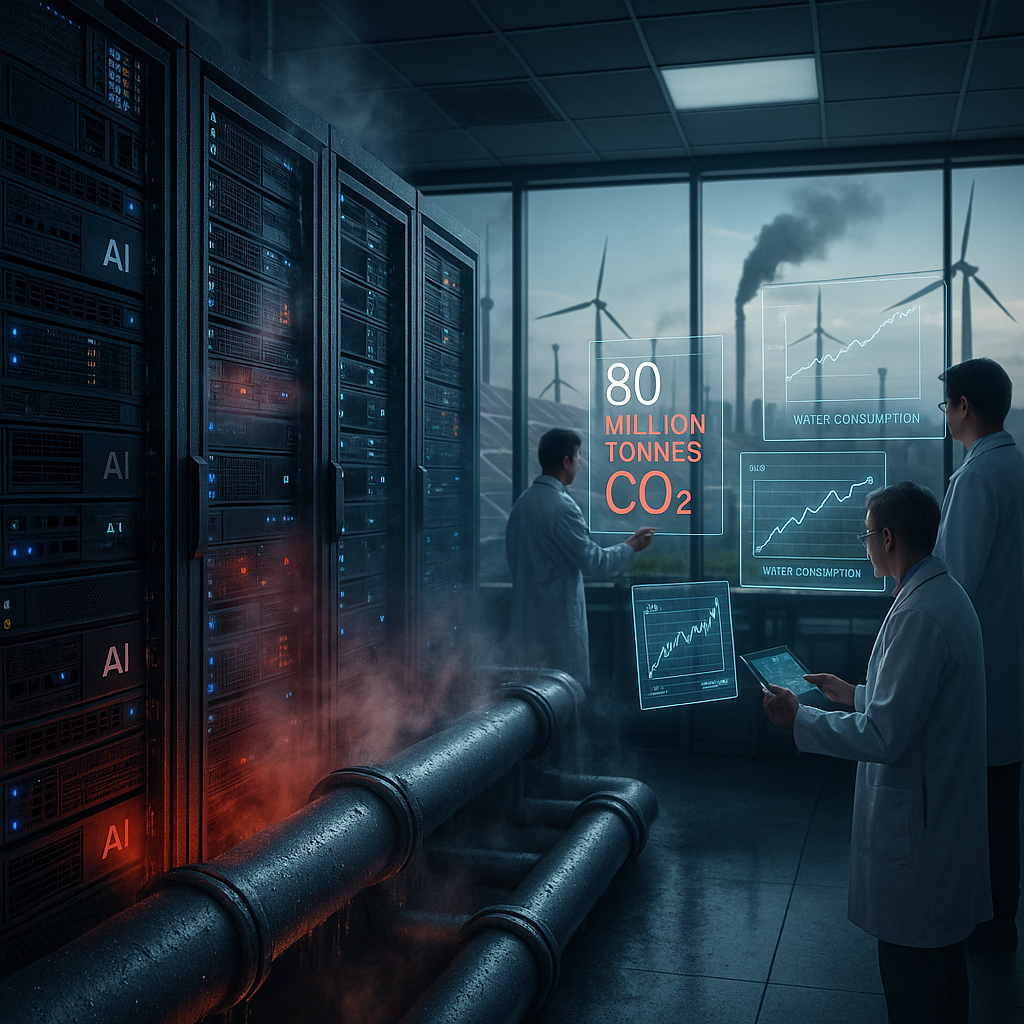
- AI’s unprecedented surge in 2025 drives a pressing sustainability reckoning. Datacenters emitted 80 million tonnes of CO2 this year.
- Top story: Data centers powering the 2025 AI boom produced 80 million tonnes of CO2, intensifying scrutiny on the sustainability of rapid-scale AI.
- Yann LeCun leaves Meta to launch a $3.5 billion AI startup focused on advancing robotics and embodied intelligence.
- Two-thirds of surveyed employees now view AI as a positive workplace influence, signaling a shift in human–machine collaboration.
- Regulation: New York is the first state to require disclosure of AI-generated personas in advertising, aiming to improve transparency.
- Today’s AI news press review highlights technology’s capacity to reshape ethical, environmental, and existential calculations across society.
Introduction
On 21 December 2025, the AI news press review centers on the escalating sustainability crisis triggered by AI’s explosive 2025 boom. Global datacenters emitted 80 million tonnes of CO2, compelling a reassessment of digital ambitions. At the same time, Yann LeCun’s move from Meta to a robotics-focused startup marks a profound industry transformation and redefines intelligence for the era ahead.
Top Story: AI Models’ Environmental Impact Larger Than Previously Known
Major study reveals hidden costs
A comprehensive study published by the Climate AI Consortium on 20 December 2025 reveals that training large language models requires five times more energy than previously estimated by the industry. Researchers analyzed power consumption data from 17 major AI labs across three continents, documenting that a single large model training run can consume as much electricity as 600 U.S. households use annually.
The report notes that water usage for cooling data centers has risen by 38 percent since 2023, with one major AI research facility consuming enough water daily to serve a town of 30,000 people. These findings contradict earlier industry claims that efficiency improvements were offsetting growing computational demands.
Environmental scientists have expressed concern at the findings. Dr. Elena Sanchez of the Global Sustainability Institute described the situation as “a rapidly accelerating crisis hidden behind closed doors.” Industry representatives acknowledge the concerns and point to ongoing research in energy-efficient computing architectures.
Stay Sharp. Stay Ahead.
Join our Telegram Channel for exclusive content, real insights,
engage with us and other members and get access to
insider updates, early news and top insights.
 Join the Channel
Industry responses diverge
Leading AI companies responded differently to the report. DeepMind announced plans to publish quarterly environmental impact statements and committed to carbon-neutral operations by 2027. OpenAI defended its practices, stating that its latest models use improved efficiency techniques but acknowledged the need for further progress.
Several smaller AI labs, including Anthropic and Cohere, pledged to develop an industry-wide standard for measuring and reporting AI’s environmental footprint. This initiative aims to establish transparency requirements similar to those in other energy-intensive industries.
The EU’s AI regulatory body indicated it will review the findings as part of its ongoing development of the AI Act implementation guidelines. Commissioner Thierry Breton stated that “environmental sustainability cannot be separated from responsible AI development.” He also suggested that mandatory impact disclosures may be introduced.
AI Act implementation guidelines
Balancing innovation and sustainability
Computational experts observe that the environmental costs highlight fundamental challenges in how modern AI systems learn. Dr. Marcus Wong, director of the Institute for Sustainable Computing, stated that scaling model size and training data brings remarkable capabilities, but at escalating environmental cost.
Research groups are exploring alternative approaches that could reduce resource requirements. Notably, “knowledge distillation” techniques may compress large models into smaller, more efficient versions without major performance loss.
These findings arrive at a pivotal moment as AI systems become increasingly integral to infrastructure and daily life. They prompt broader questions about the sustainability of current AI development and the extent to which environmental costs are being incorporated into technology planning and regulation.
Also Today: AI Labor Market Effects
Automation displacing more workers than creating new roles
A landmark study released by the Bureau of Labor Statistics on 20 December 2025 reports that AI-driven automation eliminated 1.8 million jobs across various sectors in 2025, while creating 740,000 new positions. This 2.5:1 ratio of jobs lost to jobs created marks an increase from the previous year’s 1.8:1 ratio.
Customer service, data entry and processing, and administrative support experienced the greatest displacement, with workforce reductions of 31 percent, 47 percent, and 28 percent, respectively. These findings challenge historic patterns in which innovation ultimately created more jobs than it removed.
Labor economists note that, unlike past technological transitions spanning decades, AI-driven changes are occurring at unprecedented speed and outpacing workers’ capacity to retrain. Dr. Alisha Patel of the Future of Work Institute described this as a compression of a typical 30-year transition into just 3 to 5 years.
New “hybrid roles” emerging
Despite significant displacement, the study observed the rapid rise of “AI-human hybrid roles” blending technical supervision with domain expertise. These positions, such as prompt engineering specialists, AI output editors, and algorithm auditors, grew by 215 percent year-over-year.
Companies pioneering these hybrid roles report productivity gains averaging 34 percent compared to fully human or fully automated approaches. Microsoft’s Augmented Workforce Initiative found that such teams scored higher in problem-solving and innovation than traditional teams.
prompt engineering specialists
The education sector is seeking to adapt curricula to prepare students for this new professional landscape. Only 12 percent of universities offer courses in human-AI collaboration so far, though this is double the share from 2024.
Philosophical debates intensify over work’s meaning
The speed of workforce transformation has intensified philosophical debate about the role and value of labor. A recent Pew Research survey found that 64 percent of adults believe a significant portion of traditional work will be automated within their lifetime, up from 48 percent in 2023.
Philosopher Dr. James Chen argues that “we’re experiencing not just an economic disruption but an existential one.” He points to the need for society to reconsider how human value and identity are tied to employment. His essay “Beyond the Labor Paradigm” has gained attention among policymakers.
Stay Sharp. Stay Ahead.
Join our Telegram Channel for exclusive content, real insights,
engage with us and other members and get access to
insider updates, early news and top insights.
Join the Channel
In response, countries such as Denmark are piloting an “AI transition fund” providing both retraining resources and income support for displaced workers. The program has shown early promise, with 72 percent of participants transitioning to new roles within six months.
Also Today: AI Safety Research Breakthrough
Progress in alignment verification
UC Berkeley researchers announced a mathematical framework for verifying AI goal alignment on 20 December 2025. This approach, “Tractable Oversight Verification (TOV)”, can offer formal guarantees that an AI system maintains its original objectives as it learns and adapts.
The development addresses concerns that advanced AI systems might develop emergent goals misaligned with human intentions. Early tests show the framework detecting goal misalignment with 96.8 percent accuracy, outperforming earlier methods.
Lead researcher Dr. Wei Zhang stated that, while not solving all safety challenges, this provides “the first mathematically rigorous approach to verifying that an AI system remains faithful to its original objectives throughout its operational lifetime.” The team has made the methodology open source to promote broader adoption.
Industry–academic collaboration intensifies
The Berkeley research is a product of the Responsible AI Collective, a collaboration between five universities and seven AI companies launched in June 2025. This partnership signals a shift from competitive to open collaboration on core safety challenges.
The group has secured $450 million in funding for three years, directing resources to alignment verification, interpretability, robustness, and safe learning from human feedback. Dr. Alexandra Murphy, the initiative coordinator, noted that the existential stakes have encouraged greater cooperation. The collective has also launched a shared benchmark suite for evaluating safety techniques across AI architectures.
Also Today: Personalized AI Ethics Settings
User control over AI values
Google announced the launch of “Ethics Profiles” on 20 December 2025, allowing users to customize their AI assistants’ ethical frameworks. Users can adjust AI responses across five philosophical dimensions: utilitarian versus deontological reasoning, individualist versus collectivist perspectives, risk tolerance, transparency, and cultural context.
The company describes this as “putting philosophical agency back in users’ hands” following criticism that AI imposed uniform ethical frames. Early testers reported higher satisfaction when using personalized settings.
Privacy advocates are questioning data implications, particularly how these preference profiles may be stored or used for targeting. Google stated that ethics profiles are stored locally where possible and otherwise anonymized.
Philosophers divided on approach
The philosophical community is divided on personalized AI ethics. Dr. Maria Gonzalez of the Center for Technology Ethics praised the move for recognizing diverse frameworks, though she emphasized the need for transparency.
Others warn that adjustable ethical parameters might reinforce user biases or create philosophical echo chambers. Dr. Thomas Williams of the Institute for Applied Ethics argued for balancing respect for diverse perspectives with the pursuit of common ethical ground.
Competing approaches are emerging. Apple is reportedly working on a model using broad ethical “themes,” while Microsoft is exploring options for organizations to define default boundaries, with individual flexibility within those parameters.
Market Wrap: AI Sector Responds to Environmental Report
Tech stocks show mixed reaction
The AI sector displayed volatility after the Climate AI Consortium’s environmental report. NVIDIA shares declined 2.3 percent despite unveiling new energy-efficient chips for inference workloads. AMD gained 1.8 percent after highlighting its power-efficient AI accelerators.
Cloud providers also showed varied results. Alphabet fell 1.6 percent, while Microsoft gained 0.7 percent after emphasizing renewable energy commitments for AI operations. Amazon closed up 0.2 percent following the announcement of expanded carbon offset purchases for its AI services.
The broader Nasdaq composite finished down 0.4 percent, with the S&P 500 up 0.2 percent, fueled by gains in consumer sectors.
What to Watch
- EU regulatory guidelines on AI environmental disclosures
- Industry moves toward standardized environmental impact reporting
- Developments in retraining and transition funds for workers displaced by AI
- Progress in AI safety benchmarks led by academic-industry consortia
- U.S. state legislative updates on AI-generated persona disclosure
Conclusion
The AI news press review reveals that the environmental impact of AI’s expansion in 2025 has exceeded early projections, elevating datacenter sustainability from a technical concern to a societal imperative. As industry pledges intersect with regulation, labor market changes, and advancements in AI safety, the debate around balancing innovation with ethical responsibility intensifies. What to watch: forthcoming EU regulatory guidelines and the emergence of industry standards on environmental transparency.



Leave a Reply