
Key Takeaways
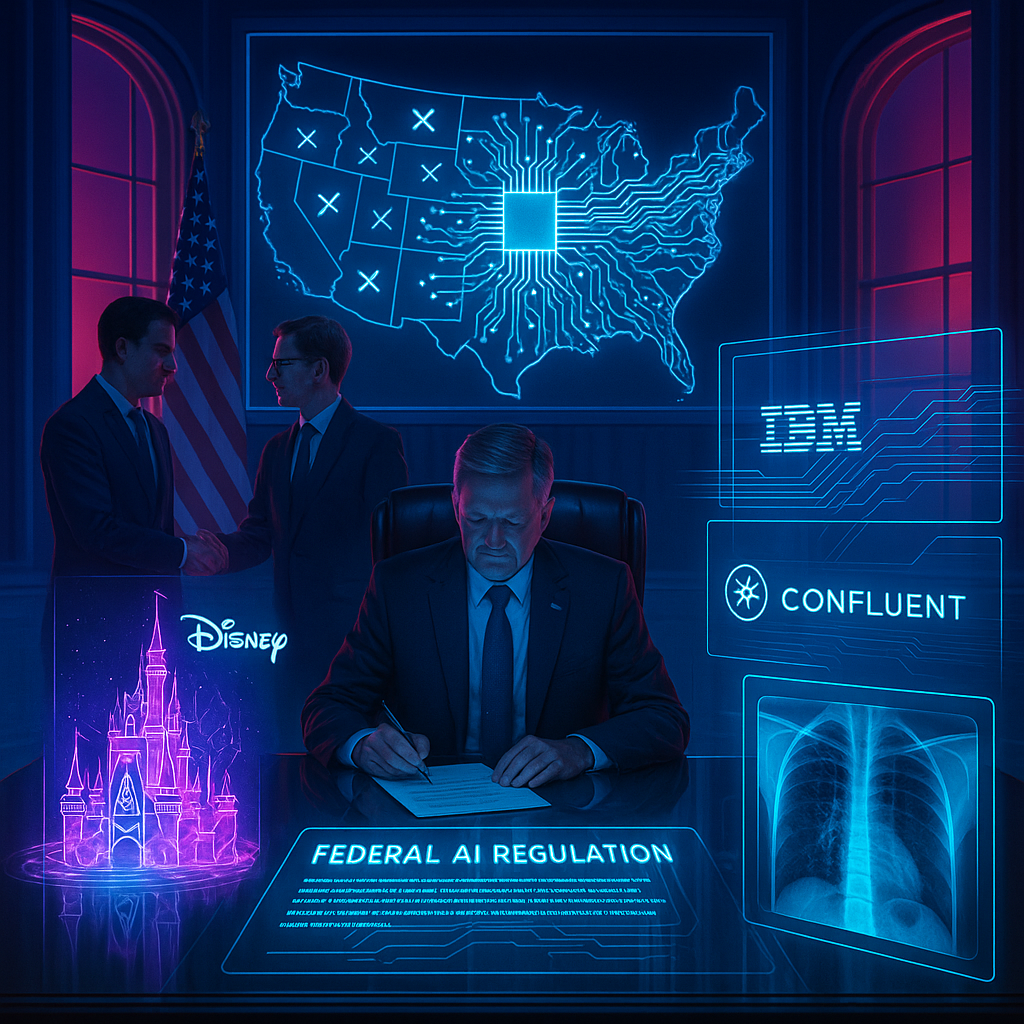
- President Trump’s executive order halts state-level AI regulations, clashing with New York’s push for specific safety frameworks.
- Disney commits $1 billion to OpenAI, aiming to reinvent character licensing and expand the role of AI in entertainment.
- IBM acquires Confluent for $11 billion, strengthening its enterprise AI capabilities and data stream integration.
- AI models identify chronic stress biomarkers in routine chest X-rays, raising new questions about privacy and predictive medicine.
- The day’s events highlight the tension between technological innovation, economic ambitions, and the ethical considerations surrounding artificial intelligence.
Introduction
On 15 December 2025, the AI press review highlights President Trump’s decision to block state-level AI regulations. This contrasts sharply with New York’s campaign for safety frameworks and underscores a pivotal debate between centralized authority and local oversight. Disney’s $1 billion investment in OpenAI further demonstrates artificial intelligence’s growing influence in society and culture.
Top Story
Trump Blocks State AI Regulations
President-elect Donald Trump has signed an executive order preventing states from enacting their own artificial intelligence regulations and assigning exclusive regulatory power to federal agencies. The order, signed on 14 December 2025, overrides existing state laws such as California’s AI Safety Act and New York’s algorithmic accountability statutes. The result: a unified national regulatory framework.
This action fulfills a campaign promise to eliminate what Trump described as a “patchwork of conflicting state regulations,” which technology leaders say hinder innovation. The executive order comes only three weeks after Trump’s inauguration. It signals the administration’s intent to establish the United States as the global AI leader.
During the signing ceremony at the White House, Trump stated that America cannot fall behind in the AI race due to state-specific regulations. The order has received support from major technology companies. OpenAI CEO Sam Altman called it “a necessary step to ensure American technological leadership.” However, digital rights groups have raised concerns about the removal of state-level consumer protections.
Stay Sharp. Stay Ahead.
Join our Telegram Channel for exclusive content, real insights,
engage with us and other members and get access to
insider updates, early news and top insights.
 Join the Channel
The U.S. Commerce Department will now set up a new AI Regulatory Office to develop “innovation-friendly” federal guidelines, with initial proposals expected by March 2026. Congressional Democrats have announced plans to challenge the order’s constitutionality in court.
Also Today
Disney Invests $1 Billion in OpenAI
The Walt Disney Company has announced a $1 billion investment in OpenAI, securing a multi-year strategic partnership. This agreement gives Disney exclusive rights to implement OpenAI’s models across its entertainment assets—from theme parks to digital content production.
Disney plans to use custom versions of GPT-5 to accelerate content creation, develop interactive characters at theme parks, and enhance streaming services such as Disney+. CEO Bob Iger stated that AI would “augment human creativity, not replace it,” during a recent investor call.
This partnership marks Disney’s largest technology commitment since launching its streaming platform. Some analysts see it as a strategic defense against tech companies entering the entertainment space. Morgan Stanley described the deal as “redefining the boundaries between technology and media companies.”
IBM Acquires Confluent for $11 Billion
IBM has completed its acquisition of data streaming platform Confluent for $11 billion, its largest purchase since acquiring Red Hat in 2019. This deal, which closed on 14 December 2025 after regulatory approval, enhances IBM’s capacity for real-time data processing, which is essential to AI applications.
Confluent’s Apache Kafka-based technology allows organizations to process and analyze millions of events per second, providing critical infrastructure for advanced AI systems that rely on constant data streams. IBM CEO Arvind Krishna, in a statement, called the acquisition the “missing piece” in IBM’s hybrid cloud and AI strategy.
The integration of Confluent’s streaming capabilities with IBM’s watsonx AI platform will create what the company describes as an “end-to-end AI factory” for enterprise clients. Market response has been positive, with IBM shares rising 3.2% following the announcement. Analysts see the acquisition bolstering IBM’s competitive position against larger cloud providers.
Also Today
AI Identifies Chronic Stress Biomarkers in Chest Scans
Researchers at a leading US medical institution have announced that AI models are now able to identify biomarkers of chronic stress in routine chest X-rays, a breakthrough with significant implications for predictive medicine. By analyzing large datasets of anonymized scans, the AI was able to detect patterns associated with prolonged physiological stress. These are signals that human radiologists could not reliably observe.
This advancement raises new questions about the privacy of patient data and the ethical uses of predictive health technologies. While medical professionals see potential for early intervention, privacy advocates urge caution regarding the use and sharing of such sensitive information for non-clinical purposes.
Experts suggest that AI-powered health diagnostics are blurring the line between standard screening and complex health predictions. This emphasizes the need for new regulatory and ethical frameworks as these tools are adopted in routine care.
What to Watch
- 18 December 2025: Congressional hearing on Trump’s AI executive order before the House Technology Committee, with testimony from Commerce Secretary Peter Thiel and state attorneys general.
- 10 January 2026: OpenAI scheduled to release GPT-5.5, a model update featuring improved reasoning skills and lower hallucination rates.
- 15 January 2026: Enforcement of the EU AI Act begins, with compliance requirements for general-purpose AI models in European markets.
- 3 February 2026: IBM-Confluent integration roadmap to be presented at the IBM Think conference, detailing product timelines and migration plans.
- 20 February 2026: FDA panel review of Stanford University’s AI-discovered Alzheimer’s biomarkers for possible approval as diagnostic indicators.
Conclusion
President Trump’s move to centralize AI regulation marks a significant shift toward a unified national framework and has intensified the debate over innovation and protection for consumers. At the same time, strategic investments and technical breakthroughs illustrate the layered, rapidly evolving landscape of AI in the United States. What to watch: Next steps include congressional examination of the executive order, release of regulatory guidelines, new AI model launches, and the start of clinical trials in early 2026.




Leave a Reply