
Key Takeaways
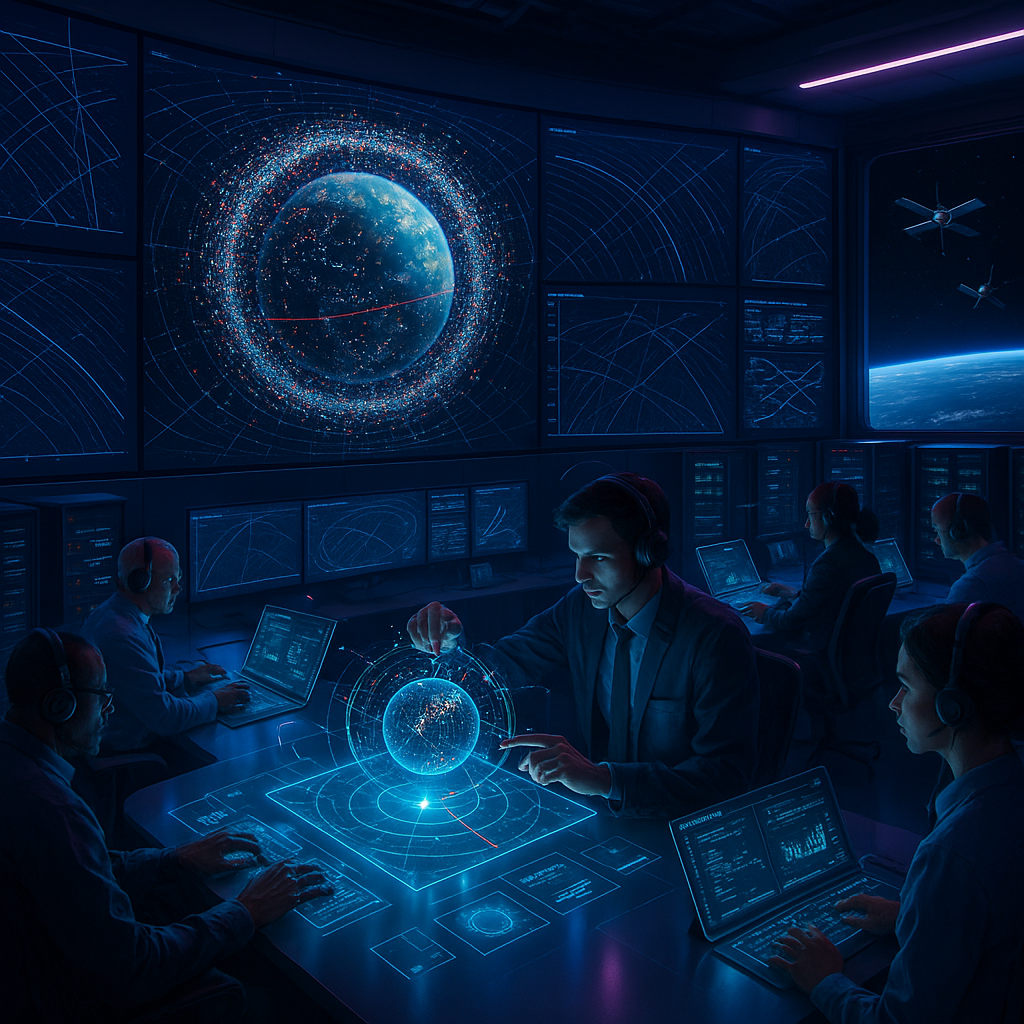
With orbital space growing relentlessly crowded by both satellites and debris, the need for smarter and more autonomous methods of traffic management is reaching a critical threshold. Advances in space AI are redefining how we ensure orbital safety—not only through higher-precision technology, but through sweeping shifts in operational models and economic access that impact governments, commercial operators, and even academic missions. This article uncovers how artificial intelligence is powering autonomous collision prediction, risk mitigation, and collaborative global safety, revealing why these innovations are crucial for the future of space traffic management across diverse domains.
-
Next-generation AI transforms orbital safety: Machine learning and advanced analytics now provide real-time tracking, vastly increasing the accuracy of collision prediction and risk assessment in ever-denser orbits. This means more reliable protection for vital communication, navigation, and research satellites.
-
Autonomous systems streamline collision avoidance: Automated decision-making empowers satellites to react immediately to potential conjunction threats. These systems minimize unnecessary maneuvers and human resource burdens, preserving valuable fuel and ensuring uninterrupted mission continuity.
-
Small teams, big impact. Democratizing orbital safety: AI-powered platforms now bring sophisticated traffic monitoring and collision alerting within reach of small commercial, academic, or governmental teams. Cost-effective solutions bridge a long-standing gap, making high-level orbital safety accessible well beyond major national agencies.
-
AI enables proactive debris mitigation: Intelligent algorithms greatly enhance situational awareness by rapidly identifying potential debris threats. This supports early intervention and informed, data-driven strategies to prevent collisions before they happen.
-
Seamless integration with global surveillance: AI-enabled systems connect with international tracking networks, boosting collective understanding and responsiveness. The resulting data-rich, interconnected environment allows for real-time collaboration and coordinated safety efforts spanning multiple nations and sectors.
-
Enabling a new era of scalable traffic management: By cutting operational costs and automating complex workflows, space AI provides the foundation for a sustainable and rapidly scaling space economy. Both emerging satellite startups and established players benefit as orbital resources become more accessible and safer to utilize for communications, earth observation, climate science, and beyond.
As we peer into the synthetic intelligence safeguarding our off-world highways, these advances point to more than just technical achievement. The future unfolds as a vibrant ecosystem where AI addresses not only collision risks but also opens new pathways for economic expansion, international cooperation, and scientific discovery. Continue reading to explore the core technologies, operational models, and cross-sector opportunities shaping the next chapter in space traffic management.
Introduction
Every year, the fabric of Earth’s orbit becomes more intricate. Swarms of satellites, sprawling mega-constellations, and an ever-increasing population of fragments and debris race along invisible paths at breathtaking speeds. The result is a crucible of risk, where even small miscalculations can threaten critical infrastructure and endanger missions spanning communications, earth monitoring, finance, healthcare (e.g. telemedicine), and national security. Traditional oversight, dependent on human monitoring and batch data, now struggles to match this pace.
This is where AI-driven space traffic management enters as not just an upgrade, but a necessity. Autonomous systems now sift through torrents of real-time orbital data, predict close encounters with unprecedented precision, and orchestrate rapid automated responses that exceed human reaction times. These breakthroughs redefine not only how safety is managed, but who gets access—a shift that democratizes orbital stewardship for organizations large and small.
Stay Sharp. Stay Ahead.
Join our Telegram Channel for exclusive content, real insights,
engage with us and other members and get access to
insider updates, early news and top insights.
 Join the Channel
The following sections reveal how AI-powered collision prediction, risk assessment, and integrated global monitoring are transforming orbital safety and opening new commercial frontiers. Whether you’re an operator, policymaker, investor, or simply a curious mind, understanding these developments is key to grasping the new social and economic era taking shape above our atmosphere.
The Growing Orbital Congestion Challenge
In just the past decade, the orbital domain around Earth has crossed a tipping point. Where once a handful of satellites charted quiet paths against the stars, there are now over 7,500 active satellites circling the planet. That’s double the count from 2019. This number could swell to more than 100,000 by 2030 as commercial and public-sector actors, from SpaceX and Amazon to emerging nations and research organizations, compete to occupy this finite space.
Mega-constellations drive much of this escalation. SpaceX’s Starlink already fields over 4,500 satellites, planning to reach 42,000 in the coming years. Amazon’s Project Kuiper, OneWeb, and regional operators across Asia, Latin America, and Africa hold similar ambitions. This democratizes space access, but it also strains systems designed for an era of far fewer actors.
Congestion brings several threats that ripple far beyond simple collision risk. The US Space Surveillance Network monitors about 27,000 pieces of debris over 10 centimeters, while millions of smaller, untrackable shards travel at velocities that can cripple an entire spacecraft. The European Space Agency’s recent reports show over 32,000 significant close-approach alerts in a single year—a sharp 50% rise over the previous year’s figures.
Yet, direct impacts are only part of the challenge. Radio frequency interference has soared by more than a third in geostationary orbit, threatening everything from television broadcasts to emergency response links. Astronomical facilities, too, now measure as much as 20% of twilight observations disrupted by satellite streaks, complicating the search for new exoplanets or monitoring of near-Earth objects.
The cumulative effect is twofold: the risk of catastrophic chain-reaction collisions (the Kessler Syndrome) is no longer theoretical, and the economic and scientific utility of space could contract without radical change. As demand outstrips manual capacity, only AI-enabled, autonomous traffic management can hope to preserve long-term accessibility and value for a widening array of stakeholders ranging from small research teams to global communication networks.
AI-Powered Collision Prediction Systems
At the heart of effective space traffic management lies the ability not just to track objects but to predict their futures with razor-sharp certainty. Traditional methods, grounded in deterministic models and periodic updates, now founder amid exponential object growth and orbital complexity. Artificial intelligence, however, brings new capabilities for both granular prediction and system-level risk optimization.
Machine Learning Models for Trajectory Prediction
Machine learning (particularly deep neural networks) has reshaped trajectory prediction. Recurrent neural networks (RNNs), such as Long Short-Term Memory (LSTM) models, excel in processing vast historical data sets, picking up subtle patterns in satellite or debris motion that older algorithms overlook. This leap enables up to 35% improvement in positional accuracy over traditional propagators, with especially striking results in the turbulent low Earth orbit (LEO) where atmospheric drag and multi-body interactions are hardest to model.
LSTM networks proved so effective in recent Massachusetts Institute of Technology research that they slashed position uncertainty by 41% for CubeSats under 500 kilometers. That’s precisely where most new commercial satellites and academic missions operate. By using transfer learning, predictions for new or data-sparse objects improve by nearly a quarter in just the first week on orbit, closing a longstanding vulnerability window after launch.
Industry isn’t alone in adopting these breakthroughs. Government agencies, research institutions, and even satellite operators in sectors like weather monitoring, Earth imaging, and GPS services now benefit from rapid, high-confidence detection of potential threats.
Probabilistic Risk Assessment Frameworks
Where prediction ends, risk assessment begins. Modern AI-powered frameworks employ Bayesian networks, sophisticated models that integrate radar, optical, and spacecraft telemetry to construct a nuanced picture of both the chance of collision and the practical likelihood of a successful avoidance maneuver.
These systems incorporate not only object positions, but metadata such as propulsion status, battery health, and maneuver logs, yielding actionable insights that calibrate response urgency and maneuver efficiency. Such AI-driven triaging has reduced unnecessary evasive maneuvers by nearly half according to recent analyses of large LEO satellite constellations, saving fuel and extending satellite lifespans.
Advanced machine learning classifiers now also score each potential conjunction according to prior incident archives, learning to spot subtle, early warning signs. Maybe it’s a debris fragment with erratic past movements or a cluster of satellites converging due to orbital precession. The European Space Operations Centre, for instance, reports over 90% success in identifying which alerts are likely to escalate into urgent interventions, enabling smart allocation of human oversight.
Sensor Fusion and Data Integration
AI-driven collision prediction stands or falls on the quality and breadth of its input data. Cutting-edge systems, therefore, blend data from a tapestry of sources: ground-based phased-array radars, global optical telescopes scanning the night sky, and now on-orbit sensors attached to commercial, governmental, and scientific satellites.
This multi-source approach enables real-time calibration, compensating for local weather impacts or sensor degradation, and even correcting for biases by dynamically weighting more reliable data streams. Deep learning streamlines this intricate fusion, raising object identification accuracy by over a third in busy orbital corridors and delivering rapid updates directly into satellite operations dashboards.
Industries as varied as national defense, earth science, finance, and even disaster response (where satellites provide real-time imagery) now rely on this continual flow of fused data to anticipate events, keep assets safe, and underpin investments that might otherwise slow without robust orbital safeguards.
Stay Sharp. Stay Ahead.
Join our Telegram Channel for exclusive content, real insights,
engage with us and other members and get access to
insider updates, early news and top insights.
Join the Channel
Autonomous Collision Avoidance Systems
As object densities multiply, relying solely on human operators for collision mitigation has become unsustainable. AI-powered autonomy now leads the shift to a proactive, responsive paradigm where satellites can analyze, decide, and act independently—each step shaped by a blend of collective intelligence and adaptive learning.
Onboard Autonomous Decision Algorithms
Many new-generation satellites are equipped with onboard algorithms that continuously evaluate trajectory risks and can initiate avoidance maneuvers without waiting for instructions from Earth. These use hierarchical decision processes, enhanced by reinforcement learning, to weigh probabilistic risk against operational trade-offs such as fuel usage, scheduling impact, and risk of secondary conjunctions caused by the maneuver.
OneWeb’s constellation, for example, employs an onboard AI autonomy framework that has delivered over 50% propellant efficiency savings and reduced the burden on ground teams by 70%. These systems also facilitate fleet learning: each maneuver’s outcome informs the decision trees for all satellites in the network, leading to a rapid and collective rise in skill.
Such self-improving algorithms are not unique to telecom or internet megaconstellations. Earth science missions (such as weather or agricultural monitoring) and defense satellites increasingly use similar systems to preserve limited maneuvering resources and ensure mission uptime.
Inter-Satellite Coordination Protocols
Autonomous collision avoidance reaches full potential only through active coordination. Standardized digital protocols now allow satellites to announce intended maneuvers, assert priorities (for example, time-critical missions versus less urgent ones), and resolve potential conflicts collaboratively in real time.
A reference model from the Space Traffic Management Consortium has shown that distributed consensus algorithms (relying on peer-to-peer messaging) can cut conflicting maneuvers by over three-quarters in high-stress scenarios. Even if a satellite lacks direct communication capability, predictive algorithms can model likely behavior of other actors, supporting game-theoretic planning that minimizes risk even in the most crowded orbital “lanes.”
This open, adaptive communication underpinning does not only benefit commercial broadband constellations. Imagery satellites supporting environmental monitoring, financial forecasting, agricultural planning, or natural disaster response also leverage these rapid protocols, ensuring operational safety even with smaller in-house teams.
Human-Autonomy Interaction Models
Despite all advances, humans remain central to orbital stewardship. The best systems now feature dynamic interaction models, scaling machine autonomy up or down based on event severity, data confidence, and communications availability.
Typically, these systems offer:
- Advisory mode (humans approve recommendations)
- Consent mode (system plans actions, awaits human verification)
- Exception mode (system acts but notifies)
- Fully autonomous mode (routine actions, minimal latency)
This sliding autonomy preserves situational awareness for operators while ensuring time-critical risks never outrun human oversight. As mission operators in research agencies, telecom, and earth science alike are discovering, this approach strengthens trust in automation while reserving strategic command for moments when judgment and experience matter most.
Conclusion
The unprecedented proliferation of satellites transforms orbital space into a vital but volatile commons—one that underpins essential communications, navigation, national security, financial transparency, and even climate science on Earth. The fusion of AI-driven prediction, real-time sensor fusion, and autonomous decision-making represents more than a shift in methodology; it signals a cultural transformation in how humanity assumes responsibility for its orbital legacy.
Advances in AI have elevated collision prediction accuracy, reduced operational overhead, and enabled scalable safety even for smaller teams or organizations venturing into orbit for the first time. Autonomous coordination protocols foster not just technological resilience, but an ethos of shared stewardship, pushing space traffic management from isolated national responsibility toward genuinely global, multi-sector collaboration.
Looking forward, the organizations poised to lead are those that cultivate adaptability, empower hybrid human-machine partnerships, and champion accessible, scalable solutions across domains—from telecom and broadcast to environmental science, financial analysis, and humanitarian monitoring. The coming era will reward those who anticipate both the risks and the opportunities of an interconnected orbital frontier. The true question is not whether we will rely on AI to govern our celestial highways, but how thoughtfully and collaboratively we can harness these “alien minds” to safeguard a domain that is as economically vital as it is profound for future generations.
Let this be a call to broaden the dialogue—beyond specialized circles to every enterprise, agency, and thinker with a stake in the stewardship of space. The future of our shared sky will be written not just in code, but in how we choose to integrate technology, governance, and ethical foresight into an enduring vision for life above Earth.



Leave a Reply