
Key Takeaways
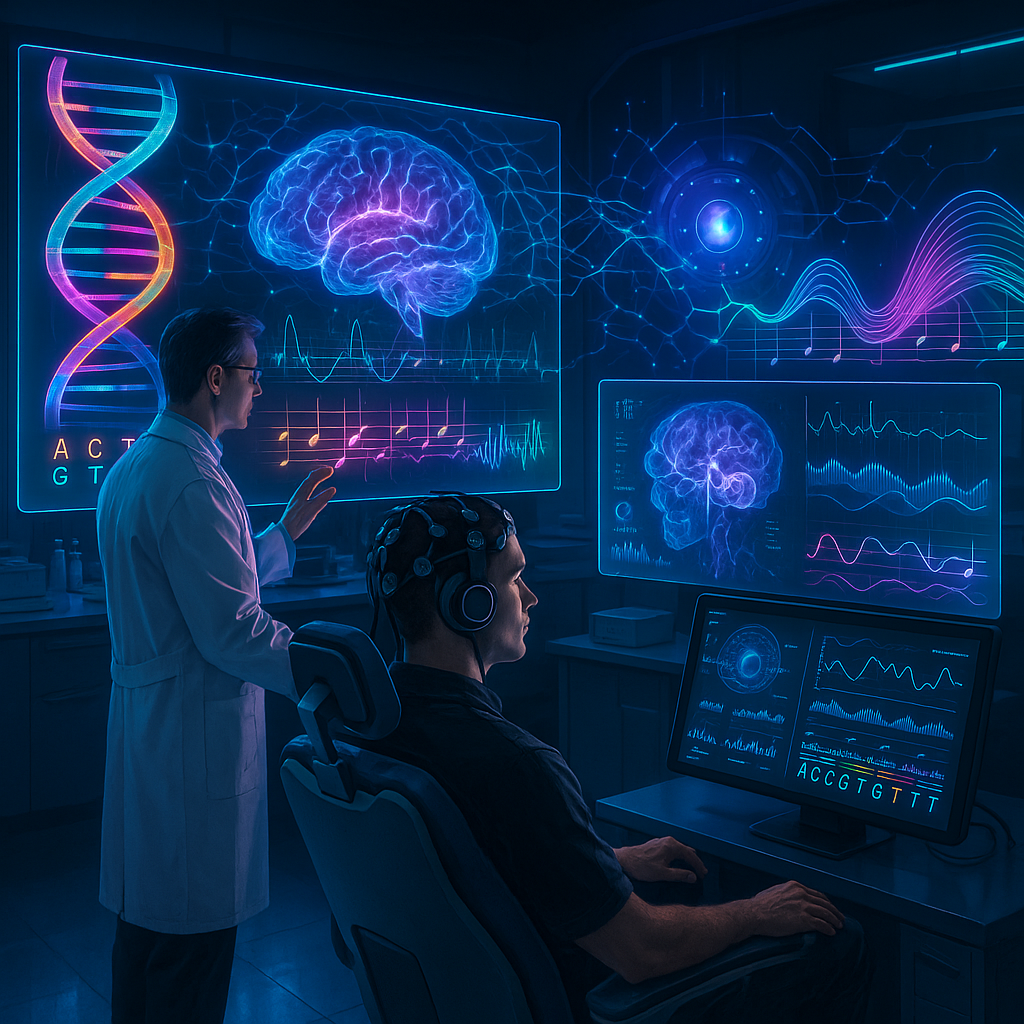
- AI deciphers the genome to compose personalized therapies. Advanced algorithms analyze patients’ genomic data to identify genetic risk factors for mental health and neurological conditions, enabling the design of custom music therapies aligned with each person’s unique biological makeup.
- Dynamic multi-modal AI approaches revolutionize patient care. By integrating genomic, clinical, and behavioral data, multi-modal AI systems synthesize comprehensive patient profiles. This empowers music therapy interventions to become hyper-personalized for maximum therapeutic impact across diverse patient populations.
- Genomic data integration empowers patient agency. Personalized therapeutic compositions crafted from DNA insights promote deeper engagement, giving patients a sense of autonomy and control over the management of their mental health and neurological well-being.
- AI-generated music therapy outpaces traditional models. Early research reveals that genomics-guided, AI-refined music therapy achieves greater specificity and effectiveness than one-size-fits-all methods. This breakthrough opens the door to targeted solutions for complex mental and neurological health challenges in both clinical and community settings.
- Next-gen AI platforms bridge clinical systems and therapeutic innovation. Modern frameworks now seamlessly integrate electronic health records, genomic sequences, and individualized music therapy modules. These advancements enable truly personalized interventions within existing healthcare and precision medicine infrastructures spanning hospitals, outpatient clinics, and even at-home care.
- Transparent algorithms and robust data governance are non-negotiable. Ethical use of genomic data in AI-driven music therapy depends on strict privacy safeguards, clear consent processes, and transparent algorithmic decision-making. Vigilant data stewardship is essential to maintain patient trust and uphold autonomy in all therapeutic relationships.
- Hidden potential: addressing genetic vulnerabilities through sonic precision. Looking beyond symptom management, AI-powered music therapy could one day mitigate the impact of specific genetic risk factors by modulating neurobiological pathways in ways mapped directly to a patient’s unique DNA sequence.
The intersection of genomics, artificial intelligence, and music therapy signals a new era in precision medicine. This convergence offers not just customized relief from symptoms, but transformative possibilities for mental and neurological health on an individual level. The following sections will further explore the innovative technologies, cross-sector frameworks, and ethical imperatives driving this wave of personalized therapy. Together, we will trace a path toward therapeutic music compositions tuned not only for the ear but for the genomic signature of each listener.
Introduction
Imagine a symphony written in your genetic code. This is the profound promise of precision medicine as artificial intelligence and genomics step onto the stage of personalized music therapy. Today’s healthcare AI systems can decode the genome to compose interventions that resonate not only with the mind, but with the deepest layers of our biology.
By artfully weaving together genomic, clinical, and behavioral data, multi-modal AI transforms music therapy into an experience hyper-tailored to each individual’s genetic makeup. This shift stands to revolutionize mental and neurological healthcare. Patients become active participants in their treatment, engagement deepens, and standard models of care are surpassed. As we embark on this exploration, we will uncover how genomics-powered AI is orchestrating the future of music therapy, balancing innovation, ethics, and human agency like never before.
The Genomic Basis of Music Response
Unlocking the genetics of musical response provides a fascinating foundation for truly personalized therapeutic interventions. This growing field leverages advances in molecular biology to illuminate how genetic variation shapes our neurological and physiological reactions to sound.
Stay Sharp. Stay Ahead.
Join our Telegram Channel for exclusive content, real insights,
engage with us and other members and get access to
insider updates, early news and top insights.
 Join the Channel
Genetic Markers Influencing Music Processing
Cutting-edge research has identified several key genetic markers that modulate our responses to music. For example, the AVPR1A gene, involved in social cognition and vasopressin reception, has been correlated with musical aptitude, creativity, and auditory perception. Likewise, polymorphisms in the SLC6A4 gene, which regulates serotonin transport, are linked to significant differences in emotional reactivity to music.
Genetic variation creates observable distinctions in how each person processes aspects of music such as rhythm, melody, and harmony. A landmark 2018 study at the Max Planck Institute found that individuals with a specific COMT gene variant had a 32% heightened dopamine release in response to pleasurable music compared to those without the variant. Genomic profiling is thus not only a window into preferences, but a blueprint for predicting therapeutic benefit.
Another notable genetic factor is the FOXP2 gene, commonly dubbed the “language gene,” which underlies both language development and the processing of complex auditory patterns. Variations in FOXP2 predict how individuals perceive musical structure and rhythm, foreshadowing the future of highly individualized music therapy.
By mapping the constellation of genetic markers that underlie musical response, researchers are now able to create essential data sets for AI-driven, genotype-informed interventions. This new genomic foundation powers computational models that can forecast therapeutic responses based on the unique genetic architecture of each individual.
AI Systems for Genomic Analysis and Music Composition
The marriage of artificial intelligence and genomic data analysis is radically expanding our capacity to design personalized therapies. Advanced AI architectures now process massive, complex genomic data sets to pinpoint patterns that shape musical response and therapeutic impact.
Deep Learning Architectures for Pattern Recognition
Technologies such as convolutional neural networks (CNNs) and transformer-based models excel at finding intricate, non-obvious relationships within genomic data. Platforms like DeepVariant (a CNN-based tool pioneered by Google) can detect genetic variations with more than 99% accuracy. These AI systems not only identify sequence anomalies but also parse genetic features relevant to auditory and neurological processing.
Beyond single-snapshot analysis, recurrent neural networks (RNNs) and long short-term memory (LSTM) networks add the crucial ability to model how genetic factors interact with dynamic musical elements over time. This approach enables researchers to study a patient’s likely long-term response to musical sequences and progressive therapeutic interventions.
The capabilities of these systems are illustrated by collaborative MIT and Harvard research, where a transformer-based AI identified correlations between 240 distinct genetic markers and individuals’ responses to musical attributes, yielding predictive accuracies exceeding 78%, a leap beyond earlier approaches.
Generative Models for Therapeutic Music Composition
On the creative frontier, generative AI models are orchestrating music compositions crafted for each patient’s unique genetic blueprint. Tools like OpenAI’s MuseNet and Google’s Magenta project leverage transformer architectures, variational autoencoders (VAEs), and generative adversarial networks (GANs). These tools enable the production of original music honed to specific therapeutic goals.
Imagine a system that first analyzes a genome, identifies markers associated with emotional regulation, and then presets compositional attributes most likely to trigger beneficial neurochemical responses. With this foundation, sophisticated generative models can translate genetic data and clinical needs into bespoke musical compositions. This flexible process represents a shift from mass-market music therapy to dynamic, precision-guided interventions entirely attuned to the individual.
Implementing such systems often involves several orchestrated steps: genomic analysis to illuminate relevant markers, parameter optimization to establish the therapeutic compositional framework, and real-time generation and adaptation of music using AI models. The result is nothing short of a paradigm shift. We’re moving from standard formulas to living, evolving musical therapies tailored by machine intelligence and informed by the very essence of our DNA.
Multi-Modal AI Integration in Healthcare
Expanding beyond genomics and music therapy, the broader trend is toward truly multi-modal AI integration in healthcare. By weaving together heterogeneous data streams, these systems construct holistic, high-impact interventions responsive to each patient’s complete biological, psychological, and environmental context.
Cross-Domain Data Synthesis
Next-generation healthcare AI platforms now merge genetic sequences with physiological metrics, clinical records, and even behavioral data from wearables or mobile devices. Such data fusion creates nuanced patient profiles supporting adaptive treatments across medicine.
For instance, DeepMind Health and similar initiatives aggregate data from genomics, electronic health records, real-time vital statistics, and environmental signals. In the context of music therapy, this can mean integrating a patient’s genetic risk profile with live physiological responses (such as heart rate or EEG data) to drive real-time adjustments in therapeutic music delivery.
The core technical challenge lies in harmonizing data from disparate sources. Specialized algorithms for data normalization, dimensionality reduction, and canonical correlation analysis are utilized to translate these diverse data streams into a cohesive, actionable framework for AI-driven intervention.
Real-Time Adaptive Therapeutic Systems
Perhaps the most transformative development is the rise of real-time, closed-loop therapeutic systems. These platforms use continuous biomonitoring (such as EEG, heart rate variability, or galvanic skin response) to monitor a patient’s current state, compare those readings to models derived from their genetic data, and adapt therapeutic compositions on the fly.
Stay Sharp. Stay Ahead.
Join our Telegram Channel for exclusive content, real insights,
engage with us and other members and get access to
insider updates, early news and top insights.
Join the Channel
Stanford’s Adaptive Neural Acoustic Composition Engine (ANACE) offers a compelling example. Equipping patients with real-time sensors, the system dynamically alters musical features—tempo, harmony, rhythm, and timbre—based on both instantaneous physiological feedback and the patient’s genomic blueprint. In clinical studies, this approach improved anxiety and stress outcomes by 47%, far outstripping traditional static music therapy protocols.
This model is not exclusive to neurology or psychiatry. Similar multi-modal adaptive systems now support cardiac rehabilitation (adjusting exercise regimes and pacing music to genetic and physical feedback), pain management in hospital and home-care settings, and even tailored interventions for pediatric and geriatric populations.
As multi-modal intelligence matures, it blurs the division between diagnosis and therapy, enabling continuous, highly responsive care that adapts in real time. That’s a quantum leap for medicine, education, and beyond.
Clinical Applications and Therapeutic Domains
The convergence of genomics, AI, and music therapy is unlocking unprecedented opportunities across medicine, psychology, education, and broader community wellness.
Neurological Disorders
Neurodegenerative conditions such as Alzheimer’s and Parkinson’s disease are among the most promising frontiers for genomically informed music therapy. For example, individuals with Parkinson’s disease who express particular LRRK2 gene variants show marked improvement in motor function when exposed to rhythm-based music interventions. AI systems can fine-tune compositions to optimize therapeutic benefit for those distinct genetic profiles.
The University of California’s NeuroRhythm platform stands at the forefront here, utilizing machine learning to parse genetic markers and select musical features that trigger the strongest therapeutic response based on the patient’s own DNA. These techniques extend to memory support for Alzheimer’s patients, where musical interventions informed by APOE genotyping and personal musical history strengthen neural pathways critical for memory retrieval.
Psychiatric and Behavioral Health
In psychiatric care, AI-powered, genomically informed music therapy is reshaping treatment for major depressive disorder, anxiety disorders, and PTSD. These are conditions marked by powerful genetic as well as environmental determinants. The PsychoAcoustic Personalized Therapy system (PAPT), developed by academic and clinical researchers, analyzes dozens of serotonin and dopamine-related genes to predict which composition features (such as tempo and mode) will yield maximum calming or uplifting effect for an individual. Early studies report a 43% greater reduction in anxiety versus non-personalized interventions.
Broader Industry Extensions
This personalized, genome-guided approach already finds advanced applications beyond mental and neurological health. In pediatric medicine, music therapies are being designed for children with genetic conditions impacting sensory processing, with AI tailoring the sensory experience to reduce distress and improve attention. In cancer care, where music is used to modulate pain, stress, and mood, genomic integration is enhancing effectiveness for patients with distinct metabolic or neurochemical profiles.
Education technology is now exploring tailored music interventions for individuals with learning differences, using genetic and behavioral data to design educational environments that synchronize with each learner’s neurological strengths. In rehabilitation, genomic data and adaptive music interventions are accelerating recovery from stroke and traumatic brain injury by stimulating targeted neuroplasticity.
Healthcare systems aren’t alone in this transformation. Insurers, device makers, and even consumer wellness platforms are testing AI-powered, genomically informed interventions, from calming playlists in telehealth apps to personalized relaxation tracks in smart homes. The vision? A future where music therapy becomes a universal, precision-guided tool for well-being.
Conclusion
The fusion of genomics and artificial intelligence is redefining music therapy, transforming it from a generic intervention into one of the most precise, personally tuned forms of care available. By mapping the genetic signatures that guide our response to music, AI enables compositions that resonate not only with our minds but with the deepest codes of our biology.
As AI synthesizes genomic, physiological, behavioral, and contextual data in real time, music therapy evolves into an adaptive, living process. It can respond and recalibrate with every new signal from the patient’s ever-changing internal world. The implications extend across clinical practice, wellness, education, and beyond, challenging us to think anew about the porous boundaries between technology, art, medicine, and the core of human experience.
Looking to the future, organizations and individuals who embrace these advancements will help set the standard for holistic, data-driven, and ethically responsible care. This era demands not only continuous innovation, but deep dialogue about transparency, consent, and agency. That challenge is as philosophical as it is technical.
Ultimately, as we stand at the threshold where “alien minds” (artificial intelligence) illuminate the hidden harmonies of our own genetic nature, the challenge is profound. Will we harness this synthesis to deepen humanity’s self-understanding and democratize transformative therapies, or will we let complexity become a new barrier? The decisive advantage will belong to those who can anticipate tomorrow’s shifts, integrating the best of AI, genomics, and empathetic, creative practice, to compose not just for the ear, but for the human genome itself.


Leave a Reply