
Key Takeaways
- Microsoft champions “AI-native” talent: The company promotes a workforce skilled in collaborating with AI, aiming to redefine roles from efficiency to co-creativity.
- Creative adaptation prioritized over technical skills: Microsoft asserts that the most valuable employees will be those who reimagine tasks rather than merely automate them, signaling a shift from traditional “future-proofing.”
- Training expands to non-technical fields: New programs target professionals beyond coding, reflecting the view that AI’s greatest influence will reach across disciplines.
- AI as a catalyst for human reinvention: Executives highlight that as AI handles routine work, human value will hinge on adaptability and novel thinking, reflecting global debates on technology’s role in shaping self-concept.
- Implications for collective intelligence: The push for an AI-native workforce is not just a corporate goal. It is an invitation to rethink “thinking” and “creating” in an era shaped by non-human logic.
With Microsoft departing from automation as an endpoint, the next months will reveal how industry leaders and society respond to this evolving vision.
Introduction
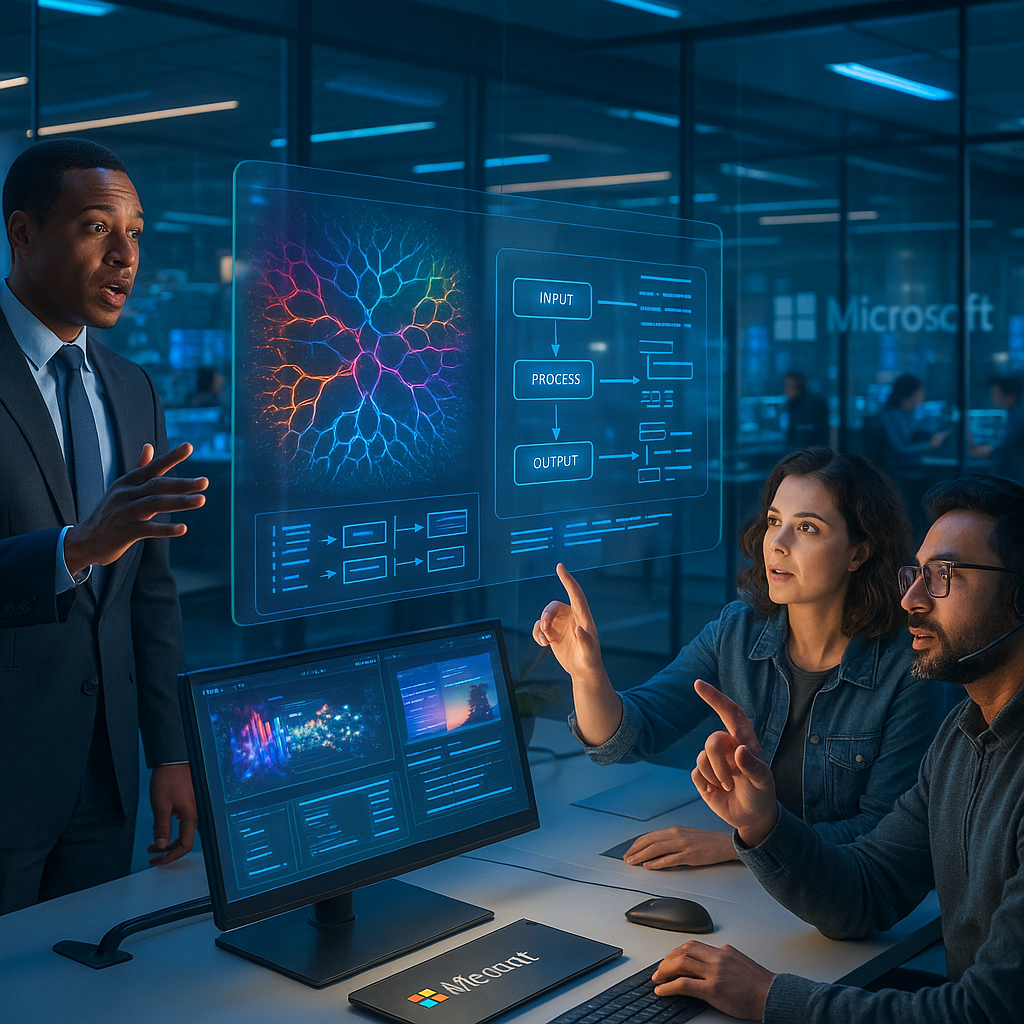
Microsoft has intensified its advocacy for an “AI-native” workforce, unveiling new initiatives in Redmond that challenge organizations and individuals to reconsider creativity and problem-solving at work. By emphasizing broad AI fluency over traditional technical skills, the company signals that the future of work (and perhaps even the future of human imagination) depends on our adaptability alongside unfamiliar forms of intelligence.
Redefining Workforce Identity in the AI Era
Microsoft’s vision for an “AI-native” workforce marks a philosophical shift in how humans and technology interact in professional environments. Rather than seeing AI as another tool to master, Microsoft imagines a deeper, co-evolutionary relationship between people and intelligent systems.
Satya Nadella, Microsoft’s CEO, stated during the recent Future of Work summit that the goal is a workforce that intuitively understands both the strengths and limits of AI. Employees are expected to think differently, shaped by their professional growth alongside these technologies.
Stay Sharp. Stay Ahead.
Join our Telegram Channel for exclusive content, real insights,
engage with us and other members and get access to
insider updates, early news and top insights.
 Join the Channel
This reimagining challenges prevailing ideas about what gives workers value. Microsoft suggests professional worth will increasingly stem from contextual judgment, creative synthesis, and ethical discernment. These are distinctly human qualities where current AI still falls short.
The company’s approach aims to move past the simplistic “human versus machine” narrative that has long defined automation debates. Instead, Microsoft envisions professional identity grounded in effective partnerships with advanced AI, not merely human labor replaced or supplemented by machines.
Microsoft’s Strategic Pivot to “Human+AI” Systems
Microsoft has realigned its enterprise strategy, placing augmented intelligence at its core rather than focusing solely on artificial intelligence. This became visible with its $10 billion OpenAI investment and the widespread integration of generative AI into its product suite.
Jared Spataro, Corporate Vice President for Modern Work and Business Applications, emphasized at a recent conference that the future workforce will not just use AI, but will think alongside it. Microsoft is redesigning its productivity tools to support this model of collaborative intelligence.
Internally, the company has established teams that blend traditional software engineers with prompt engineers, ethicists, and creative professionals who specialize in human-AI interaction. This move signifies Microsoft’s belief that real competitive advantage arises from synergy between human creativity and machine intelligence, rather than from simply replacing people with AI.
Beyond Technical Skills: The New Currency of Creativity
Microsoft’s AI-native model prioritizes skills that reach beyond technical expertise. The company increasingly values metaphorical thinking, pattern recognition across disciplines, and the ability to frame problems inventively. These are domains where humans still outperform sophisticated AI.
Kate Crawford, Senior Principal Researcher at Microsoft Research, noted during a panel that technical skills are now foundational, but the truly valuable employee will be the one who can pose questions that maximize AI’s strengths while remaining mindful of its boundaries.
This shift challenges universities and training programs to go beyond technical curricula. Microsoft is collaborating on new courses that pair AI foundations with humanities-informed approaches to solving complex issues.
The company’s research indicates that those with backgrounds in fields like philosophy, anthropology, or the arts may bring unique mental models to AI collaboration (perspectives often missing from conventional technical education).
The Democratization of AI Fluency
Microsoft’s strategy consciously extends AI fluency beyond the realm of technical specialists. The “AI Skills for Everyone” initiative, for example, aims to empower non-technical workers from healthcare to retail.
Kevin Scott, Microsoft’s Chief Technology Officer, noted the importance of creating AI systems that adapt to humans. Natural language interfaces and visual tools are enabling AI collaboration skills to permeate organizations regardless of employees’ technical backgrounds.
The company’s Office suite was reimagined with “AI-first interfaces,” making it possible for users with limited technical expertise to access advanced AI features through intuitive workflows and prompts.
By lowering technical barriers, Microsoft hopes to share the benefits of AI more widely. Still, as these skills democratize, questions emerge about whether meaningful AI collaboration can happen without deeper understanding than what new interfaces alone enable.
Educational Transformation: Learning to Learn With AI
Microsoft’s vision calls for a major shift in educational philosophies across all stages of learning. The company has invested $50 million in initiatives targeting the development of collaborative intelligence skills from early education through lifelong learning.
Mary Snapp, Corporate Vice President of Microsoft Philanthropies, noted that while traditional education emphasized knowing and recalling (areas where AI now excels), the focus must move to human capabilities: asking insightful questions, bridging domains, and making ethical choices.
Microsoft’s educational partners have adopted project-based learning, encouraging students to work alongside AI instead of simply learning about it. This hands-on approach treats AI as both subject matter and teammate, fundamentally shaping students’ attitudes toward creative problem solving.
Stay Sharp. Stay Ahead.
Join our Telegram Channel for exclusive content, real insights,
engage with us and other members and get access to
insider updates, early news and top insights.
Join the Channel
Research from these programs suggests that students exposed early to AI collaboration develop new ways of seeing themselves—not just as users or coders, but as inventive orchestrators of technology.
Ethical Dimensions and Power Dynamics
Microsoft’s AI-native philosophy invites scrutiny about agency and autonomy in the workplace. Some critics worry that talk of partnership may obscure shifting power dynamics as algorithms mediate more decisions and evaluations.
Meredith Whittaker, president of the Signal Foundation and former Google AI researcher, underlined the risk of systems evolving where humans serve AI-driven processes instead of the other way around, whatever the rhetoric of collaboration.
In response, Microsoft has formed an AI Ethics Review Board to examine these questions, though outside observers debate whether such internal structures suffice for issues with systemic societal impact.
Emma Brunskill, Senior Director of AI Research at Microsoft, acknowledged the challenges ahead. She noted that designing collaborative systems presents choices that will reflect our collective values about agency, dignity, and purpose rather than following technological determinism.
Global Implications and Digital Divides
Microsoft recognizes that the AI-native vision will play out differently worldwide. Region-specific programs address the fact that some economies require basic digital literacy alongside AI skills, while others are ready for advanced human-AI collaboration.
Jean-Philippe Courtois, Executive Vice President of Microsoft International, confirmed that these disparities shape both product strategy and training priorities.
The company’s “AI inclusion principles” are designed to ensure products remain accessible across different levels of connectivity, device quality, and prior tech exposure. Despite these safeguards, questions persist about whether the new paradigm may reinforce existing inequalities between technology-rich and technology-poor regions.
Given Microsoft’s global reach, its framing of the AI-native workforce will inevitably influence labor markets and educational agendas far beyond its own offices.
What Happens Next: The Evolving Human-Machine Contract
Microsoft’s roadmap points toward deeper AI integration into critical areas of knowledge work. The company plans to launch its Collaborative Intelligence Platform in Q3 2023, offering organizations new tools for reshaping workflows around human-AI partnerships.
Academic institutions are adjusting. Stanford University, for example, has established a Human-AI Collaboration major blending computer science, psychology, and philosophy, inspired in part by Microsoft’s thinking.
Policymakers are also taking note. The forthcoming EU “AI and Work Directive” includes standards for human-AI collaboration, incorporating insights from Microsoft executives around worker agency and algorithmic transparency.
These trends mark the beginning of a renegotiation of the human-machine relationship at work. Nadella recently said the coming decade will shape patterns of collaboration that could last generations. He emphasized that this moment is about reimagining the social contract between humans and their tools.
Conclusion
Microsoft’s push for an AI-native workforce represents not just a technological strategy but a profound reimagining of work and human agency. As organizations, educators, and policymakers adjust at varying paces, the interplay between creativity, ethics, and automation will reshape the social fabric of work. What to watch: the launch of Microsoft’s Collaborative Intelligence Platform in Q3 2023 and the evolution of educational and regulatory frameworks that will help define the next era of workforce transformation.
generative AI
structure of thought
collaborative intelligence skills
collective intelligence

Leave a Reply