
Key Takeaways
- AI supercharges quantum error detection: Machine learning algorithms rapidly analyze and decipher complex error patterns in real time, dramatically surpassing the capabilities of static rule-based approaches for identifying and correcting quantum errors.
- Quantum firmware: A stealth revolution bridges hardware and logic. Emerging quantum firmware acts as middleware, dynamically optimizing qubit error correction protocols. This reduces the need for excess physical qubits and sets the stage for truly scalable, practical systems.
- From physical to logical qubits: AI smooths the transition. Quantum AI algorithms enable the consolidation of error-prone physical qubits into robust logical qubits, boosting computational reliability without imposing unmanageable hardware demands.
- Surface code implementations find new allies in AI. By integrating AI-driven error suppression into surface code frameworks, researchers are driving error thresholds lower and making fault tolerance achievable at more manageable code distances.
- Error suppression techniques evolve beyond brute force. Instead of simply increasing the number of physical qubits, sophisticated AI models now predict, preempt, and neutralize error sources. This makes scaling up quantum systems more efficient and resource-conscious.
- Real-world demonstrations edge closer to fault-tolerant quantum computing. Advanced experiments are increasingly combining quantum AI and dynamic error correction middleware, marking tangible progress toward deployed, application-ready quantum processors.
- Hidden leverage: Middleware unlocks rapid quantum progress. Quantum firmware powered by AI strategically minimizes hardware overhead for error correction. This fundamental shift could accelerate the timeline for quantum computers to impact real-world challenges in fields from finance and healthcare to environmental modeling and logistics.
As AI-driven innovation quietly revolutionizes the landscape of quantum error correction, the convergence of quantum AI, intelligent middleware, and next-generation error suppression techniques may finally represent the catalytic force required to transform quantum theory into practical, world-changing technology.
Introduction
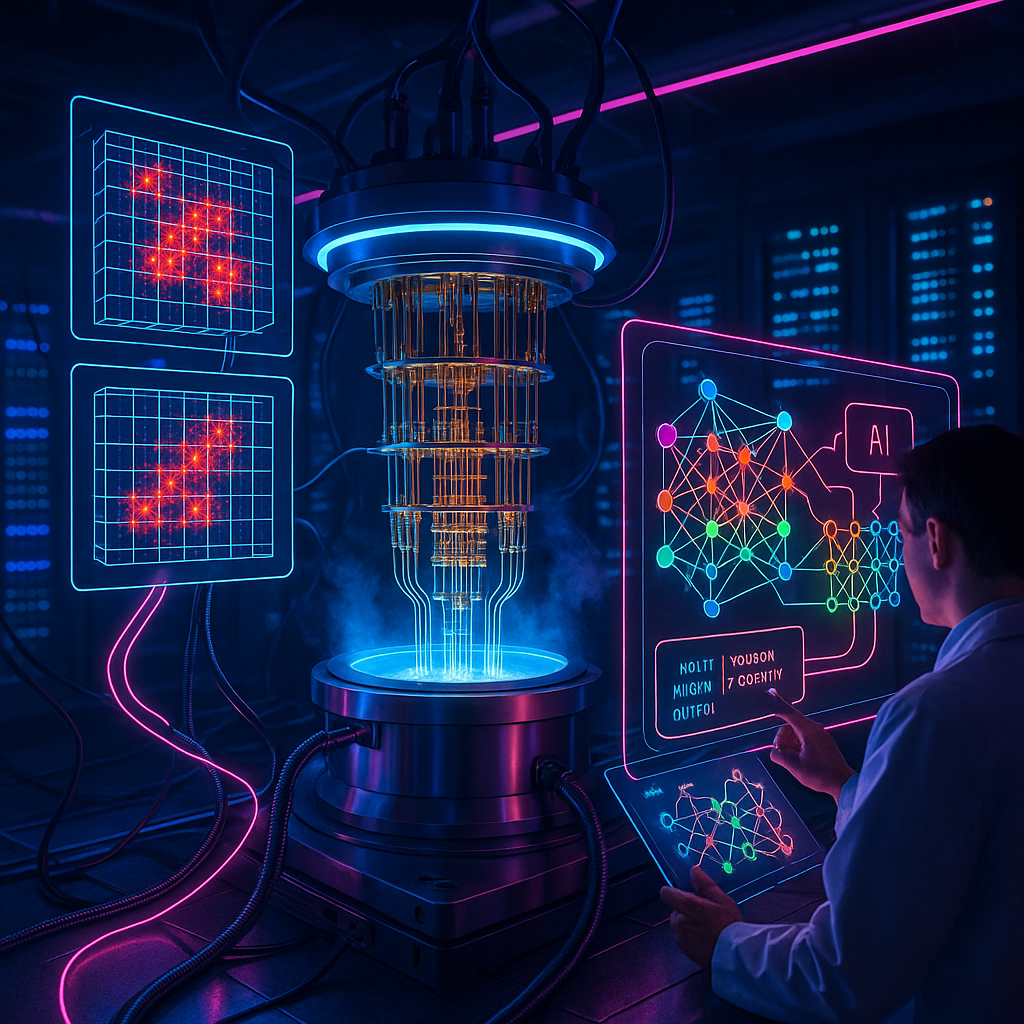
Quantum computing’s greatest strength is inseparable from its greatest vulnerability. The capacity to encode and manipulate information through fragile, entangled quantum states exposes qubits to relentless error threats from even the most subtle environmental influences. As scientific teams race to develop robust quantum processors, a central puzzle remains: How do we insulate these delicate quantum systems from the cascading inaccuracies that threaten their transformative potential?
Enter quantum AI. No longer just a tantalizing tool, but a strategic inflection point in the evolution of quantum hardware. Advanced machine learning algorithms are decoding the labyrinthine patterns of quantum errors, turning brute-force redundancy into nimble, adaptive intelligence. When combined with revolutionary quantum firmware, these innovations reduce the hardware burden and move fault-tolerant quantum performance from theory to tangible possibility.
In the journey ahead, we will unpack how the union of AI-powered insights and sophisticated middleware is redefining error correction. This union is stabilizing qubits and propelling quantum machines from laboratory prototypes to platforms capable of solving some of society’s most complex problems across diverse sectors.
Stay Sharp. Stay Ahead.
Join our Telegram Channel for exclusive content, real insights,
engage with us and other members and get access to
insider updates, early news and top insights.
 Join the Channel
The Quantum Error Correction Challenge
The road from quantum theory to functional technology is paved with the uncertainty of error. Quantum error correction (QEC) stands as the central gatekeeper between quantum computing’s promise and its practical realization. Unlike their classical counterparts, quantum bits (qubits) occupy fragile superpositions that are easily perturbed by environmental “noise.” This challenge is referred to as decoherence.
Quantum information is uniquely susceptible to a spectrum of error types:
- Bit-flip errors: Analogous to errors in conventional computing, where a |0⟩ flips to a |1⟩ or vice versa.
- Phase errors: Uniquely quantum errors disrupting the phase relationships that underpin quantum superposition and entanglement.
- Measurement errors: Mistakes in the essential process of reading out qubit states.
- Gate errors: Imperfections in performing logical operations that introduce distortions into quantum data.
The quantum noise floor is particularly challenging. Today’s NISQ (Noisy Intermediate-Scale Quantum) devices typically operate with gate error rates ranging between 10^-3 and 10^-2. However, practical quantum applications such as cryptography, complex simulations, and optimization demand error rates approaching 10^-15. Surpassing this 12-order-of-magnitude gap is a monumental endeavor and has spurred radical rethinks in both theory and engineering.
Hybrid approaches that merge quantum hardware with advanced AI techniques are opening dramatic new paths forward. Machine learning algorithms, specialized for deep pattern recognition, are now essential for uncovering subtle error signatures that evade conventional detection. Integrating these AI advancements into QEC frameworks could dramatically accelerate progress toward scalable, deployable quantum systems.
The significance of QEC cannot be overstated. Without it, quantum computers will remain limited by fleeting coherence times and prohibitively high error rates, locked far beneath their computational potential. As we explore the landscape of surface codes and their new AI-empowered capabilities, we see a glimpse of how error correction may become less a limitation and more a strategic advantage.
Surface Codes and Topological Protection
Surface codes stand at the forefront of the quest for practical quantum error correction. They offer a compelling combination of theoretical elegance and operational resilience, leveraging the principle of topological protection to resist the corrosive effects of noise and decoherence.
Surface Code Fundamentals
At their core, surface codes use a 2D lattice of entangled physical qubits to encode logical qubits in a way that distributes information across many locations. This non-local encoding confers a remarkable immunity to localized errors, since any single disturbance is unlikely to corrupt the entire logical state. Topological protection allows surface codes to correct errors without directly measuring (and disturbing) the quantum information they guard.
The mechanism is subtle. Instead of observing qubits individually, surface codes use “stabilizer measurements” to check the parity of groups of qubits. These measurements produce “error syndromes” (clues to what type of error, if any, has occurred) without collapsing the vital superposition underpinning quantum calculations.
The efficacy of a surface code is largely governed by its “distance,” defined by the minimum number of errors required to irreversibly corrupt the logical qubit. For a code of distance d, around d² physical qubits are needed, and up to ⌊(d-1)/2⌋ errors can be rectified. Early experiments have demonstrated codes with distances of 3 to 5 (9 to 25 qubits per logical qubit). Achieving commercial-grade quantum computation will likely require distances of 15 to 49, translating to hundreds of physical qubits per robust logical qubit. That’s a testament to the magnitude of the engineering challenge, isn’t it?
Recent Advancements in Implementation
The past several years have seen rapid progress in the realization and optimization of surface codes:
- Google’s Sycamore processor set a milestone by demonstrating that increasing surface code distance reliably suppressed logical errors, validating theoretical expectations in hardware.
- IBM’s heavy-hexagon lattice created customized variants of the surface code that map efficiently onto their superconducting qubit platforms, reducing fabrication and connectivity constraints.
- IonQ and Honeywell’s ion trap architectures offer high gate fidelity with natural advantages for error correction, potentially slashing the physical qubit cost of logical qubits.
The most disruptive leap forward, however, comes from blending AI with surface code decoders. Classic decoding algorithms (like minimum-weight perfect matching) often falter when facing correlated errors typical of real quantum devices. Neural network decoders learn the actual error patterns present in hardware, yielding observed improvements in logical error rates by up to a factor of 2.3 over traditional methods.
Topological codes themselves are evolving, with hardware-aware variants (rotated surface codes, heavy-hexagon codes) tailored to the quirks and strengths of specific quantum architectures. This co-optimization ensures that every hardware platform, from superconducting chips to trapped ions, extracts maximal benefit from its error correction code. As we will now see, AI-driven error correction further extends this trend, bringing bespoke intelligence to every layer of the quantum computing stack.
AI-Enhanced Quantum Error Correction
Artificial intelligence is not merely complementing quantum error correction; it is redefining its possibilities. Machine learning thrives where systems are too intricate for explicit modeling, making it the ideal ally for the perplexing noise landscapes of quantum hardware.
Machine Learning for Error Detection
Traditional error correction schemes depend on fixed, hand-crafted noise models. Yet the reality is far messier: quantum systems are plagued by drifting, device-specific, and sometimes even context-dependent types of error. Neural networks and other machine learning systems can absorb raw, noisy data straight from quantum experiments and learn to detect troublesome patterns that would otherwise evade human-designed algorithms.
Key advancements include:
- Deep neural decoders: Leveraging multiple layers of abstraction, these networks have demonstrated reductions in logical error rates by up to 70% over classic decoders in surface code implementations. Their real strength lies in perceiving subtle, correlated error phenomena invisible to rule-based systems.
- Reinforcement learning agents: Deployed by teams at MIT, Google Quantum AI, and other institutions, these agents adaptively optimize error correction protocols in real time, tailoring their strategies as the noise landscape shifts during operation.
- Generative models: By synthesizing richly realistic noise profiles, these models furnish robust data streams for training and benchmarking error correction systems prior to deployment on critical hardware.
A particularly intriguing technique involves applying recurrent neural networks (RNNs) to sequences of error syndromes, capturing not just static error types but also their temporal evolution. By modeling the unfolding history of noise, these systems extract new quantum “early warning” signals that increase the window for effective intervention.
Stay Sharp. Stay Ahead.
Join our Telegram Channel for exclusive content, real insights,
engage with us and other members and get access to
insider updates, early news and top insights.
Join the Channel
Predictive Analysis and Preemptive Correction
The next frontier is shifting from detection to true anticipation. AI algorithms are moving beyond spotting errors after the fact, instead forecasting and neutralizing quantum errors before they cause irreparable harm.
This predictive revolution is powered by:
- Bayesian inference: Continuously updating probability maps of possible error sources, enabling ever-quicker, more precise interventions.
- Anomaly detection: Spotting the statistical outliers in error syndrome streams, flagging subtle danger signals ahead of critical computation steps.
- Temporal convolutional networks: Mining deep into syndrome histories to predict the likelihood and location of impending errors, supporting proactive correction strategies.
A striking example comes from ETH Zürich, where a predictive neural network extended the mean lifetime of logical qubits by 300%, offering a crucial microsecond-scale window to arrest looming decoherence before observable computation failures. While such timescales may seem fleeting, they represent gold in the context of quantum computation cycles. That’s enough for firmware to deploy timely corrective measures.
Today, classical-quantum hybrid neural networks are emerging, harnessing quantum parallelism itself to further speed up and strengthen error identification. As quantum computers inch toward larger, noisier devices, this AI-quantum synergy will be indispensable—not only for error correction but for the advancement of the entire quantum computing paradigm.
The profound feedback between these disciplines creates a virtuous cycle. As quantum systems scale and complexity grows, the AI models gain richer training grounds, which in turn yield smarter, more powerful error correction. This emerging model of quantum-AI co-evolution signals a pivot point in computational history, with implications far beyond the lab.
Adaptive Learning in Quantum Systems
Quantum environments are neither predictable nor static. Their noise profiles mutate, hardware parameters age, and cross-talk between components evolves, creating a living landscape of uncertainty. To confront this reality, adaptive learning has become critical—a living, breathing approach where quantum systems continuously retrain themselves to optimize error resilience.
Real-time Calibration and Feedback
Historic quantum error correction strategies typically called for fixed, scheduled calibration breaks, a costly and sometimes insufficient measure. Today, adaptive quantum systems weave calibration and feedback directly into ongoing computation, creating a continuous thread of quality assurance.
This dynamic capability depends on:
- Bayesian optimization: Algorithms systematically refine control parameters using up-to-the-moment measurement feedback, squeezing maximal performance from every qubit.
- Online learning: Adaptive frameworks absorb fresh data streams and update error models in real time, slashing the downtime and resource waste of legacy recalibration routines.
- Digital twins: These continuously synchronized virtual representations mirror the actual quantum processor, predicting behavior, flagging emerging hotspots for preventative correction, and providing a powerful tool for simulation-based optimization.
A landmark demonstration from NIST saw an 85% reduction in drift-driven errors using such methods. Here, a multi-armed bandit algorithm allocated calibration resources adaptively, focusing attention on the most error-prone qubits and smartly distributing maintenance across the quantum grid.
The value of adaptive learning is not just theoretical. For computations that must run thousands or millions of cycles, only an adaptive, vigilant error correction engine can hope to maintain coherent, reliable performance. While these techniques originated in research labs, their real power will be fully realized in applied domains—from healthcare (improving the reliability of quantum-enhanced diagnostics), to finance (guarding against stochastic failures in quantum portfolio simulations), to environmental science (ensuring stable modeling of quantum systems in climate prediction).
Expanding the Impact: Industry Applications of Quantum Error Correction
The practical implications of robust, AI-enhanced quantum error correction ripple across a vast spectrum of industries, each facing its own distinct challenges of reliability, speed, and scale.
- Healthcare: Fault-tolerant quantum systems can boost computational biology, enabling stable modeling of molecular interactions for drug discovery and precision medicine initiatives. AI-driven error correction ensures that quantum simulations produce reliable, actionable results—a game-changer for clinical research and diagnostics.
- Finance: Error-resilient quantum processors can unlock new algorithms for risk assessment, fraud detection, and portfolio optimization. Adaptive quantum error correction allows financial institutions to trust quantum outputs in scenarios where mistakes could have enormous cost implications.
- Education and Academic Research: As quantum computing curricula emerge, scalable error correction tools democratize hands-on access for students and researchers. Quantum AI offers a teaching tool for error resilience, accelerating the next generation’s ability to innovate with quantum technology.
- Legal and Compliance: Legal analytics firms and regulatory agencies looking to process massive, sensitive data sets could benefit from quantum speeds only if error correction is rock-solid. AI-powered middleware makes these advances trustworthy and audit-ready.
- Marketing and Consumer Behavior: By stabilizing quantum-enhanced machine learning systems, businesses can use predictive analytics to model consumer behaviors or forecast market trends with unprecedented fidelity—if the underlying quantum processes are reliably error-corrected.
- Environmental Science: Accurate quantum simulations can revolutionize resource allocation, climate modeling, and environmental risk analysis, provided quantum errors are suppressed to maintain integrity over long, computationally intensive runs.
This multi-sector impact demonstrates that AI-enhanced quantum error correction is not a niche technical achievement. It is a foundational shift that will shape the evolution and accessibility of quantum computing far beyond its origins.
Conclusion: The Next Horizon of Quantum Reliability
Quantum error correction sits at the heart of our era’s most profound technological journey. It is the silent membrane that separates quantum promise from palpable utility, the key to bridging ephemeral coherence with sustained, actionable computation. As we have explored, the path to this goal crosses not just hardware improvements but an intellectual reinvention of error resilience (delivered by the synergy of surface codes, judicious hardware customization, and the adaptive intelligence of AI).
AI-driven advances are transforming error correction from a static defense to an active, self-improving strategy. Neural networks, Bayesian models, and adaptable online frameworks now turn the indecipherable noise of the quantum world into a wealth of actionable insight. Their integration elevates logical qubit stability, breaks through scalability barriers, and redefines the competitive edge in quantum computation. It is not simply a matter of surviving error, but anticipating it, learning from it, and evolving beyond it.
Looking to the future, the convergence of quantum computing and AI foreshadows new frontiers in collective human-machine intelligence. The organizations and communities that embrace adaptable error correction (embedding it at every level, from research platforms to enterprise applications) will lead as quantum technology transforms domains as diverse as medicine, law, science, and industry. This evolution is a testament to our willingness to engage with systems fundamentally different from our own—a dialogue with the “alien minds” that quantum technologies represent.
The real challenge is no longer whether we will achieve fault-tolerant quantum computing, but how thoughtfully and creatively we will use these capabilities to unlock new realities. Expanding not just the reach of our machines, but the boundaries of human understanding itself.
AI agent architecture fundamentals

Leave a Reply