
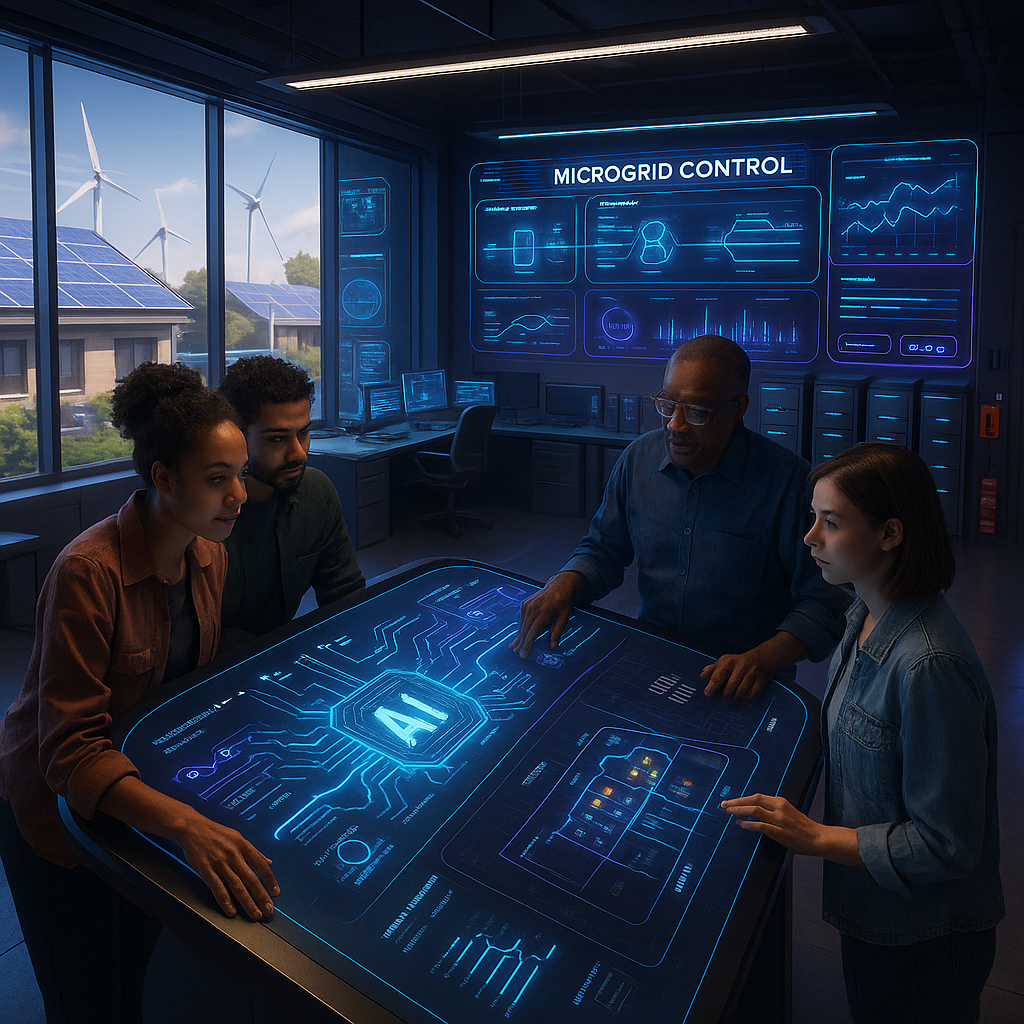
Key Takeaways
- AI orchestrates real-time resilience against grid instability: Intelligent controllers instantly balance loads, forecast demand, and autonomously route energy. This ensures local power remains reliable, even during outages or supply fluctuations, fortifying communities against unexpected disruptions.
- Smarter microgrids unlock seamless renewable integration: AI algorithms optimize the use of variable sources like solar and wind by predicting generation patterns and managing storage deployment. This strategic orchestration allows for greater reliance on clean energy without jeopardizing reliability, accelerating the transition to sustainable communities.
- Energy storage becomes strategic, not static: Continuous learning allows AI to maximize storage efficiency. By charging batteries when renewables peak and deploying reserves during grid stress, systems extract more resilience from every kilowatt-hour, transforming storage from a passive backup into an active grid asset.
- Decentralized systems put power in community hands: AI-powered microgrids enable local stakeholders to shape their energy destiny. Through collective decision-making, peer-to-peer trading, and agile adaptation to changing needs, communities harness greater agency and customization in their energy use.
- Resilience meets equity in underserved communities: By lowering technical and financial barriers, AI microgrids are becoming a lifeline for remote, marginalized, or disaster-prone areas. They empower these communities with energy security and self-sufficiency where centralized grids often fall short.
- AI-driven microgrids bridge the gap in the energy transition: Advanced microgrid controllers integrate seamlessly with existing infrastructure, enabling towns and regions to modernize incrementally. This accelerates the shift from fossil-fueled central utilities to adaptive, low-carbon local systems.
- Beyond efficiency: AI fosters energy democracy and empowerment: The deeper transformation emerges as intelligent microgrids redistribute agency. Communities become active participants in, and beneficiaries of, the revolution in their local energy futures.
Together, these insights reveal the powerful synergy between artificial intelligence and microgrids. The coming era is one where resilience, equity, and human agency are hardwired into the very fabric of our energy systems. As we unpack the technologies and real-world case studies behind this quiet revolution, we discover how AI is not only rewriting the rules of power infrastructure, but redefining community engagement and empowerment.
Introduction
A prolonged blackout in one neighborhood leaves thousands in the dark. Meanwhile, just down the road, AI-driven microgrids quietly keep the lights on, adapting seamlessly to outages with precision well beyond what human operators can achieve. Microgrid AI is not simply introducing a new tool. It is reshaping the future of local energy systems. What was once a luxury (resilience) has become a standard, opening pathways to equitable access to reliable power for all communities, not just the privileged few.
This confluence of intelligent automation and decentralized infrastructure signals something far deeper than a technical leap. It marks a fundamental reimagining of who holds control over energy, how clean power is distributed, and which communities can weather disruption and thrive. Exploring the impacts of microgrid AI reveals how it empowers local resilience, accelerates renewable adoption, and fosters equity, while activating a new era of agency at the grid’s edge.
Understanding AI-Powered Microgrids
Before diving into their societal impact, it’s essential to understand what makes AI-powered microgrids so transformative.
Stay Sharp. Stay Ahead.
Join our Telegram Channel for exclusive content, real insights,
engage with us and other members and get access to
insider updates, early news and top insights.
 Join the Channel
Components of Modern Microgrids
AI-powered microgrids are sophisticated, distributed energy ecosystems composed of diverse interconnected resources. At the foundation are distributed energy resources (DERs) such as solar panels, wind turbines, battery energy storage systems (BESS), and sometimes small-scale hydro or biomass generators. Coordinated by an advanced distribution management system (ADMS), these generation assets smoothly interact via specialized power electronics, like inverters and conversion systems that ensure the stability of voltage and frequency.
The true intelligence of modern microgrids arises from AI-driven controllers processing torrents of data collected by pervasive sensors and advanced metering infrastructure. These instruments offer real-time updates on critical electrical parameters (voltage, frequency, power quality, resource status), feeding into a centralized or often distributed control layer. The result is a dynamic, self-aware system that fine-tunes operations by the second.
At the heart of reliable microgrid function is robust communication infrastructure built on protocols like Modbus, DNP3, IEC 61850, and new IoT standards. These ensure secure, lightning-fast data exchange across all components. Increasingly, edge computing capabilities push critical decision-making closer to the source, keeping operations resilient even if cloud connectivity is lost during emergencies.
Today’s distribution networks are engineered for bidirectional power flow, featuring advanced switching equipment. This enables microgrids to disconnect and operate independently from the main grid (island mode) or coordinate with it, flexibly responding to grid-wide or local priorities. This infrastructure enables AI to orchestrate sophisticated strategies for optimizing both normal operations and disruptions.
How AI Enhances Microgrid Performance
Artificial intelligence fundamentally redefines what microgrids can achieve, elevating them from programmable systems to adaptive, predictive engines capable of balancing multiple objectives in real time. Machine learning, particularly reinforcement learning, empowers microgrids to devise optimal dispatch strategies autonomously, managing energy availability, load forecasts, and even market fluctuations without rigid manual intervention.
AI’s impact on forecasting is transformative. Research from the National Renewable Energy Laboratory (NREL) shows that AI-driven forecasting can reduce errors in predicting both renewable generation and loads by as much as 30-45%, facilitating more efficient use of resources and minimizing dependence on backups.
Through powerful pattern recognition, AI detects consumption trends, operational anomalies, and incipient system vulnerabilities that legacy systems would overlook. These insights enable proactive maintenance, reducing downtime up to 60% according to studies from the Electric Power Research Institute (EPRI).
Advanced optimization algorithms simultaneously juggle cost minimization, emissions reductions, and resilience targets, learning and refining their priorities from each operational cycle. These self-improving systems recalibrate strategies continuously, evolving with every weather event, demand spike, or equipment update.
Real-time control is perhaps the most visible advantage, as AI recalculates optimal settings within milliseconds. This rapid adaptability allows microgrids to maintain grid stability even as renewable contributions soar past 80%, a milestone once thought unmanageable without significant redundancy.
Precision farming techniques and AI-driven resource optimization are closely related to the technologies that enable this level of dynamic management within modern microgrids.
Types of AI Algorithms Used in Microgrid Control
The inner workings of microgrid AI rest on a toolkit of specialized algorithms:
- Artificial neural networks (ANNs) are the backbone for many forecasting tasks, processing vast historical and real-time data sets. Variants such as long short-term memory (LSTM) networks excel at capturing subtle time-dependent weather and usage patterns, sharply improving generation forecasts.
- Genetic algorithms and particle swarm optimization are frequently deployed for complex, multi-constraint optimization. These evolutionary methods efficiently search for optimal decisions in systems where traditional equations fall short. A study at the University of California San Diego found these techniques cut microgrid operating costs by 15% and lifted renewable utilization by 22%.
- Reinforcement learning represents the vanguard of microgrid decision-making. Using frameworks like Deep Q-Networks and Proximal Policy Optimization, AI controllers learn from millions of micro-decisions, eventually developing strategies that anticipate and neutralize grid disturbances before they occur.
- Unsupervised learning algorithms (such as clustering and autoencoders) shine in predictive maintenance and anomaly detection, flagging failing equipment or cyberthreats up to 72 hours before legacy systems raise alarms, based on Department of Energy field trials.
- Federated learning, an emerging approach, enables multiple microgrids to collaboratively train AI models without sharing sensitive local data. This not only improves system intelligence and adaptability across different locations but also preserves privacy and autonomy for individual communities.
Together, these diverse algorithms endow microgrids with an unprecedented blend of foresight, flexibility, and resilience, making them the backbone of a future-ready energy system.
Microgrids and Community Resilience
AI microgrids are not just an upgrade in engineering; they are a paradigm shift in how communities confront uncertainty and change.
Disaster Response and Energy Security
One of the most profound impacts of AI-controlled microgrids surfaces in disaster situations, where centralized grids routinely falter. Through autonomous islanding, microgrids disconnect from failing infrastructures in milliseconds, keeping internal power balanced and communities operational while chaos reigns elsewhere.
The aftermath of Hurricane Maria in Puerto Rico starkly illustrated this advantage. Over 200 microgrids were deployed post-disaster; those equipped with AI reported 87% higher uptime compared to traditional backup generators, optimizing every available watt of generation and storage. In California, healthcare facilities reliant on AI microgrids maintained nearly continuous power during wildfire-driven grid shutoffs, a sharp contrast to the partial outages witnessed in conventionally powered centers.
AI also fortifies cybersecurity, a critical, often overlooked, facet of modern grids. With advanced machine learning, microgrids can detect and isolate cyber-intrusions before they escalate, achieving over 96% accuracy in real-world trials while minimizing costly false alarms.
Stay Sharp. Stay Ahead.
Join our Telegram Channel for exclusive content, real insights,
engage with us and other members and get access to
insider updates, early news and top insights.
Join the Channel
Perhaps most importantly, as demonstrated by the Blue Lake Rancheria microgrid in California, communities with robust AI microgrids serve as bastions of safety and recovery, providing uninterrupted energy for emergency and relief operations when broader public systems collapse.
Adaptive Learning and Grid Evolution
The real magic of AI microgrids is in their self-improving nature. Over time, these systems sharpen their forecasts and optimize strategies through adaptive learning, reducing errors and waste as they accumulate data unique to their environment. Regular operation yields a richer tapestry of local insights, eventually enabling the system to predict both energy patterns and community needs with ever-increasing accuracy.
The Brooklyn Microgrid project is a powerful example. By leveraging reinforcement learning that evolved with participant behavior, the microgrid developed energy trading rules reflecting community preferences, resulting in 35% greater engagement and a more enthusiastic embrace of local energy investment and exchange.
This intelligence extends to guiding infrastructure evolution. Through continuous operational analysis, microgrid AI generates targeted recommendations for expansion, identifying exactly where added storage, new renewables, or upgraded network capacity would yield the greatest community benefit for each dollar spent.
Interoperability is another frontier. AI is enabling microgrids to develop collaborative protocols, coordinating with neighboring systems for shared resilience without restructuring existing infrastructure. In Connecticut, municipal microgrids gradually learned to synchronize, lifting regional resilience by almost 30% through information sharing and load balancing alone.
Federated learning further amplifies this growth, allowing remote or isolated microgrids to benefit from the experiences and strategies of others, accelerating the evolution of distributed energy networks while protecting the uniqueness and sovereignty of each deployment.
Predictive models and collaborative approaches are also revolutionizing other sectors, providing valuable lessons for the ongoing development of distributed energy networks.
Economic Benefits for Local Communities
AI-powered microgrids also foster economic revitalization and resilience.
By implementing dynamic energy arbitrage, microgrids buy power when it’s cheap and sell or deploy stored energy when prices surge. Machine learning strategies regularly outpace manual or fixed schedules, boosting community and institutional revenue—returns in California markets average 23% higher through automated trading.
Peak demand management is now more precise than ever. AI systems vent stored energy to flatten spikes, saving large facilities substantial sums on demand charges. In manufacturing environments, these strategies have delivered annual savings of over $175,000 for operations with peak loads around 2MW.
Beyond direct utility savings, microgrids create a ripple of local economic growth. Their distributed nature supports installation, operation, and maintenance jobs within communities, spurs local entrepreneurship in energy services, and seeds educational programs for emerging green technology careers.
This nurturing of local economies, paired with unprecedented energy autonomy, lays the groundwork for broader social gains. Schools can remain open during outages, healthcare facilities run reliably, and local businesses avoid costly interruptions. In short, energy resilience can become a wellspring for communal prosperity and growth.
As distributed energy resources increasingly rely on advanced digital infrastructure, the importance of ethical data collection and governance grows across all smart grid initiatives.
Conclusion
AI-powered microgrids are not merely upgrades to outdated grids; they are the scaffolding for a new era of energy consciousness, community resilience, and operational intelligence. By intertwining adaptive machine learning with advanced power electronics and communications, these systems transcend their roles as backup plans. They emerge as catalysts of operational excellence, economic growth, and social empowerment.
The results are clear and compelling. AI microgrids substantially increase uptime, forecasting precision, cost efficiency, disaster readiness, and overall system learning. What truly sets them apart, however, is their evolving character. Like living organisms, these microgrids accumulate operational experience, sense community behaviors, and autonomously guide their own growth and adaptation. Their continual self-improvement mirrors the broader revolution occurring across artificial intelligence. We’re not simply automating solutions; we’re augmenting our collective journey toward a future where resilience, equity, and agency are deeply embedded, not just in infrastructure, but in the very spirit of community life.
Looking forward, the challenge and the promise are equally profound. How will we, as creators and stewards of these “alien minds,” wield their growing powers? Will we harness their insights to build not only smarter technologies but stronger, more interconnected societies? In the rapidly shifting landscape of energy and beyond, those who embrace adaptive learning, collaborative engagement, and community-first innovation will lead. True energy democracy is within reach, but its realization depends on how wisely and inclusively we partner with our new digital allies. The future will favor those who do not just react to change, but actively anticipate and shape it. We may even turn every blackout into a beacon of progress and collective empowerment.
For a deeper dive into the role of collaborative data analysis and distributed intelligence, explore how AI transforms citizen science through smarter crowdsourced data analysis, a concept with striking parallels in the evolution of energy networks.



Leave a Reply