
Key Takeaways
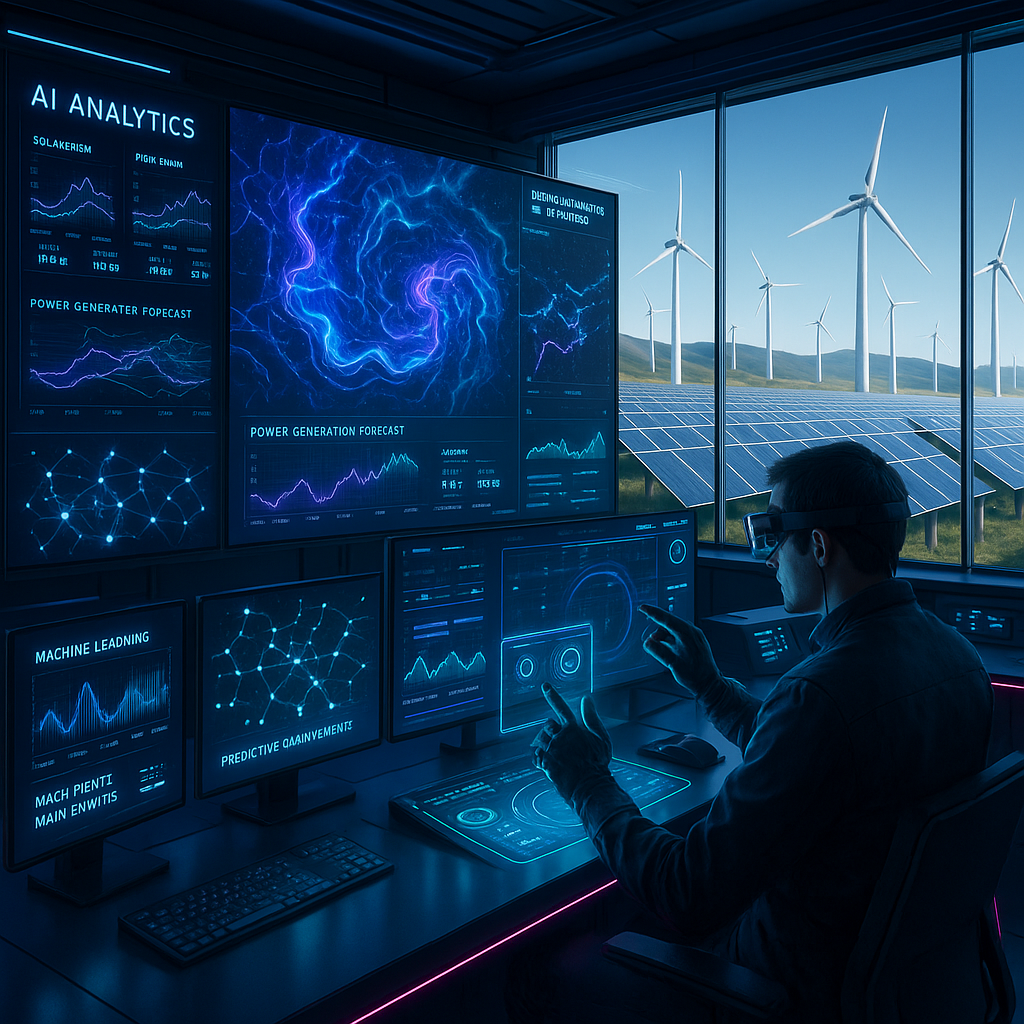
- AI transforms unpredictability into precise energy forecasting. By analyzing immense streams of weather, production, and market data in real time, AI substantially improves the accuracy of solar and wind output predictions. This reduces the uncertainties that have long limited the widespread adoption of renewable energy.
- Intelligent automation turns static grids into adaptive networks. AI-driven control systems continuously balance electricity supply and demand, orchestrating renewables, storage, and consumption with split-second responsiveness. This enables the shift from traditional, reactive grids to dynamic, living infrastructure.
- Deep learning revolutionizes infrastructure maintenance and reliability. Advanced AI models anticipate equipment failures, optimize preventative maintenance schedules, and extend the lifespan of critical assets. This directly reduces downtime, minimizes outages, and maximizes energy delivery.
- Energy markets evolve with digital intelligence. AI-powered forecasting and real-time automation enable dynamic energy pricing and trading, empowering both producers and consumers to respond instantly to grid conditions. This fosters a more efficient, transparent, and resilient marketplace.
- Grid integration at new levels. AI eliminates longstanding barriers to incorporating large-scale solar, wind, and storage solutions. As renewables approach dominance in the energy mix, AI ensures grid stability and reliability.
- Decentralization empowers communities and businesses. With AI optimizing microgrids and distributed energy resources, unprecedented levels of autonomy and resilience become possible. This accelerates the transition away from centralized power structures and enables stakeholder-driven energy ecosystems.
- AI brings transparency and builds trust in green energy. By delivering clear, data-backed performance insights, AI fosters confidence among operators, regulators, and the public, helping renewable energy to gain widespread acceptance and credibility.
As we journey further, we will unravel not only the algorithms themselves, but also the human stories and seismic technological shifts propelling this harmonious convergence between AI and renewables. Together, we are witnessing a new chapter in how humanity learns to harness the once alien forces of sun and wind.
Introduction
Each day, solar farms and wind turbines pour more clean energy into our global grids. Yet the visible technology is only part of the transformation quietly reshaping the landscape. The true revolution operates behind the scenes, orchestrated by silent streams of data and powerful algorithms. Artificial intelligence is now turning the mercurial nature of sun and wind into actionable precision, reinvigorating how we forecast, manage, and trust renewable power sustaining our world.
As intelligent automation embeds deeper into grid infrastructure, smart energy systems no longer simply react—they anticipate and adapt. AI-powered models decode the turbulence of weather, predict when and how equipment may falter, and choreograph energy flows second by second. This seismic shift extends well beyond engineering, catalyzing decentralized grids, dynamic markets, community resilience, and transparent environmental accountability. Let us explore how artificial intelligence is quietly conducting a new age of reliable, scalable, and transparent green energy. This is reshaping not just power, but the direction of civilization itself.
The Technical Foundation of AI in Renewable Energy
From Data Collection to Predictive Intelligence
The deployment of AI within renewable energy systems begins with robust and sophisticated data architectures. These platforms ingest a wide array of inputs simultaneously, ranging from meteorological details (such as temperature, wind speed, cloud cover, and precipitation) to historical energy outputs, demand patterns, and real-time market signals. By synthesizing information across multiple timescales and sources, AI uncovers nuanced relationships that conventional statistical techniques often overlook.
Stay Sharp. Stay Ahead.
Join our Telegram Channel for exclusive content, real insights,
engage with us and other members and get access to
insider updates, early news and top insights.
 Join the Channel
In the wind energy sector, AI models now analyze atmospheric pressure gradients, topography, and turbine characteristics to generate granular wind forecasts. Convolutional neural networks (CNNs) and other deep learning architectures ingest satellite imagery and feed it into numerical weather prediction engines, enhancing forecast accuracy and spatial resolution. For example, when GE Renewable Energy integrated such systems into North Sea wind farms, day-ahead wind production forecast errors dropped by nearly 30% compared to classical methods.
Solar forecasting leverages deep learning tools that integrate continuous pyranometer readings and high-resolution cloud imagery, providing precise 15-minute increment forecasts. Technical architectures often combine computer vision for interpreting sky cameras with recurrent neural networks (RNNs) that recognize temporal patterns in solar insolation. These AI systems transcend the limitations of static clear-sky models, adapting to shifting weather in near real-time.
The cutting edge of renewable forecasting now incorporates transformer models, a technology that has transformed natural language processing and now excels at distilling complex spatial and temporal dependencies. These models fuse multimodal data (satellite images, sensor readings, market data), delivering superior forecasting, particularly during extreme weather events.
This fusion of data collection, machine learning, and predictive analytics marks a fundamental shift in how renewable energy is integrated and managed. It transforms weather volatility from a liability into actionable intelligence, underpinning smarter grid operations and dependable resource planning across every sector reliant on clean energy.
AI-Enhanced Weather Prediction for Renewable Optimization
Beyond Traditional Meteorology
AI has revolutionized weather prediction for renewables by enabling highly localized, frequently updated forecasts that were unthinkable with traditional meteorological models. While conventional numerical weather prediction tools might operate at grid spacings of ten kilometers and six-hour intervals, AI-based systems now deliver hyperlocal forecasts, down to one kilometer and updated every fifteen minutes. Such precision is vital wherever microclimates strongly influence energy production, whether on a wind-swept coastline or an urban rooftop hosted with solar panels.
Machine learning shines in the process known as downscaling. This means extracting detailed, site-specific insights from broader, global forecasts. Techniques like gradient boosting and random forests help connect large-scale atmospheric data to hyperlocal environmental conditions. The Danish Meteorological Institute’s neural network system, for instance, improved wind forecasting accuracy by 22% for offshore installations, unlocking multi-million-euro operational savings annually.
Solar energy companies employ similar strategies, combining satellite data with sky cameras to track real-time cloud development. DeepMind’s collaboration with the UK National Grid, blending computer vision and neural networks, boosted six-hour-ahead solar production accuracy by 30% over legacy techniques. Here, AI discerns cloud movement, evolving sun angles, and the interaction of atmospheric particles with sunlight, issues too complex for classical physics-based approaches alone.
Crucially, AI-enabled weather systems are exceptionally adept at detecting and preparing for extremes. By analyzing historical links between atmospheric signals and production impact, machine learning models can flag risks days ahead. This proactive capability protects grid stability, enabling operators to arrange supplemental reserves or reconfigure energy dispatch before disruptions occur.
Looking beyond energy, these advancements in AI-based weather modeling are finding vital applications across sectors such as precision agriculture (optimizing irrigation and crop protection schedules), logistics (predicting weather-related delays), and disaster response (providing early warnings for floods and storms). These cross-industry benefits demonstrate how AI-powered meteorology is quietly revolutionizing the way society responds to the environment.
Real-Time Generation Forecasting
Adapting to Dynamic Conditions
In the rapidly evolving world of energy, real-time forecasting may be AI’s most transformative tool. Modern architectures deploy ensemble strategies, blending multiple forecasting models from machine learning to traditional physics simulations. Each model receives dynamic weighting depending on its historical performance under current conditions, resulting in highly resilient and adaptive predictions.
These platforms are typically organized hierarchically by forecasting timescale. Short-term systems harness high-frequency data from local sensors, running through neural networks that digest second-by-second shifts in production or consumption. Middle-term predictions synthesize meteorological patterns and grid signals, while longer-range outlooks scan for seasonal or climate-cycle phenomena.
Tesla’s Autobidder provides a striking example. This platform uses reinforcement learning to optimize forecasts and market participation for solar and battery storage installations, processing over thirty input streams to manage both generation and energy storage. Facilities leveraging such intelligence have seen revenue boosts of up to 40% compared to sites using traditional forecasting methods.
Wind energy developers benefit from asset-specific AI models. Uptake, for example, incorporates vibration, mechanical pitch, and maintenance status from turbine fleets to refine output projections, yielding accuracy gains of up to 25%. These tailored models support decisions ranging from minute-by-minute dispatch to long-term investment.
Advanced systems now go further, embracing probabilistic methodologies. Instead of just outputting “best guess” values, they generate full probability distributions of potential outcomes. This provides grid operators and energy markets with essential insight into uncertainty and risk, leading to more informed, resilient planning.
Beyond renewables, real-time, AI-driven forecasting is now being adopted in other critical sectors. In finance, predictive analytics for stock exchanges and commodity flows benefit from similar ensemble and deep learning strategies. In healthcare, hospital resource scheduling uses short-term AI forecasts to allocate personnel and equipment. These diverse applications illustrate how adaptive, data-driven forecasting is reshaping entire industries beyond energy.
Grid Integration Challenges and AI Solutions
Managing Intermittency Through Intelligence
The intermittent nature of renewables has long challenged grid integration, introducing unpredictability and risk to a system built for steady, controllable power. Here, AI shines as a powerful equalizer, transforming grids from static infrastructure into dynamic, responsive systems.
Stay Sharp. Stay Ahead.
Join our Telegram Channel for exclusive content, real insights,
engage with us and other members and get access to
insider updates, early news and top insights.
Join the Channel
At the transmission level, AI algorithms perform contingency analysis with unprecedented speed. Using graph neural networks, these systems scan network topologies for vulnerabilities and simulate thousands of “what if” scenarios in a matter of seconds. PJM Interconnection’s security assessment tool uses this approach, reducing assessment timelines from hours to seconds and identifying complex failure modes that previously escaped detection.
Distribution networks, where voltage stability is most sensitive to sudden changes in renewable output, now leverage predictive control powered by machine learning. Arizona Public Service demonstrated this with an AI platform that, by anticipating neighborhood-level solar variations, reduced voltage violations by 85% while integrating 45% more residential solar customers than before.
Virtual power plants (VPPs) represent a major leap in integrating and managing distributed energy resources. Companies like AutoGrid and Stem use AI to coordinate thousands of small-scale batteries, rooftop solar systems, and flexible loads, allowing them to operate together as cohesive, dispatchable assets. These VPPs learn from evolving market and weather conditions, continuously optimizing their collective behavior to meet grid needs, respond to changing prices, and maximize resilience.
AI’s grid integration role extends sooner to other sectors as well. In water management, similar reinforcement learning optimizes reservoir releases and consumption patterns; in transportation, AI-driven traffic control systems adapt to fluctuating demand and infrastructure stress.
The upcoming frontier is “physics-informed” machine learning, where neural networks are rigidly constrained by the principles governing electrical flow and infrastructure limits. These hybrid systems guarantee that AI recommendations remain feasible and safe, bridging the gap between data-driven adaptability and hard engineering realities.
Case Studies: Success Stories and Lessons Learned
Real-World Applications Driving Transformation
Concrete examples of AI in renewable integration abound, offering valuable lessons and blueprints for replication in other sectors.
The South Australian Virtual Power Plant stands as a benchmark for AI-enabled grid transformation. By networking over a thousand Tesla Powerwalls across residential rooftops, reinforcement learning algorithms continuously optimize battery charging and discharging, leveraging forecasts of solar output, home consumption, and grid conditions. During the 2019 grid separation event, this AI-managed virtual power plant responded within milliseconds, preserving critical frequency stability and staving off a large-scale blackout. Beyond crisis response, the system has delivered a 22% increase in customer savings and eased demand peaks by 80MW. This demonstrates real-world benefits for both individuals and the broader grid.
Europe’s Nordic Wind Power Forecasting Consortium pioneers collaborative AI with over 350 wind farms sharing anonymized data. Through federated learning, they refine powerful ensemble models on site-specific data, reducing forecast errors by 42%. These gains proved essential during the severe 2021 winter storms, when the system’s early-warning predictions prevented blackouts and saved operators over €12 million in emergency costs. This collaborative approach to data underscores how AI can foster industry alliances and surmount competitive barriers, echoing similar advances in healthcare (for example, federated learning in rare disease research) and finance (cross-institutional fraud detection).
In utility-scale solar, First Solar’s partnership with the US National Renewable Energy Laboratory exemplifies how AI can optimize both facility design and real-time operation. Their system utilizes reinforcement learning to tactically adjust inverter parameters, tracker orientations, and curtailment strategies based on live weather data and grid conditions. During periods of partial cloud cover, historically problematic for solar output, the model improved plant production by 3.6% and drastically reduced disruptive power swings, making solar more grid-compatible.
Outside of energy, similar case studies can be found in manufacturing, where predictive AI reduces equipment failures and waste; in agriculture, where smart algorithms balance variable fertilizer application for both yield and environmental sustainability; and in logistics, where real-time data flows and machine learning keep global supply chains resilient and optimized.
The Role of Machine Learning in Grid Stability and Security
From Reactive to Predictive Grid Management
Today’s power grids face rising complexity: bi-directional power flows, the proliferation of distributed energy resources, and active participation from millions of prosumers. AI is central to managing this complexity, shifting the paradigm from reactive operations to anticipatory, predictive management.
Machine learning algorithms now continuously monitor grid health, detecting subtle anomalies before they blossom into major faults. Predictive maintenance models process sensor and historical operation data to flag deteriorating components or cyber-vulnerable points in infrastructure, allowing preemptive scheduling and targeted hardening. Some utilities are beginning to deploy generative AI systems that simulate potential attack or outage scenarios, further informing both incident response and regulatory compliance strategies.
Moreover, AI’s capacity to synthesize and interpret massive operational datasets also paves the way for more agile and inclusive governance. Data-driven insights empower policymakers to design regulatory frameworks that anticipate sectoral shifts. In environmental science, for example, similar predictive models guide climate resilience planning and resource allocation across municipalities. In legal and compliance fields, automated monitoring tools scan market and operational activities for rule violations, enhancing oversight and building systemic trust.
Conclusion
Artificial intelligence is quietly conducting a paradigm shift in renewable energy. It is advancing a world where weather, human engineering, and market forces are not merely managed, but learned from and anticipated in real time. Through deep networks and algorithmic ingenuity, AI turns sustainability’s greatest hurdles—uncertainty, volatility, and integration complexity—into stepping stones for a resilient, interconnected future.
The most profound breakthroughs extend beyond technical prowess. Hyperlocal weather prediction, real-time grid risk analysis, and industry-spanning collaborations like cross-border wind forecasting or virtual power plants reveal how AI fosters resilience, security, and even community empowerment. Quietly, these “alien minds” are redefining the very intelligence that animates our infrastructure.
As climate volatility intensifies and global electrification demands surge, the crucible of this technological revolution becomes clear. The leaders of tomorrow will not simply adopt AI. They will form deep partnerships with it, unlocking new horizons for trust, governance, and innovation. Whether optimizing microgrids in rural communities, orchestrating intercontinental energy markets, or safeguarding critical systems in the face of unprecedented challenges, the organizations and nations that harness AI’s potential will define the sustainable era.
The open question is one both practical and philosophical: How will we govern these generative, adaptive energies that increasingly power and protect our civilization? The answers, emerging at the intersection of technical ingenuity, human collaboration, and societal vision, will steer not only our energy systems, but our shared planetary future.


Leave a Reply