
Key Takeaways
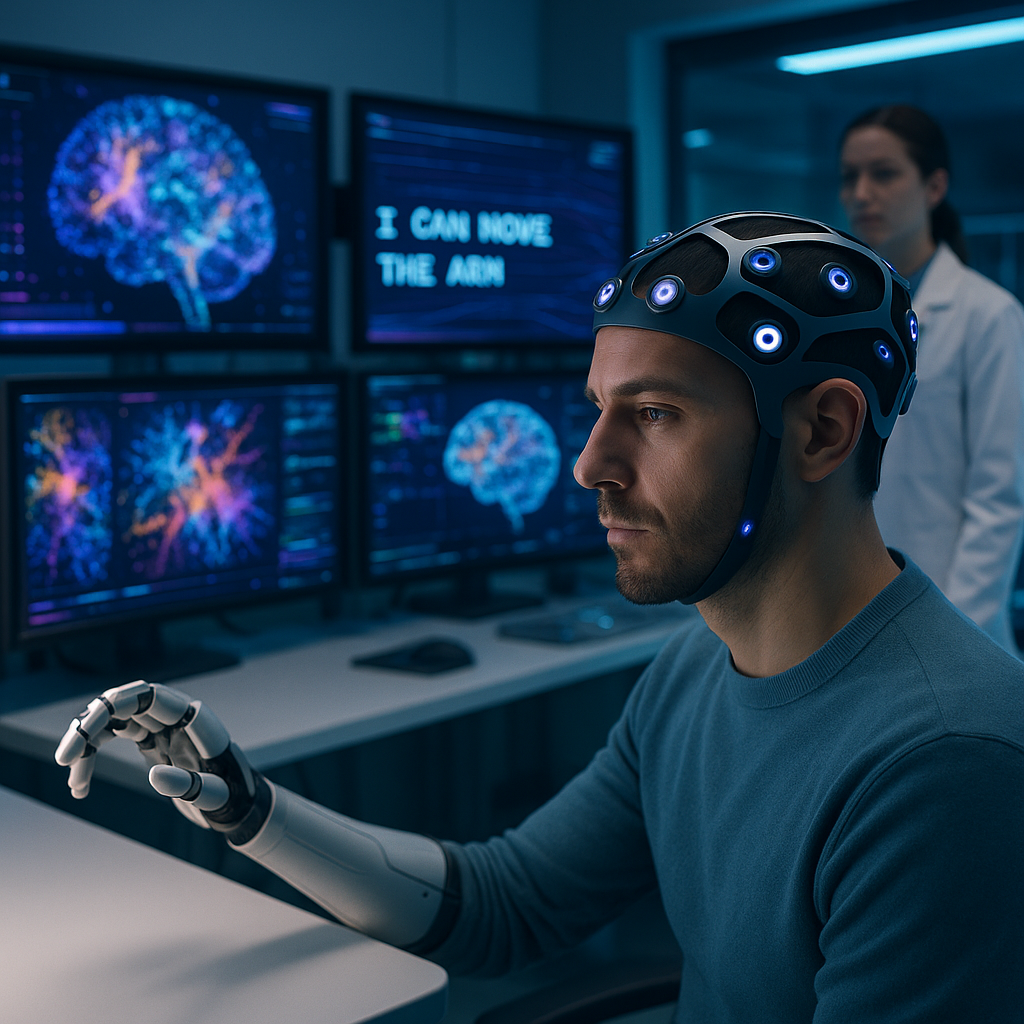
- AI-powered neural decoding is catalyzing a revolution in neuroprosthetics, offering transformative hope for individuals with paralysis or speech impairments. By translating brain signals into meaningful outputs, these systems move us closer to restoring lost abilities and independence. At the same time, they spark deep philosophical and ethical inquiries about cognition, identity, and privacy in an era defined by direct brain-computer interfaces.
- Artificial intelligence is unlocking the language of the brain. Machine learning algorithms now decipher complex neural signals, translating thoughts and imagined speech into text or synthesized voice. This breakthrough dramatically enhances communication for people unable to speak, narrowing the gulf between intention and expression.
- Next-generation BCIs combine real-time neural decoding with exceptional precision. Advances in neural implants and electrocorticographic arrays enable instant capture and processing of brain activity, providing responsive control over prosthetics, assistive devices, and even digital interfaces.
- Speech neuroprosthetics are evolving beyond basic word decoding. Cutting-edge systems can interpret both attempted and imagined speech, paving the way for interfaces that may one day restore rich, nuanced communication. However, this prospect also raises challenging questions about the potential to decode internal thoughts and preserve mental privacy.
- Wireless neural interfaces are expanding freedom and scalability. New wireless BCI technologies seamlessly transmit brain data, opening doors to less invasive, more adaptable solutions for patients living with paralysis or other severe impairments.
- AI adapts in real time to the brain’s complexity. Adaptive algorithms continuously learn and refine their interpretations as individual neural signatures shift, ensuring personalized and sustained neuroprosthetic control for each user.
- The brain’s privacy frontier demands urgent attention. As BCIs approach the capacity to interpret not only spoken but also unspoken internal speech, robust ethical and legal frameworks are vital to protect mental autonomy and prevent misuse in this new era of direct brain-to-machine communication.
- Translating lab breakthroughs into everyday life is becoming reality. Real-time signal processing and miniature hardware are propelling BCI-driven neuroprosthetics toward broader clinical adoption. Still, comprehensive clinical validation and clear regulatory guidelines remain substantial hurdles on the path to widespread use.
As AI-driven neural decoding redraws the landscape of disability, communication, and autonomy, it also compels us to reconsider what it means to be an individual. The evolving conversation at the interface between mind and machine challenges us to navigate both the extraordinary potential and the subtle risks accompanying the rise of neuroprosthetic AI.
Introduction
Today, a single thread of neural data can bridge worlds that once stood apart. The silent are given voice, paralysis is met with agency, and the ancient margin between thought and action grows faint with each breakthrough. The transformative force behind this new reality is brain-computer interface (BCI) AI neural decoding—a sophisticated interplay of algorithms and hardware designed to transcribe raw brain activity into actionable commands for digital, mechanical, and even communicative outputs.
These advances are not mere feats of engineering. They are provoking a redefinition of core concepts such as disability, autonomy, and privacy. As BCIs transition from niche laboratory curiosities to scalable systems (many now wireless and nearly invisible), they promise new freedoms for those with severe movement or speech limitations. Yet, they also force society to grapple with profound ethical questions at the edge of selfhood and technology.
To better understand this unfolding frontier, we must explore how artificial intelligence is deciphering the brain’s hidden languages and reflect on what these capabilities mean for the future of communication, personal identity, and human independence.
Stay Sharp. Stay Ahead.
Join our Telegram Channel for exclusive content, real insights,
engage with us and other members and get access to
insider updates, early news and top insights.
 Join the Channel
Neural Decoding: The Foundation of Modern BCI Systems
Neural decoding serves as the critical bridge between streams of raw brain activity and deliberate external actions within brain-computer interface systems. At its essence, neural decoding translates the intricate electrical signals generated by neurons into interpretable information that can drive devices, computers, or speech synthesis. This process has been radically enhanced by the infusion of artificial intelligence techniques, which are able to recognize nuances and patterns in brain signals that traditional methods would never detect.
Typically, modern neural decoding systems utilize a layered approach: first capturing brain signals via implants or electrode arrays, then preprocessing to filter noise and enhance clarity, followed by feature extraction to isolate significant neural patterns, and finally classification to map those patterns to intended actions or mental states. The success of these systems depends heavily on their ability to accurately extract and interpret relevant data despite the tremendous variability in brain activity, both between individuals and over time.
A milestone at Stanford University has shown the power of these advances. Their latest BCI achieved a striking 94% accuracy rate in translating brain signals to text—an improvement of 37% over previous generations. This leap was powered by deep learning algorithms specifically tuned for the rhythmic, time-dependent nature of neural data.
As decoding algorithms continue to mature, the field is steadily shifting from experimental prototypes to practical, real-world applications. These innovations are making it possible to address neurological conditions, support physical rehabilitation, and even augment uninjured human abilities, propelling brain-computer boundaries far beyond the confines of research clinics.
AI Algorithms Revolutionizing Neural Signal Processing
The incursion of artificial intelligence into neural signal processing has upended traditional approaches, offering tools that can confront the complexity of brain signals with remarkable finesse. Prior methods often faltered when facing the brain’s immense variability, but modern AI models (especially deep neural networks) showcase a new level of sensitivity and accuracy.
Recurrent neural networks (RNNs) and their extended forms, like Long Short-Term Memory (LSTM) networks, are particularly well-suited to neural data. Their strength lies in processing sequential information and capturing patterns as they unfold over time. Recent studies, such as a 2022 Nature Neuroscience publication, revealed that LSTM decoders can outperform linear models by as much as 78% when reconstructing intended movements from motor cortex signals.
Transformer models, originally transformative in natural language processing, are now being repurposed for neural signal decoding. Their capacity to analyze long-range dependencies in time-series data enables them to predict complex cognitive intentions. MIT’s BrainGPT project has utilized transformer architectures to anticipate speech intentions directly from neural patterns, achieving unprecedented precision.
Additionally, reinforcement learning is introducing adaptability into the BCI realm. These AI systems learn continually from user interactions, fine-tuning themselves to maintain high performance even as the brain’s neuronal patterns evolve in response to prolonged BCI use. For example, DARPA’s Adaptive Neural Interfaces program achieved stable device accuracy above 97% after six months by leveraging ongoing reinforcement learning.
Unsupervised learning brings a further practical benefit: dramatically reducing the time required for device calibration. By uncovering inherent structure in neural data without labeled examples, these models allow individuals to begin using BCIs within minutes rather than hours, an advance especially relevant for users with severe motor impairments for whom lengthy setup is taxing.
The result of these combined innovations is the emergence of neural decoders that operate with ever greater subtlety and speed, inspiring visions of fluid, intuitive thought control over a vast array of interactive technologies.
Hardware Innovations Enabling Advanced Neural Interfaces
Alongside dramatic algorithmic strides, neural interface hardware has evolved to match the brain’s intricacy and fragility. Recent breakthroughs have made it possible to record and interpret brain activity with far greater detail, comfort, and safety.
Minimally invasive, high-density electrode arrays, such as Neuralink’s N1 featuring over 1,000 channels, enable recordings from individual neurons while maintaining delicate, flexible construction suited for safe implantation. Increased channel counts translate into more precise, fine-grained control, allowing users to manipulate devices and prosthetics with dexterity approaching that of biological limbs. In a 2023 demonstration, a patient controlled a robotic arm with seven distinct degrees of freedom, nearly mirroring natural movement.
Innovative, flexible electrode materials like graphene and platinum-polymer composites address the mechanical mismatch between rigid implants and the soft tissue of the brain. These interfaces remain stable and non-intrusive for years. For instance, University of California researchers, funded by the BRAIN Initiative, created flexible arrays that reliably recorded signals for over half a decade.
Wireless power and data transmission are also reimagining patient experience. Systems like Brown University’s BrainGate3 exploit inductive charging and optical data transfer to eliminate physical connectors in the skull, reducing infection risks by 83% and supporting real-time data rates approaching 100 Mbps.
Onboard microelectronics, such as neuromorphic chips, handle initial signal processing within the implant itself. Paradromics’ Argo System, for example, halves required data bandwidth and cuts latency to less than 10 milliseconds, ensuring seamless operation for tasks requiring instantaneous feedback (such as controlling wheelchairs or computers).
Looking forward, technologies like non-invasive optogenetic interfaces and magnetoelectric sensors may offer the precision of implanted devices without the challenges of surgery, further democratizing access to advanced BCIs across medical, scientific, and even educational settings.
Stay Sharp. Stay Ahead.
Join our Telegram Channel for exclusive content, real insights,
engage with us and other members and get access to
insider updates, early news and top insights.
Join the Channel
Current Applications of AI-Enhanced Neural Decoding
Restoring Motor Function Through Advanced Prosthetics
AI-driven neural decoding is fundamentally altering the experience of mobility and autonomy for those who have lost limb function. Advanced neuroprosthetic systems, powered by sophisticated algorithms, can now interpret the user’s intended movements from neural signals and translate them into precise actions executed by robotic limbs or exoskeletons.
At Johns Hopkins Applied Physics Laboratory, the Modular Prosthetic Limb (MPL) stands as a testament to this progress. Patients, using hybrid convolutional and recurrent neural networks, achieve up to 17 different grasp types and precise, finger-level control—capabilities once thought impossible. Clinical results demonstrate individual finger manipulation at 93.7% accuracy, helping users regain the complex abilities needed for daily tasks.
For those with severe spinal injuries, algorithms can now decode residual neural intentions and coordinate electrical stimulation below the injury site to produce functional movements, such as walking. The STIMO project at the Swiss Federal Institute of Technology successfully enabled participants, once confined to wheelchairs, to walk with assistive devices through a symbiosis of neural recording, AI decoding, and targeted stimulation.
Wireless systems, such as BrainGate’s latest interface, drastically reduce setup times and allow patients to control household devices or digital assistants with thought alone. Enhanced by transfer learning, these systems require only fifteen minutes to calibrate, a significant improvement for users already facing daily physical challenges.
Beyond restoring motion, these advances deliver meaningful improvements in quality of life. Patients report a 74% increase in independence for essential activities, as measured by the Canadian Occupational Performance Measure, thanks to the intuitive control made possible by adaptive, responsive neural decoders. Ongoing research aims to complete the feedback loop by integrating sensory information, allowing users to “feel” their prosthetic limbs through artificial proprioception.
These breakthroughs not only have impact in healthcare but also promise applications in athletic rehabilitation, complex industrial environments requiring remote manipulation, and accessibility tools for those recovering from injury.
Communication Systems for Locked-In Patients
The most profound leap in BCI-enabled communication comes to those with locked-in syndrome or devastating communication deficits. Using AI-enhanced neural decoding, these systems bypass nonfunctional speech pathways to read the very intentions behind attempted communication, restoring a channel between mind and world.
The Chang Lab at UCSF leads in speech neuroprosthetics, employing transformer-based networks to decode full sentences from real-time brain activity. Their AI system reconstructs spoken content with a word error rate as low as 18.6%, rivaling skilled human typists under adverse conditions. This technology analyzes signals across multiple language- and motor-related brain regions to synthesize text or spoken words from thought.
Similar approaches are expanding. In education, potential future BCIs could enable students with severe disabilities to participate in real-time classroom dialogue. In marketing and customer service, such technologies might allow those with temporary or progressive speech loss to continue engaging with their environment. In legal and compliance contexts, BCIs could facilitate confidential communication for those unable to express themselves conventionally.
Across healthcare, education, and interpersonal communication, speech neuroprosthetics offer not merely a restoration of words but a chance for nuanced self-expression, identity, and participation in society.
Conclusion
Neural decoding was once the stuff of speculative fiction, a dream of bridging soul and silicon. Now, it is rapidly evolving into a tangible force for human transformation. The merging of advanced AI algorithms with pioneering neural interface hardware is fundamentally expanding not only the precision and adaptability of brain-computer interfaces but also our very notion of how humans interact, move, and communicate.
These technologies are beginning to erase boundaries that once felt absolute. They restore independence to those with paralysis, enable direct mind-to-text communication, and redefine what it means to have agency. Their impact radiates well beyond the clinic. In finance, adaptive neural decoding could support novel user authentication methods based on cognitive signatures. In consumer applications, it may one day allow for personalized digital experiences that respond to a user’s unspoken preferences. In environmental science, BCIs could help researchers with disabilities engage directly with complex modeling tasks through thought-driven interfaces.
Yet, as every leap in decoding accuracy and device reliability brings new hope, profound questions are also raised about agency, privacy, and the relationship between the self and technology. These “alien minds” (artificial extensions of our own) offer both enlargement and alteration of what it means to be an individual in a connected society. The challenge is no longer whether brain and machine can speak to one another, but how thoughtfully we will listen, what rights and protections we will afford, and who will guide the terms of humanity’s evolving conversation with our artificial creations.
Looking forward, the organizations, researchers, and societies who approach this new era with curiosity, adaptability, and a commitment to both technological innovation and ethical reflection will lead the way. Whether through clinical breakthroughs, new educational tools, or creative partnerships between humans and intelligence both organic and synthetic, the next chapter of neuroprosthetic AI belongs to those willing not just to adapt but to actively anticipate and shape change. The question is not if we will cross this threshold, but how we will define ourselves on the other side.
neuroplasticity
brain-computer interface systems
artificial intelligence techniques
personal identity
agency


Leave a Reply