
Key Takeaways
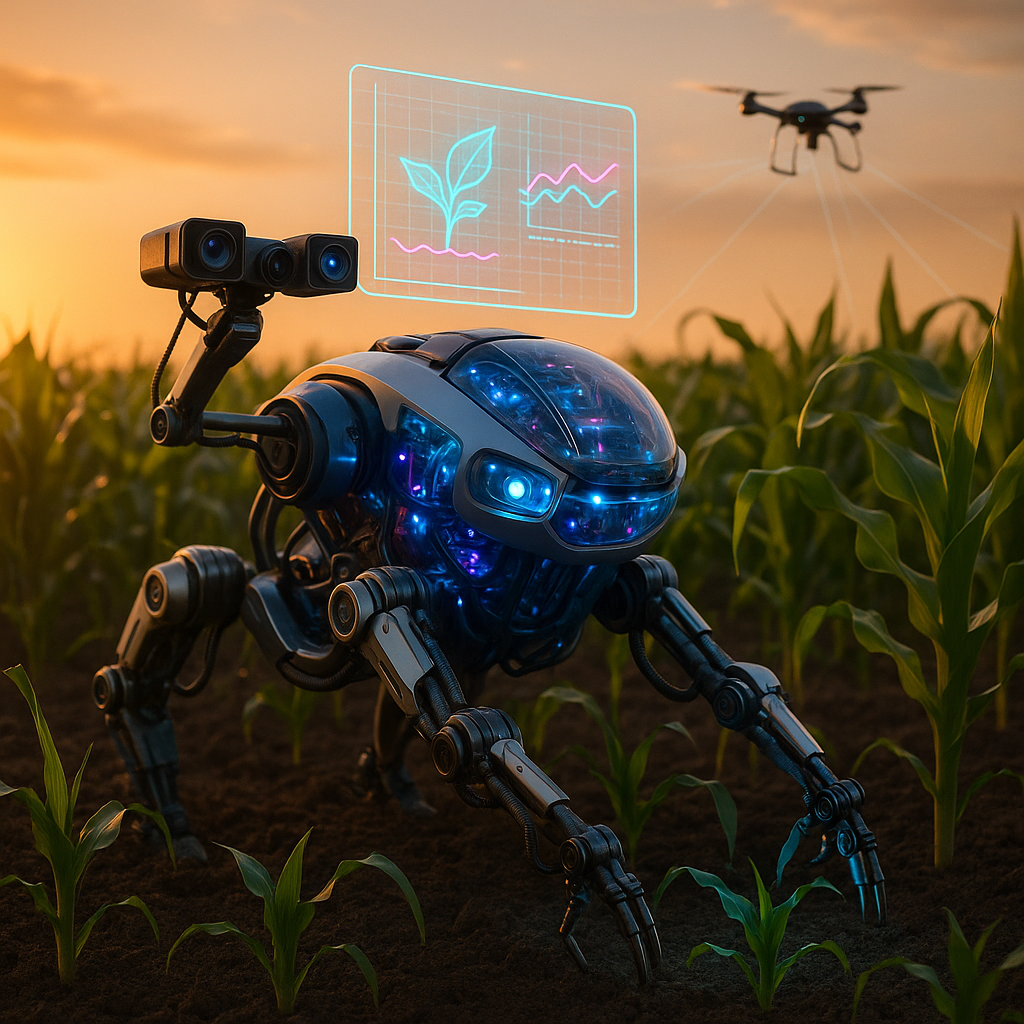
- AI-powered agri-robotics is rapidly transforming precision farming by integrating intelligent machines, data-driven decision-making, and sustainable agricultural practices. At the intersection of robotics, artificial intelligence, and crop science, this field is redefining not only food production but also the way future talent interacts with agriculture.
- Precision reimagined with AI-driven vision and automation: Agri-robots leverage advanced computer vision and machine learning to identify crops, optimize plant spacing, and distinguish between plants and weeds. This enables targeted intervention, drastically reducing chemical use and improving crop care.
- Autonomous navigation unlocks operational efficiency. State-of-the-art navigation systems equip autonomous farm machinery to map and traverse fields with sub-centimeter accuracy. These systems operate continuously, day and night, reducing labor costs and minimizing human error while optimizing resource allocation.
- Seamless integration with traditional equipment drives adaptability. Modern agri-robotics platforms can retrofit or enhance existing tractors and implements. This allows farms to introduce smart technologies without scrapping trusted machinery, forging a practical link between legacy farming methods and technological innovation.
- Data-driven insights empower smarter farm management. With embedded sensors and IoT connectivity, agri-robots collect and transmit real-time environmental, crop, and equipment data. This granular insight enables timely, evidence-based decisions, reducing guesswork and maximizing productivity.
- Eco-friendly impact achieved through ultrafine control. Precise seeding, targeted spraying, and selective weeding by agricultural robots limit input waste, minimize soil compaction, and mitigate ecological harm. These practices promote environmental stewardship while maintaining or even enhancing yield.
- A multidisciplinary frontier sparks new career paths. The revolution in agri-robotics extends beyond machine technology. It merges engineering, agronomy, data science, and policy, opening new educational opportunities and dynamic careers in the emerging landscape of autonomous agriculture.
As autonomous machinery and AI continually advance the frontiers of precision farming, they prompt us to rethink the foundations of agricultural expertise. The following sections delve into the technical underpinnings, practical applications, and the rich interdisciplinary future now taking root in agricultural fields around the globe.
Introduction
Robots distinguishing a weed from a wheat stalk and laboring tirelessly through the night are no longer the realm of science fiction. They are actively redefining the landscape of precision farming. At the convergence of agri-robotics, AI, and advanced machinery, autonomous field machines are revolutionizing crop cultivation, real-time data collection, and on-the-fly decision-making on today’s farms.
The accelerating adoption of AI-powered agricultural robots signals a watershed moment. Farms now achieve sub-centimeter accuracy in field operations, minimize chemical usage through precisely targeted interventions, and inject fresh capability into legacy equipment via seamless integrations. For farmers, scientists, and aspiring innovators, the rise of agri-robotics promises greater efficiency and sustainability as well as an interdisciplinary spectrum of career opportunities.
To understand the depth of this transformation, we’ll explore how these intelligent machines are changing precision farming, from advances in computer vision and autonomous navigation to their eco-friendly ramifications and the convergence of diverse expertise across engineering, crop science, data analytics, and beyond.
Stay Sharp. Stay Ahead.
Join our Telegram Channel for exclusive content, real insights,
engage with us and other members and get access to
insider updates, early news and top insights.
 Join the Channel
Core Technologies in Modern Agri-Robotics
Modern agricultural robotics sits at the intersection of several breakthrough technologies, each adapted to the unique demands of farm environments. The synergy between these innovations enables a new class of systems capable of autonomously performing the complex, delicate, and high-stakes tasks typical of modern agriculture.
Computer Vision and AI-Based Recognition Systems
Core to today’s agri-robotics revolution is advanced computer vision. By combining RGB, infrared, multispectral, and hyperspectral imaging, agri-robots “see” their surroundings in extraordinary detail. Contemporary deep learning models, trained on massive agricultural image datasets, now allow these robots to distinguish between crops and weeds with over 95% accuracy under optimal conditions.
Convolutional neural networks (CNNs) have proven particularly transformative, enabling machines to conduct pixel-level analysis for species differentiation, disease detection, and fruit ripeness assessment. For instance, Blue River Technology‘s See & Spray system utilizes computer vision to identify and treat individual weeds, slashing herbicide usage by up to 90% compared to broadcast spraying.
This technology doesn’t stop at identifying plants. It interprets plant health indicators like chlorophyll levels, water stress, and early signs of pest activity, often detecting threats days before they become visible to humans. Predictive insights allow farmers to manage crops proactively, with controlled studies reporting 7-15% yield improvements through such early interventions.
Applications of AI-powered vision extend across industries. In horticulture, automated vision systems inspect fruits for quality control. In environmental science, similar algorithms track invasive species in forests. In livestock management, image analysis monitors animal health and movement.
Autonomous Navigation and Positioning Technologies
Agri-robotics relies on pinpoint navigation for effective fieldwork. While early models depended on standalone GPS, modern platforms utilize sensor fusion, blending inputs from:
- RTK-GPS for centimeter-level positioning
- Inertial measurement units (IMUs) for orientation and acceleration
- LiDAR technology to build accurate 3D environmental maps
- Ultrasonic sensors for close-range obstacle detection
- Wheel encoders for detailed movement tracking
This comprehensive sensor strategy ensures robust performance even in scenarios where one sensor fails, such as GPS interference or inclement weather. Naïo Technologies, for example, achieves consistent navigation in vineyards with only 2cm deviation, even between tightly planted vines.
Beyond simple point-to-point movement, today’s navigation algorithms include real-time path planning and dynamic obstacle avoidance. Robots recognize and react to unexpected obstacles (fallen branches, animals, or human workers), while maintaining efficiency.
These navigation strategies see wide adoption. Autonomous tractors in large-scale grain operations, drones in precision forestry for mapping tree stands, and robotic lawnmowers in sports turf management all benefit from similar technologies.
Advanced Sensor Networks and IoT Integration
Precision farming demands high-resolution, real-time data. Modern agri-robots operate as mobile sensor hubs, equipped to capture everything from soil composition to microclimate measurements, including:
- Soil moisture levels at various depths
- Electrical conductivity for nutrient mapping
- Multispectral scans for crop health monitoring
- In-field temperature and humidity
- Gas sensors for CO2 and soil respiration
Collected data is transmitted to cloud-based analytics platforms via cellular, satellite, or LoRaWAN networks, where it integrates with historical datasets and predictive models. Farmers receive actionable recommendations for irrigation, fertilization, or crop protection interventions.
Integration with stationary IoT networks further enhances farm intelligence. This networked approach, validated in both research trials and commercial practice, has yielded water savings of 20–30% and fertilizer reductions of 15–25%, while sustaining or boosting crop yields.
Beyond agriculture, networked sensing finds application in environmental monitoring, tracking air and water quality, and in healthcare for large-scale epidemiological studies.
Autonomous Machinery Applications in Agriculture
The intersection of these technologies manifests in diverse, practical solutions across the entire farm lifecycle, from planting through to harvest. Each application marks a significant leap in both productivity and sustainability.
Stay Sharp. Stay Ahead.
Join our Telegram Channel for exclusive content, real insights,
engage with us and other members and get access to
insider updates, early news and top insights.
Join the Channel
Precision Seeding and Planting Systems
Autonomous seeders stand among the most advanced commercial applications of agricultural robotics. Coupling mechanical precision with real-time environmental sensing, these systems deliver:
- Variable seeding depth based on in-field moisture gradients
- Adaptive spacing aligned with granular soil fertility data
- Micro-fertilizer application at each seed point
- Digital field mapping, tracking exactly where each seed is planted
In North America’s grain belts, precision planting platforms have driven stand establishment improvements of 12–18%, with a 15% boost in corn emergence equating to $75–100 more revenue per acre. The economic case is clear, and the practice is rapidly spreading to soybean, cotton, and vegetable crops.
Next-generation systems incorporate individual seed selection, optimizing for microenvironmental variation and further maximizing crop potential. This level of precision, once unthinkable at scale, is fast becoming industry standard.
Outside of grains, autonomous planting finds traction in specialty crops. For example, robotic rice transplanters in East Asia and automated forestry planters for ecosystem restoration.
Weeding and Crop Management Robots
Weed management remains a labor- and chemical-intensive challenge. Autonomous robots provide three primary approaches:
- Micro-dosed chemical application, only where weeds are detected
- Mechanical removal using precisely controlled blades or tines
- Thermal disruption through targeted heat or electricity
FarmWise’s Titan robot mechanically removes weeds with robotic accuracy, replacing large manual crews and reducing herbicide usage by over 95%. For organic farms or crops with tight row spacing like strawberries and lettuce, compact robots from Naio Technologies and Earthsense offer precision interventions previously impossible with traditional equipment, driving cost savings that can reach $1,000 or more per acre.
Other fields see parallel advancements. In forestry, autonomous vehicles clear invasive brush, and in urban landscaping, similar systems maintain parks and public spaces with reduced chemical usage.
Harvesting Robotics for Different Crop Types
Harvest automation presents one of agriculture’s greatest technological hurdles due to each crop’s unique requirements. Nonetheless, rapid progress is being made:
- In row crops (corn, soybeans), autonomous combines from industry leaders like John Deere operate 24/7, achieving efficiency improvements of up to 20%
- In fruit orchards, Root Robotics harvests apples with 85% efficiency while minimizing crop damage
- Advanced Farm Technologies’ strawberry harvesters reach rates approaching 80% of a human crew, offering much-needed solutions for labor shortages
The business case for these machines strengthens as labor costs rise globally, with payback periods for certain robots dropping below four years. These trends are echoed in viticulture (grape harvesting robots), berry picking, and even the greenhouse industry with autonomous cucumber and tomato harvesters.
Drones and Aerial Systems in Precision Agriculture
Aerial robotics supplement work on the ground by providing a bird’s-eye view of large areas and performing interventions unreachable by ground machines. Key uses include:
- Macro-level imaging: Multi-spectral drones identify stress patterns, disease outbreaks, and nutrient deficiencies across extensive fields
- Variable-rate application: Drones equipped for spraying apply crop protection products only where needed, reducing input usage by 30–50%
- Seeding and pollination: Certain drones can distribute cover crops or assist with orchard pollination in response to bee shortages
DJI’s Agras T30 exemplifies this trend, treating up to 40 acres daily with remarkable precision. Integration between aerial and ground platforms, as with American Robotics’ autonomous monitoring solutions, delivers a unified, multi-layered approach to farm management.
The influence of aerial robotics is seen in environmental science for monitoring deforestation, finance for large-scale asset assessment of plantations, and even disaster response by mapping flood-affected farmlands.
Integration with Precision Farming Systems
While the advancements in standalone machines are impressive, the true leap comes from orchestrating robotics within a broader precision farming ecosystem. Integrated platforms combine robotic data streams with static sensor networks, weather data, and cloud-based crop modeling, providing truly holistic management of agricultural environments.
These integrated systems empower farmers and agronomists not only to automate repetitive labor but to anticipate challenges, adapt strategies on the fly, and optimize resource use for both economic and environmental benefit. Platforms designed for compatibility with existing equipment, such as John Deere’s retrofit kits, ease technology adoption, while open data frameworks foster cross-vendor integration and innovation.
Importantly, similar approaches are emerging in industries like healthcare (where surgical robots integrate with hospital data systems) and logistics (with warehouse robots tied to inventory and supply chain software), illustrating the far-reaching potential of unified automation and analytics.
logistics and supply chain optimization
Conclusion
The transformation of global agriculture through robotics and intelligent automation is not on the distant horizon. It is already harvesting real-world results across a variety of fields, from staple crops to specialty produce and beyond. Advances in computer vision, sensor integration, and autonomous machinery are ushering in a new standard, one where every action on the farm can be uniquely calibrated to the precise needs of that plot on that day.
Yet, efficiency gains and reduced input use are only the beginning. The greater promise of agri-robotics lies in building interconnected networks. Ground-based machines, aerial drones, and IoT sensors work in concert, and insights flow seamlessly from field to cloud to decision-maker. With this holistic intelligence, farmers can achieve greater resilience, produce healthier crops, and manage resources more responsibly.
Technological adoption, however, requires more than investment in machines. It demands a new synthesis of expertise across engineering, agronomy, data science, policy, and education. This boundary-crossing frontier creates opportunities not only for productivity gains but for reimagining what agricultural expertise means in the digital age.
Looking forward, the future of farming belongs to those prepared to leverage both human insight and machine intelligence. Agricultural leaders who cultivate adaptability, foster interdisciplinary skills, and champion data-driven stewardship will shape the food systems of tomorrow. Whether through advanced robotics, cross-sector collaboration, or a relentless curiosity at the edge of possibility, the real challenge is not whether you will adapt, but how boldly and thoughtfully you will lead in this age where alien minds are helping to shape our shared human world.




Leave a Reply