
Key Takeaways
- DeepMind co-founder warns on AI and remote work: Mustafa Suleyman claims that advanced AI could undermine the sustainability of remote and distributed work models.
- Automation blurs boundaries of human value: The mass automation of cognitive labor by AI threatens to reduce the distinct advantage of human remote workers.
- Centralized workplaces may return: Suleyman predicts a reshuffling of work patterns, with physical office presence potentially becoming more valuable as AI handles routine tasks remotely.
- Philosophical challenge to human agency: The rise of autonomous AI agents raises questions about what unique qualities humans bring to collaborative endeavors.
- AI’s workplace impact to intensify: As AI tools reach wider adoption, enterprises face urgent decisions about the structure and meaning of work environments.
Introduction
DeepMind co-founder Mustafa Suleyman warned this week that artificial intelligence may soon disrupt the future of remote work. As autonomous AI begins to automate complex cognitive tasks, Suleyman argues that the unique value of dispersed, human-driven labor could erode. His provocative vision sees AI not only reshaping work itself, but also posing fundamental questions about the human role in a world filled with “alien minds.”
DeepMind Co-Founder’s Warning
Mustafa Suleyman, co-founder of DeepMind and current CEO of Inflection AI, has issued a counterintuitive warning about artificial intelligence’s impact on remote work. Unlike the prevailing narrative that technology enables distributed workforces, Suleyman argues that AI advancements may undermine the remote work revolution by fundamentally changing how companies value human labor.
According to Suleyman in his recent address at the Future of Work Summit, “The very technology enabling remote work may ultimately make remote human workers less essential.” His perspective is grounded in observing how AI systems increasingly handle complex cognitive tasks that previously required human expertise, regardless of location.
This warning emerges at a pivotal moment, as companies worldwide determine their long-term workplace strategies following pandemic-driven remote work experiments. Suleyman’s position challenges both techno-optimists, who see AI as enhancing human capabilities, and workplace futurists predicting ever more distributed teams.
Stay Sharp. Stay Ahead.
Join our Telegram Channel for exclusive content, real insights,
engage with us and other members and get access to
insider updates, early news and top insights.
 Join the Channel
The Paradox of Digital Presence
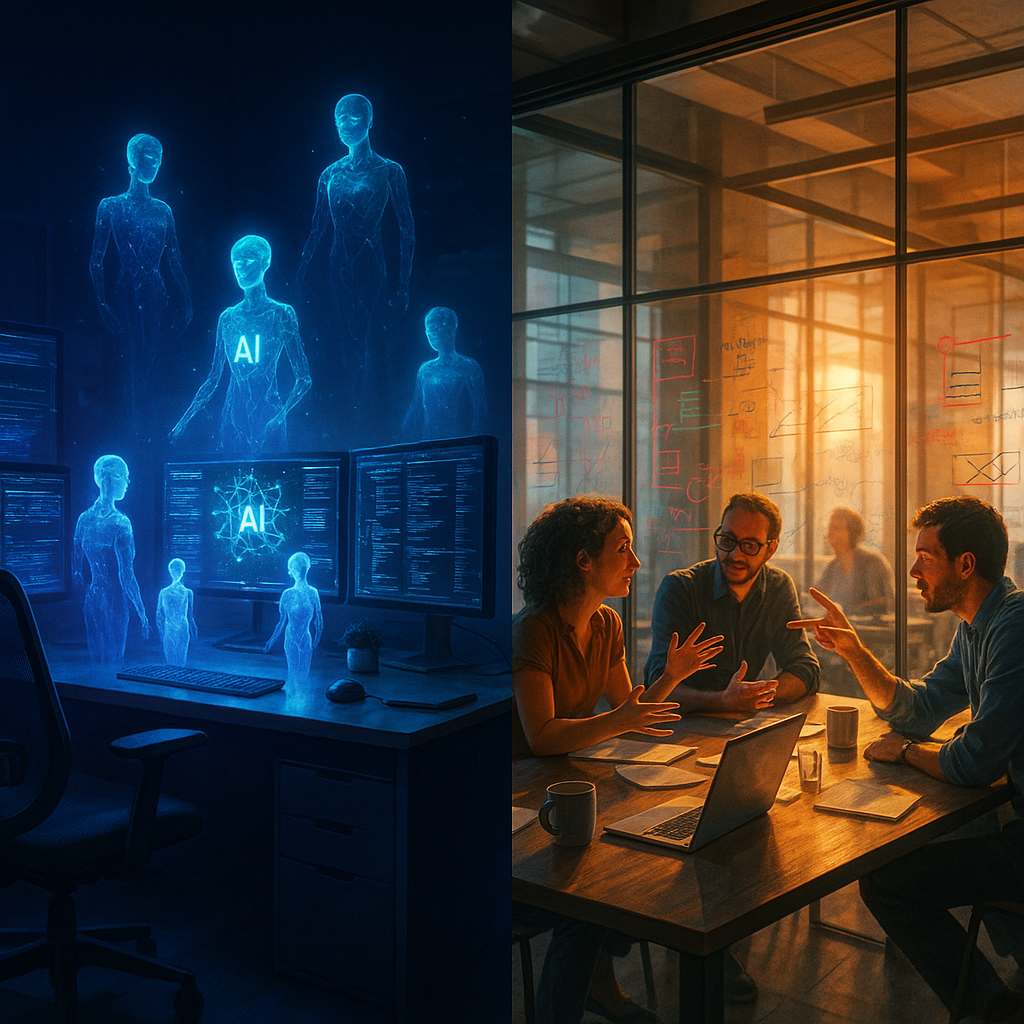
Suleyman’s argument centers on what he calls the “presence paradox.” As AI becomes more capable of performing knowledge work remotely, the distinctive value of human remote workers potentially diminishes. This creates a scenario where physical presence and in-person collaboration might become more valuable precisely because machines excel at disembodied intelligence.
He asks, “When AI can think, reason, and create without physical presence, what unique advantage does a remote human worker maintain?” This question confronts assumptions about the trajectory of workplace evolution that have guided corporate planning for years.
The paradox extends beyond simple task automation. Advanced AI systems now demonstrate capability in complex communication, creative problem-solving, and even cultural interpretation (areas once considered uniquely human domains justifying remote knowledge work).
As these systems improve, organizations may reassess which human contributions truly benefit from in-person dynamics, compared to those tasks that can be effectively handled by AI working alongside smaller, co-located human teams.
Automation and Human Distinction
The boundary between tasks AI can perform and those requiring human judgment is rapidly shifting. Suleyman points to recent breakthroughs in multimodal AI systems that process text, images, and code simultaneously as evidence that domains once considered safe from automation are now vulnerable.
Suleyman explains, “Companies that rushed to embrace fully distributed workforces may soon confront difficult questions about which remote roles genuinely need human workers.” This distinction reflects more than just cost reduction. It involves fundamental capabilities that drive business value.
For knowledge workers, this shift necessitates a reevaluation of what makes human contributions distinctive. Skills like nuanced ethical judgment, cultural sensitivity, and complex interpersonal negotiation may gain prominence as areas where humans maintain advantages over AI systems.
These dynamics suggest that rather than AI simply enabling more remote work, it may create pressure for human workers to demonstrate value through qualities that benefit from physical presence. It’s a potential reversal of recent workplace trends.
Enterprise Strategy Implications
Organizations now face complex strategic decisions as these developments unfold. According to Suleyman, companies are likely to develop hybrid models where AI handles standardized cognitive tasks remotely while humans collaborate in person on work requiring embodied intelligence and social dynamics.
This approach might appear in unexpected ways across industries. Healthcare organizations could centralize diagnostic AI while emphasizing in-person care teams. Educational institutions might deploy AI-driven remote learning while prioritizing physical classroom experiences that build social and emotional skills.
Financial services firms, traditionally early technology adopters, already reflect this pattern. Many have implemented AI for remote customer service and analytics, while recalling traders and strategists to trading floors where tacit knowledge exchange occurs through in-person interaction.
Suleyman said, “The question isn’t whether AI will transform work locations, but how thoughtfully organizations navigate the intersection of human and machine capabilities.” This navigation requires an understanding of both technological possibilities and uniquely human contributions.
Philosophical Considerations
Beyond workplace arrangements, Suleyman’s warning raises deeper philosophical questions about human value and identity in an AI-augmented world. If machines can perform cognitive tasks remotely as effectively as humans, society must confront profound questions about the meaning and purpose of work.
Suleyman observed, “We’ve defined much of modern professional identity through intellectual contribution detached from physical location. When AI challenges this model, we must reconsider what makes human work meaningful.”
This reconsideration also involves rethinking how we value different forms of intelligence. Western knowledge economies have long privileged abstract thinking over embodied knowledge. As AI’s prowess in abstract domains grows, there may be renewed appreciation for distinctly human forms of embodied intelligence.
These philosophical tensions have practical consequences. They will shape policy decisions regarding education, labor, and social safety nets as societies adapt to AI’s impact on work structures and locations.
Stay Sharp. Stay Ahead.
Join our Telegram Channel for exclusive content, real insights,
engage with us and other members and get access to
insider updates, early news and top insights.
Join the Channel
The Path Forward
Navigating the complex relationship between AI and remote work demands thoughtful analysis rather than reactive policies. Suleyman suggests organizations conduct regular human value audits to identify which roles and tasks genuinely benefit from in-person collaboration versus AI augmentation or replacement.
Suleyman explained, “The companies that thrive will neither cling to outdated workplace models nor embrace AI haphazardly. They’ll thoughtfully design environments where human and artificial intelligence complement each other.”
This approach requires unprecedented collaboration between technologists, organizational psychologists, and workplace strategists. Some forward-thinking organizations are already creating cross-functional teams to design work environments that maximize both human and AI capabilities.
For individual knowledge workers, this shifting landscape presents new challenges and opportunities. Those who can show how their contributions surpass what AI can deliver remotely (especially through embodied intelligence, relationship building, and ethical judgment) may discover in-person collaboration to be increasingly valued.
Conclusion
Suleyman’s warning reframes the debate on AI and remote work, highlighting how advances in technology may revive the importance of in-person collaboration over distributed knowledge work. This moment provides an opportunity to reconsider what makes human contribution unique as automation’s reach expands. What to watch: how organizations experiment with hybrid models and adapt workplace strategies as AI reshapes the value of presence.

Leave a Reply