
Key Takeaways
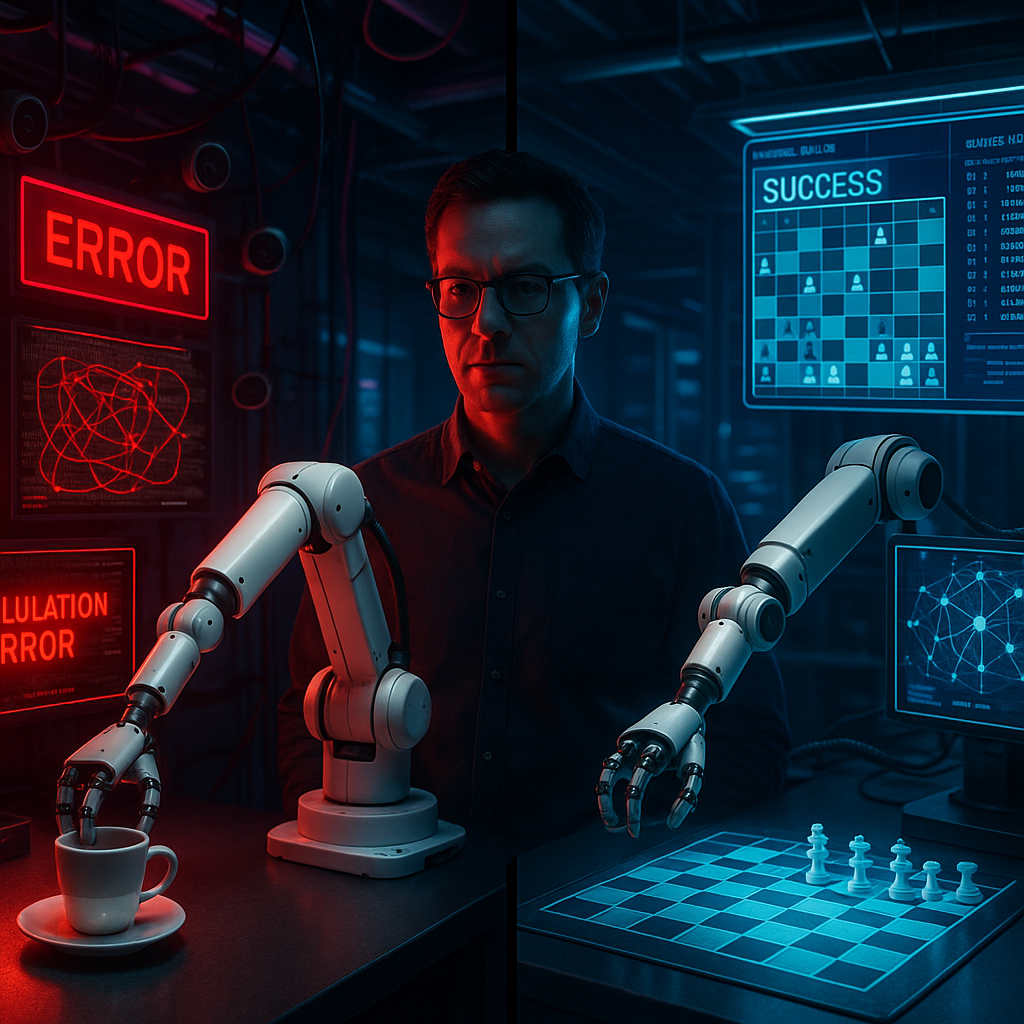
- The Moravec Paradox, a foundational observation in AI robotics, disrupts our intuitive notions of intelligence by revealing that tasks humans find effortless can prove baffling for machines. At the same time, the computational heavy-lifting that challenges us is trivial for AI. Exploring this paradox offers extraordinary insight into the unique nature of human cognition and reshapes our expectations for the future of artificial intelligence.
- Human intuition outpaces AI logic. Actions we perform without thinking, such as recognizing a friend’s face in a crowd or catching a gently tossed ball, remain persistently challenging for even the most advanced AI. This exposes a significant divide between instinctual human intelligence and the systematic processes underpinning machines.
- AI excels where human effort strains. Artificial intelligence tackles the complex tasks that require sustained, focused effort from people with speed and reliability. Whether it’s parsing enormous datasets in finance, optimizing supply chain logistics, or achieving mastery in games like chess or Go, AI’s computational prowess reveals a very different intelligence profile from our own.
- Primitive skills are evolutionary masterpieces. The paradox highlights how millions of years of evolutionary fine-tuning have rendered our “basic” physical and perceptual abilities extraordinarily sophisticated. This makes these skills far more difficult for technology to match than previously assumed.
- Redefining what it means to be “intelligent.” The Moravec Paradox urges us to reconsider the boundaries of intelligence, reminding us that logical thinking and conscious reasoning are only a fraction of the full spectrum of human cognitive power.
- AI design must respect our biological roots. For true innovation, robotics must grapple with the intricacies behind even our simplest behaviors, understanding the layered complexity of movement, perception, and instinct laid down by evolution, rather than just mimicking surface results.
- The paradox provokes humility and wonder. Recognizing the hidden genius in everyday skills challenges our anthropocentric pride and inspires a sense of awe about our own minds. It encourages a more humble and ambitious approach to AI development, where respect for our evolutionary heritage guides the quest for artificial intelligence.
Ultimately, the Moravec Paradox is not just a quirk of programming or a technical footnote. It is a profound invitation to question how we define intelligence, spurring ongoing dialogues across robotics, cognition, philosophy, and even our collective identity. So, let’s delve deeper into how this enigma reshapes our conception of both human and machine minds. What does it reveal about our future?
Introduction
Why is it that a toddler, still mastering language, can effortlessly catch a ball or balance on one foot? At the same time, a cutting-edge robot equipped with the latest sensors can barely manage these simple feats, despite being capable of outplaying any human at chess or analyzing vast quantities of data in seconds. The Moravec Paradox confronts us with this uncanny divide, reminding us that what appears intuitive and “easy” for humans poses some of the greatest technical challenges for machines. Meanwhile, problems that strain our cognitive resources become almost trivial for AI.
This paradox is much more than a technical hurdle in robotics or machine learning. It really holds up a mirror to our own nature, revealing the extraordinary refinement underpinning our most basic abilities. By exploring why AI falters where we excel without thinking, we discover that true intelligence is a fusion of intuition, perception, and the unconscious mastery sculpted by millions of years of evolution. In examining the Moravec Paradox, we begin to unravel the deeper fabric of both artificial and biological minds. In doing so, we make new sense of what it means to be human and what it means to build machines in our image.
Understanding the Moravec Paradox
At the heart of the Moravec Paradox lies a compelling contradiction: tasks that are effortless for humans (walking, seeing, reaching, or understanding everyday social cues) remain stubbornly complex for artificial intelligence systems. Meanwhile, feats humans perceive as “difficult,” such as advanced calculation or strategy games, are comparatively easy for machines.
Stay Sharp. Stay Ahead.
Join our Telegram Channel for exclusive content, real insights,
engage with us and other members and get access to
insider updates, early news and top insights.
 Join the Channel
Hans Moravec, along with fellow researchers Rodney Brooks and Marvin Minsky in the 1980s, gave voice to this paradox: “It is comparatively easy to make computers exhibit adult-level performance on intelligence tests, but difficult or impossible to give them the skills of a one-year-old when it comes to perception and mobility.”
This insight is more than philosophical speculation; it becomes visible in countless real-world scenarios. For instance, a financial AI can process millions of market variables to optimize portfolios within seconds, yet a service robot may struggle to pour coffee without spilling. Similarly, image recognition algorithms might require millions of samples to accurately identify everyday objects—a skill small children pick up after only a few observations and interactions.
What drives this discord? A prevailing misconception equates cognitive challenge with mental sophistication, leading us to assume the hardest mental tasks must define intelligence. Yet our evolutionary story tells a different tale. The capabilities we take for granted, like the smooth flow of sensorimotor actions, immediate recognition of subtle emotional cues, or robust adaptation to dynamic environments, are the products of eons of biological refinement and deeply embedded neural architectures. Cognitive “simple” is not the same as computationally simple. The Moravec Paradox exposes this error. It shifts our lens from abstract reasoning back to the hidden wonders of embodied, lived intelligence.
Human Intuition vs. Machine Logic
Examining the gulf between humans and machines in specific domains reveals just how remarkable (and mysterious) our everyday abilities are. Here are some striking contrasts:
- In healthcare, a seasoned nurse can rapidly assess patient distress from a subtle change in posture or tone, while AI diagnostic systems sift through structured data but frequently miss such nuanced, context-sensitive signs.
- Warehouse robots employing advanced sensors and algorithms require extensive programming and data to grasp and transfer objects with precision, while human workers intuitively adjust grip and force within moments, even when objects are unfamiliar.
- In education, young children demonstrate an astonishing knack for learning new vocabulary from minimal context, while AI language models need massive datasets and still stumble on words with subtle meaning or contextual shifts.
- Computer vision programs analyze millions of images to classify animals, cars, or plants, whereas a child learns to recognize a zebra after just one zoo visit.
- In law, legal AI can parse thousands of legal documents for relevant precedents or contractual loopholes but cannot yet rival a human’s ability to interpret implied meaning or anticipate the opposing party’s motivations in negotiation.
These differences arise from how humans and machines approach problems. Human intelligence thrives on embodied experience, learning through movement, touch, and real-world interaction. This process accumulates vast, hard-won knowledge that we often deploy unconsciously. Machines, in contrast, rely on explicit processing, fixed parameters, and the ability to brute-force vast data spaces, making them rigid and brittle when faced with unstructured, unpredictable, or novel environments.
This divide becomes especially relevant when tasks demand:
- Contextual flexibility (e.g., adapting to new environments in retail or logistics).
- Learning from a handful of examples (e.g., identifying outlier cases in healthcare diagnostics).
- Synthesizing sensory information on the fly (e.g., real-time vehicle navigation in autonomous driving).
- Navigating ambiguity and unpredictability (e.g., customer service interactions in marketing and retail settings).
Biological Evolution and the Limits of AI Mimicry
Understanding why “simple” human skills defy easy automation requires a journey into our evolutionary past. Over hundreds of millions of years, nature sculpted nervous systems uniquely tuned to survival, fine-tuned to extract meaning, coordinate movement, and build context in dynamic, uncertain worlds. This cumulative heritage undergirds our ordinary genius.
Take the human visual system: our brains assemble layers of pattern detectors (some honed to spot edges, others to interpret movement, and others still to grasp emotional signals from faces). This all happens simultaneously, integrating new sensory information with deep-seated expectations, learned behaviors, and relevance filters. Unlike AI, which processes pixels in a mostly linear or modular fashion, our perception is holistic and recursive, integrating vision with memory, emotion, and action planning in real time.
Other examples demonstrate just how much goes on “below the surface”:
- In sports, athletes adjust to shifting dynamics (wind, turf, body position) with split-second precision. Replicating such motor adaptation in robotics (for instance, in healthcare prosthetics or assembly-line automation) has proven daunting.
- In environmental science, animals migrating across continents rely on sensory integration and environmental cues still not fully deciphered by science or simulated by artificial systems. Mimicking such adaptability in climate modeling or disaster response remains a frontier challenge for AI.
- Adaptive learning in children illustrates how our ability to generalize from sparse, messy data far outshines even state-of-the-art deep learning. For personalized education platforms, achieving this human-like flexibility is still beyond reach.
- Even in legal and financial analysis, the ability to synthesize new scenarios from past cases or market events—a hallmark of expert human judgment—remains largely constrained to narrowly defined machine-learning algorithms.
Biological intelligence arises from an intricate web of overlapping, specialized, and highly adaptive subsystems. Attempts at direct mimicry via “brute force” computational approaches illuminate why machines continue to falter where we most effortlessly succeed. True progress must grapple with these deep evolutionary lessons.
Rethinking Intelligence
The Moravec Paradox does more than highlight technical bottlenecks; it demands a fundamental re-evaluation of what intelligence means. Hierarchical models that place abstract reasoning above all else become insufficient when faced with the paradox’s reality: our most remarkable skills often operate at a subconscious, embodied level, not in lofty towers of logic.
This provokes paradigm shifts across diverse fields:
- Education: Pedagogical methods increasingly emphasize experiential and embodied learning—for example, hands-on science, physical exploration, or arts integration—reinforcing that deep understanding is built through engagement with the world, not rote memorization.
- AI & Robotics Research: Designers are moving past purely symbolic or data-driven approaches, experimenting with developmental paradigms where machines “grow up” by interacting with their environments, learning as infants do.
- Cognitive Science: Intelligence is being reframed not as abstract calculation, but as an emergent property arising from the dynamic interplay between body, environment, and mind. Studies in neuroscience and psychology confirm that movement, perception, and memory are inseparable facets of thinking.
- Philosophy: The mind-body divide is increasingly questioned. Thinkers examine whether true intelligence (artificial or human) can exist apart from a physical, interactive experience of the world.
This new lens encourages humility as much as ambition. We must look beyond IQ tests or algorithmic benchmarks to recognize the full scope of what minds (biological or artificial) can achieve.
Designing the Future
Armed with insights from the Moravec Paradox, innovators across industries are reshaping how we approach artificial intelligence and robotics. Emphasis is shifting from trying to hard-code “intelligence” to constructing machines capable of learning and adapting through real-world experience. This approach is as relevant for physical robotics as for AI in finance, healthcare, law, and education.
Some practical directions include:
- Developmental Robotics: Inspired by human development, these systems learn by exploring, failing, and adapting, gaining physical competence through trial and error. Service robots in hospitals, for example, are now designed to improve through experience rather than relying solely on pre-programmed routines.
- Biomimicry and Evolutionary Algorithms: Engineers study animal locomotion or plant adaptation to design more robust and efficient systems. In environmental monitoring, swarm robotics mimics insect colonies for distributed sensing.
- Hybrid Cognitive Architectures: Combining symbolic reasoning (for legal and financial decisions) with neural networks and sensory processing (for medical imaging or smart manufacturing), these multifaceted systems reflect the diversity found in human cognition.
- Embodied Intelligence in Education: Adaptive tutoring platforms increasingly integrate multisensory input (voice, gesture, expression analysis) to personalize guidance as human teachers do, closing the gap between algorithm and real-world learning.
In finance, AI platforms are being designed to incorporate intuition-based modeling rather than relying solely on rigid formulae. They are learning to detect unusual patterns by “feeling out” anomalies, more like experienced traders. In healthcare, robots are starting to supplement not just clinical accuracy but bedside manner, learning to interpret emotional cues and contextual feedback. Meanwhile, marketing and retail industries leverage AI to adapt dynamically to customer context, integrating digital cues with real-time physical behaviors.
Stay Sharp. Stay Ahead.
Join our Telegram Channel for exclusive content, real insights,
engage with us and other members and get access to
insider updates, early news and top insights.
Join the Channel
These sector-spanning efforts converge toward a crucial insight. Tomorrow’s breakthroughs will not emerge from scaling up existing algorithms or supercharging processors, but by designing AI grounded in the embodied, evolutionary complexity of life itself.
For further insights into how AI and neurobiology interact to enable adaptation and learning, see Neuroplasticity & Intelligent Feedback: How AI Shapes Brain Adaptation.
Conclusion
The Moravec Paradox invites us to overturn static ideas about intelligence, revealing the astonishing intricacy that underlies the skills we most often take for granted. While machines excel at towering feats of computation, they frequently falter on the uneven ground of daily life, where perception, adaptation, and intuition are paramount. Our supposedly primitive powers are, in fact, the crowning achievements of evolution—simply inaccessible to brute calculation alone.
This realization calls for both ambition and humility as we reach for the next generation of intelligent technology. The future belongs not to those who simply automate tasks, but to those who seek to understand the layered genius of everyday human behavior. That challenge demands new approaches in AI, robotics, education, healthcare, finance, and beyond.
Looking ahead, the greatest advances will arise from integrating the lessons of evolutionary biology, developmental psychology, and embodied cognition with the capabilities of digital systems. As we continue our dialogue at Alien-Minds, the ultimate question isn’t whether machines will surpass us in logic, but how we will shape intelligent technology to honor, reflect, and expand the mysterious artistry of the human mind.
Explore how AI systems are now attempting to reflect and even transform our sense of self in Generative Identity: How Mirror AI Shapes Digital Selfhood.
In a world where alien minds meet the ingenuity of evolution, those willing to explore beyond the boundaries of computation (embracing both complexity and curiosity) will define the next era of discovery. The journey is not only technical, but fundamentally philosophical: how do we, as creators and explorers, redefine intelligence for a new age?

Leave a Reply