
Key Takeaways
- AI-generated content dominates online spaces: Algorithm-produced articles, images, and videos now outpace human-created material on major platforms.
- Quality assurance faces new challenges: Tech companies and publishers struggle to detect inaccuracies, bias, and manipulation in AI outputs.
- Public trust in digital information declines: Audiences are more skeptical of the authenticity of online content, complicating the search for reliable knowledge.
- Detection tools lag behind AI advances: Moderation and vetting systems are often outpaced by evolving generative models.
- Calls for ethical and educational responses: Experts advocate for critical thinking initiatives and clear content labeling to promote discerning engagement.
- Policy debates intensify: Regulatory bodies and industry leaders are preparing to set standards and consider legislative action for responsible AI-generated content.
Introduction
A surge of AI-generated content is reshaping the internet, rapidly surpassing human-created material across platforms. As algorithm-driven text, images, and videos flood screens worldwide, established systems for ensuring quality and trust struggle to keep pace. This new information landscape compels technologists, publishers, and audiences to reconsider how knowledge is built and authenticated in a world where the line between authentic and artificial blurs.
AI-Generated Content: The New Digital Majority
AI-generated content has swiftly moved from niche experimentation to a pervasive digital phenomenon, fundamentally altering how information circulates online. By 2024, estimates indicate that more than 30% of written content online will involve AI, whether for editing, ideation, or full-content creation.
This shift is not limited to text. Visual content generation tools such as Midjourney and DALL-E produce millions of images each day, filling websites, advertisements, and social feeds. At the same time, advances in synthetic audio and video have led to lifelike deepfakes and AI-generated presenters, which further blur the boundaries between real and artificial media.
Widespread access to these tools has dramatically lowered the barriers to content creation. Small businesses generate marketing materials without agencies, students write essays with minimal effort, and non-programmers develop complex digital applications through natural language. While this accessibility has fueled productivity, it also raises new questions about what constitutes authenticity and value in digital content.
Stay Sharp. Stay Ahead.
Join our Telegram Channel for exclusive content, real insights,
engage with us and other members and get access to
insider updates, early news and top insights.
 Join the Channel
Erosion of Trust and the Quality Challenge
The growth of AI-generated content presents a fundamental dilemma. As convincing content becomes easier to create, the challenge of discerning truth from fabrication increases. Traditional credibility signals (such as production quality, coherent writing, or detailed knowledge) no longer reliably signify human authorship or accuracy.
AI systems often produce content that looks authoritative but may lack genuine insight or original thinking. Dr. Elena Rodriguez, a digital ethics researcher at Oxford University, observed that we are seeing “the rise of plausible but hollow content.” Text that reads smoothly but, on closer inspection, repeats information or lacks substantive value.
This issue extends beyond deliberate misinformation to what some experts refer to as “unintentional falsehoods.” AI models can confidently present outdated or incorrect information due to their data limitations. Such subtle inaccuracies risk contaminating even credible information channels, gradually undermining the collective knowledge base.
Market forces compound the problem. Platforms and marketers prioritize content volume and engagement metrics over verification, while search engines struggle to distinguish deep insights from well-crafted simulations. The result is a digital marketplace where quantity often eclipses authentic quality and original thought.
Detection Technologies: Navigating a Technical Arms Race
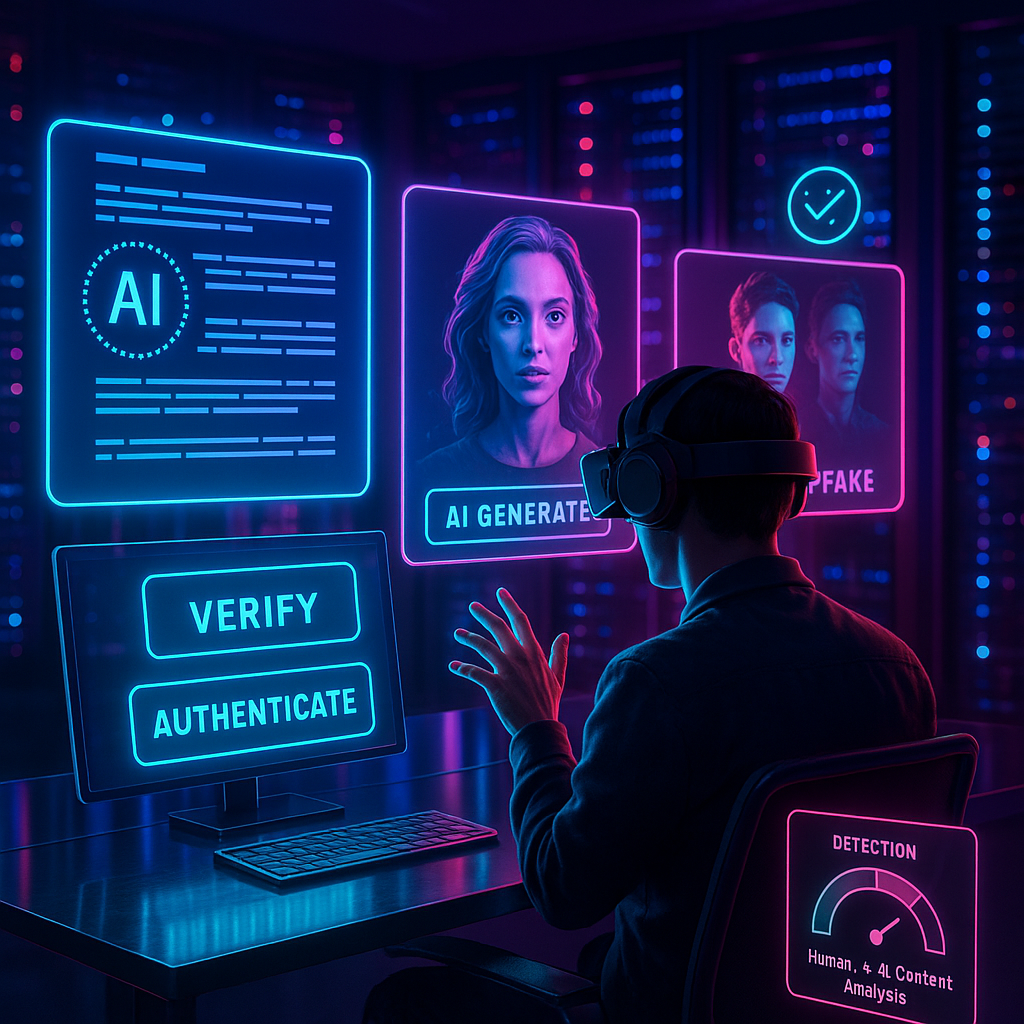
Detection technologies have become a frontline defense against synthetic content, but they are often locked in a constant game of catch-up. Tools analyze linguistic traits, contextual clues, and statistical oddities to tell human and AI-generated text apart. Yet with each improvement in detection methods, generative models adapt, mimicking human quirks more convincingly.
Beyond technical ability lies a philosophical puzzle. As AI systems improve, the distinctions between human and AI communication become harder to draw and, at times, may lose practical meaning. Dr. James Liu, a computer scientist at MIT, pointed out that the boundary between “human-like” and “human” communication can become so fine it is nearly invisible.
Technological countermeasures abound. Some content creators intentionally insert human-like inconsistencies to bypass detection, while hybrid workflows blend AI and human editing to obscure origins. These trends signal that technical solutions alone cannot resolve the challenges of synthetic content.
Innovative strategies expand beyond simple detection. Initiatives like the Coalition for Content Provenance and Authenticity (C2PA) seek to embed traceable metadata into content creation, while watermarking techniques aim to tag AI outputs at their source. However, each approach introduces its own set of technical and practical limitations.
Human Response: Adaptation and New Literacies
Educational institutions increasingly recognize that information literacy must evolve in the era of AI-generated content. Universities worldwide, including Stanford and Singapore National University, are integrating “AI literacy” into their core teaching, helping students assess not only factual accuracy but also the likelihood of synthetic origin and potential algorithmic bias.
Communities have crafted grassroots approaches, combining technology with human judgment. Journalists now use collaborative verification networks that blend technical tools and subject-matter expertise. Maria Chen, founder of the Digital Verification Collective, emphasized that “the most effective approaches combine technological literacy with deep subject expertise.”
Professional adaptation is widespread. Lawyers and doctors are revising verification protocols, and creative professionals are developing attribution standards to distinguish human, assisted, and fully automated works. These shifts suggest a broader societal learning curve rather than a purely technical solution.
A less explored but vital dimension is the psychological toll. Research indicates that constant skepticism may lead to “AI skepticism fatigue,” causing either relentless doubt or resigned acceptance of all information sources. Creating sustainable strategies for verification is thus as much a psychological challenge as a technical one.
Ethics, Standards, and Accountability
The ethical terrain of AI-generated content remains fragmented, with various perspectives vying for prominence. Transparency advocates argue for required disclosure of AI involvement, framing it as a basic right for audiences interacting with digital content. Dr. Aisha Johnson, digital ethics professor at UC Berkeley, has stated that disclosure serves to preserve human agency as well as prevent deception.
However, critics warn that focusing strictly on origins (rather than merit) can reinforce biases. Research suggests that audiences sometimes discount quality work solely because it is AI-generated, a phenomenon known as “AI prejudice.” This raises concerns about whether mandatory labeling could occasionally undermine fair appraisal.
Regulatory approaches are inconsistent across regions. The European Union’s AI Act addresses synthetic content explicitly, while the United States has adopted more targeted policies, focusing especially on high-risk sectors like finance and politics. Meanwhile, voluntary industry standards vary widely in their adoption and enforcement.
Accountability remains a thorny issue in an environment where content generation involves many actors and technical layers. Harmful outputs can trace back to developers, platform operators, or end users, complicating the question of responsibility. These gaps in accountability have prompted calls for systemic regulations that address the entire content supply chain, not just individual creators.
Stay Sharp. Stay Ahead.
Join our Telegram Channel for exclusive content, real insights,
engage with us and other members and get access to
insider updates, early news and top insights.
Join the Channel
Imagining the Future: Beyond Detection and Regulation
Looking ahead, the future of digital content will likely involve deeper integration between human and synthetic creation rather than clean separations. Some envision “content provenance ecosystems,” where all artifacts carry transparent creation records, allowing audiences to make informed choices without blocking or marginalizing AI-generated work. This model acknowledges that human-AI collaboration will underpin most future content production.
New philosophical questions surface about the meaning of authenticity itself. History shows that previous media innovations (from writing to photography) eventually led societies to redefine what counts as “real” or “authentic.” Philosopher Dr. Robert Zhang suggested that we may not be witnessing the end of authenticity but its ongoing evolution, as societies devise new standards for interpreting technologically mediated communication.
Legal and cultural norms are also being reimagined. Courts and legislators worldwide are negotiating issues of copyright and authorship when AI systems trained on human work generate new creations. The tension between long-established concepts of intellectual property and new forms of human-machine collaboration is reshaping ideas about creativity and ownership.
Ultimately, the most significant implication may involve our relationship to knowledge itself. As AI-generated content grows more sophisticated, concerns arise about how to protect space for genuinely human insight, empathy, and creative judgment. The challenge for society is to clarify which human qualities remain most crucial (whether intuition, moral reasoning, or lived experience) and to ensure these traits have an enduring role as artificial intelligence advances.
Conclusion
The spread of AI-generated content is redefining authenticity and fueling both progress and uncertainty in our digital knowledge landscape. Adapting to this era demands new norms of provenance, literacy, and accountability as human insight becomes increasingly interwoven with algorithmic creativity. What to watch: ongoing policy debates and the implementation of provenance standards as pressure mounts for greater transparency.


Leave a Reply