
Key Takeaways
- AI chip demand is causing global shortages of critical memory components like DRAM and NAND flash.
- Device prices are rising worldwide as memory costs increase and supply remains tight.
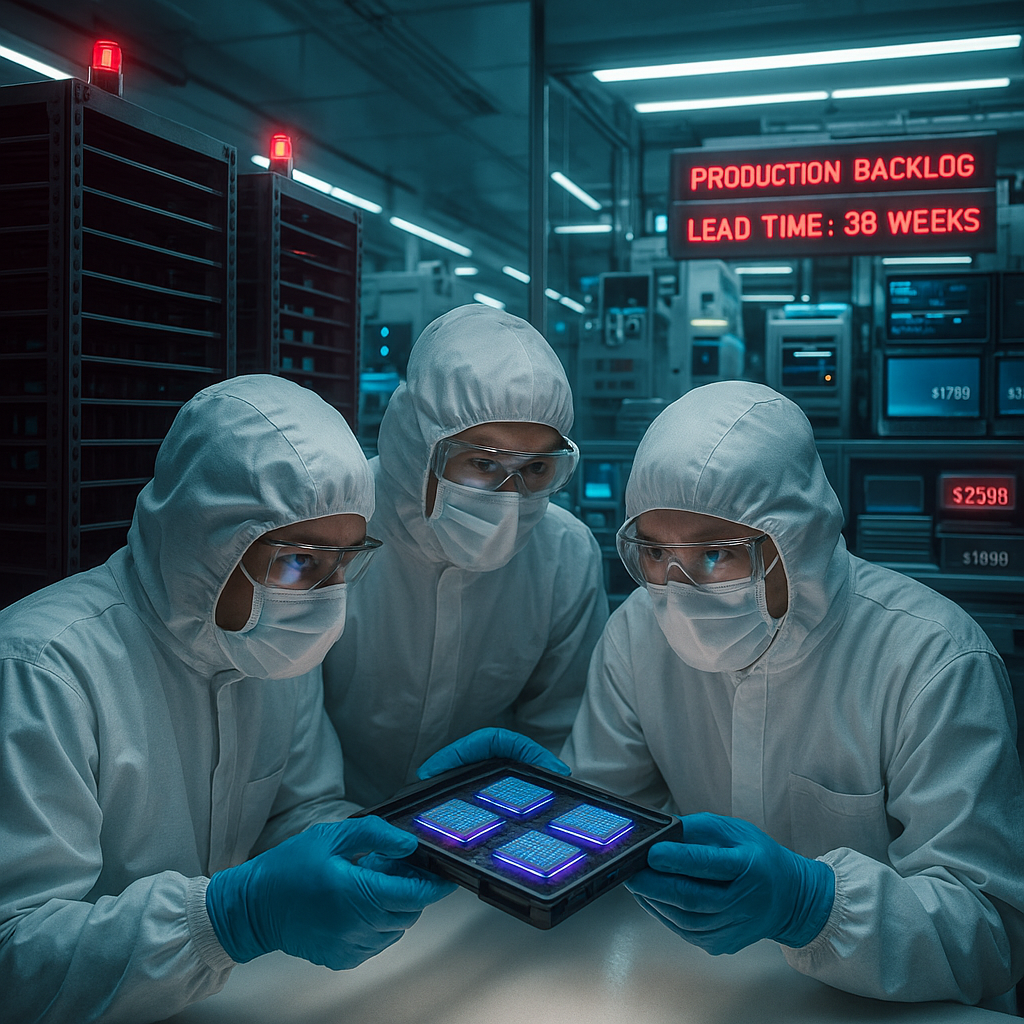
- Production delays are escalating, with device makers reporting longer lead times and potential slowdowns in innovation.
- Smaller companies and academic researchers face greater challenges obtaining affordable hardware, increasing centralization in AI development.
- Major memory manufacturers are investing billions in new factories, but significant supply relief is not expected until late 2025.
- The hardware scramble raises deeper questions about power and equity in the evolving AI landscape.
Introduction
A global surge in demand for AI chips is rapidly depleting memory supplies and driving device costs higher in 2024. Technology giants’ appetite for faster, smarter hardware is resounding through markets from Silicon Valley to Seoul. As price hikes, production delays, and access barriers redefine the sector, the race for memory chips forces a broader reckoning over who directs and who truly benefits from the age of intelligent machines.
The AI Chip Surge and the Great Memory Shortage
High-bandwidth memory (HBM) and specialized DRAM are in critically short supply as demand for AI accelerator chips surged by 340% in the first half of 2024, according to TrendForce. Modern AI processors like NVIDIA’s H100 require as much as six times more high-performance memory than their predecessors, causing unprecedented strain on global memory production.
Manufacturers are struggling to adapt quickly enough. Lead times for HBM orders have increased to over 38 weeks, up from the typical 12-14 weeks. SK hynix CEO Kwak Noh-Jung stated during a recent earnings call that they are selling every advanced memory module they can produce.
The shortage now stretches beyond AI components as production is diverted from conventional memory products. Since January, standard DRAM prices have climbed by 27%, and high-capacity NAND flash storage has increased 34%, as reported by DRAMeXchange.
Stay Sharp. Stay Ahead.
Join our Telegram Channel for exclusive content, real insights,
engage with us and other members and get access to
insider updates, early news and top insights.
 Join the Channel
Industry analysts expect the gap between supply and demand to widen further before conditions improve. Maria Chen, semiconductor analyst at Morgan Stanley, described the market as entering a “fundamental restructuring,” with AI applications now determining priority allocations.
Device Costs on the Rise
Electronics prices are increasing across all categories. Laptop manufacturers have raised prices by 7 to 12% this quarter due to higher memory component costs. Both Dell and Lenovo have adjusted retail pricing, citing “unprecedented component cost inflation” in their communications.
Smartphone companies are under similar pressure. Memory now accounts for up to 15% of total device manufacturing costs, up from 9% in 2022. Apple’s recent iPhone price adjustments were partly attributed to these cost increases, with CFO Luca Maestri acknowledging the challenge in a company earnings call.
Products requiring large memory configurations are most affected. Gaming consoles, high-end smartphones, and professional workstations have seen the steepest price hikes, with some specialized models up by as much as 18% since December.
These increases are already changing consumer behavior. According to IDC, people are holding onto their smartphones longer; replacement cycles extended by an average of four months in early 2024.
Production Disruptions and Timeline Delays
Major tech launches are facing delays of three to six months as companies struggle to secure enough memory. Samsung has postponed several laptop releases, while smaller manufacturers report they cannot obtain certain high-density memory modules at any price.
Contract manufacturers like Foxconn and Pegatron are warning of longer production timelines, with memory allocation now the main bottleneck in electronics assembly. Young Liu, Foxconn’s chairman, stated he has never seen such severe constraints across so many product categories simultaneously in his 30 years in the industry.
The automotive sector is also affected. Advanced driver assistance systems (ADAS) require vast memory arrays, leading Toyota and Volkswagen to revise production forecasts due to memory shortages.
Enterprise hardware deliveries are similarly impacted. Dell Technologies notified enterprise customers that delivery windows for memory-intensive servers now stretch 16-20 weeks, more than double the usual wait time.
The Widening Digital Divide
Small and medium-sized businesses are particularly vulnerable. Many lack the buying power and supplier relationships enjoyed by tech giants. A recent McKinsey survey found 68% of SMBs struggle to obtain IT hardware at budgeted prices, with 41% delaying technology upgrades.
Educational institutions face acute challenges as well. Robert Martínez, technology director at the Los Angeles Unified School District, reported the district was forced to extend its device replacement cycle by two years because of budget constraints and increased prices.
Geographical disparities are emerging. While North American and Chinese markets are prioritized, manufacturers in Southeast Asia, Africa, and South America report severe challenges acquiring components. For example, Brazil’s Positivo Tecnologia has temporarily halted production of top specification devices due to memory shortages.
These patterns risk intensifying existing technological inequalities. As AI becomes more central to competition, organizations without infrastructure or capital face rising barriers to entry. Ayesha Khan of the Oxford Internet Institute noted that such trends disadvantage those lacking established resources.
Those interested in the broader impacts of machine learning on resource allocation and the digital divide may find insights in AI Origin Philosophy: Did We Invent Intelligence or Unearth It?, which explores deeper questions surrounding intelligence and access.
Memory Makers Scramble to Expand
Samsung Electronics, SK hynix, and Micron Technology have announced a combined $120 billion in new investments to expand memory production, the largest capacity growth in semiconductor history. Samsung’s $44 billion project in Pyeongtaek, South Korea, will focus primarily on HBM production and is expected to come online in mid-2025.
Despite the scale of investment, relief is not immediate. New fabrication facilities typically take 24-36 months from groundbreaking to production, with more time needed to reach full yields. Jim Handy, memory market analyst at Objective Analysis, emphasized the complexity of ramping up such facilities despite accelerated construction efforts.
Stay Sharp. Stay Ahead.
Join our Telegram Channel for exclusive content, real insights,
engage with us and other members and get access to
insider updates, early news and top insights.
Join the Channel
Existing plants are being rapidly retooled for AI-focused memory. For example, Micron has shifted roughly 35% of its DRAM production to HBM varieties, expediting response to shortages but reducing supply for conventional products.
Governments are offering incentives. Taiwan’s Ministry of Economic Affairs has approved $3.8 billion in subsidies for memory expansion, while the US CHIPS Act is channeling funds specifically to memory manufacturing.
Broader Questions About AI Resource Allocation
The ongoing memory crisis surfaces larger questions about resource allocation in the AI era. When critical hardware is scarce, who decides which applications take priority? At present, market forces and pricing mechanisms favor wealthier organizations and highly profitable uses.
The environmental costs of expansion are noteworthy. Memory production is one of the most resource-intensive areas in semiconductors, involving huge amounts of water and energy. Environmental engineer Priya Sharma of Climate Tech Research described the AI infrastructure buildout as carrying “significant hidden environmental costs.”
Alternative development approaches could help. Researchers at ETH Zurich recently demonstrated algorithms that require 40% less memory while retaining 93% of performance in certain applications. Dr. Andreas Weber, the research lead, suggested that current shortages should motivate greater efficiency.
The consolidation among large technology firms also raises competition concerns. As access to memory becomes a gatekeeper, smaller players may find it harder to keep pace, potentially diminishing diversity and innovation in AI.
For a look at how cognitive differences, access, and resource allocation shape the effectiveness of human-AI collaboration, see Human Limits, Not Machine: The Real Boundaries of AI Collaboration.
What Happens Next
According to SEMI, memory makers will use priority allocation systems through at least Q3 2025. Major customers have secured guarantees via long-term contracts, with NVIDIA reportedly locking in $15 billion in memory purchases to secure supplies for its AI accelerators.
Meanwhile, alternative memory technologies may gain a foothold. Companies working on resistive RAM (ReRAM) and magnetoresistive RAM (MRAM) report increasing investor interest. For example, Weebit Nano recently raised $75 million to advance its ReRAM technology, which promises lower power consumption.
Regulatory scrutiny is increasing. The European Commission has launched an inquiry into allocation practices, while the US Federal Trade Commission has requested details from major buyers. These investigations could result in regulations aimed at fairer component access.
Price pressures are expected to persist. TrendForce forecasts memory prices will rise another 15 to 20% before stabilizing in mid-2025, with true balance unlikely before 2026. The prolonged shortage ensures that memory supply will remain a pivotal issue in the ongoing AI expansion.
To understand the larger epistemological and social consequences of technology-driven resource allocation and engineered reality, explore Borges, Musk, and Grok: Reinventing Reality Through AI’s Lens.
Conclusion
The global memory crunch brought on by the AI chip surge is redrawing the map of technological power, amplifying costs and deepening digital divides as manufacturers and regulators race for solutions. Scarcity is exposing new ethical dilemmas around resource allocation in emerging technology. What to watch: Expect continuing price rises, expanding regulatory investigations, and major investments in manufacturing through mid-2025, all with lasting impacts on competition and equitable access.
For those interested in data-driven frameworks that help address system-level consequences, see AI Personal Knowledge Management Comparison: Best Tools & Features. And for a discussion of ethical challenges created by algorithmic power and allocation, you may also want to read Digital Rights & Algorithmic Ethics: Rethinking Governance Today.




Leave a Reply