
Key Takeaways
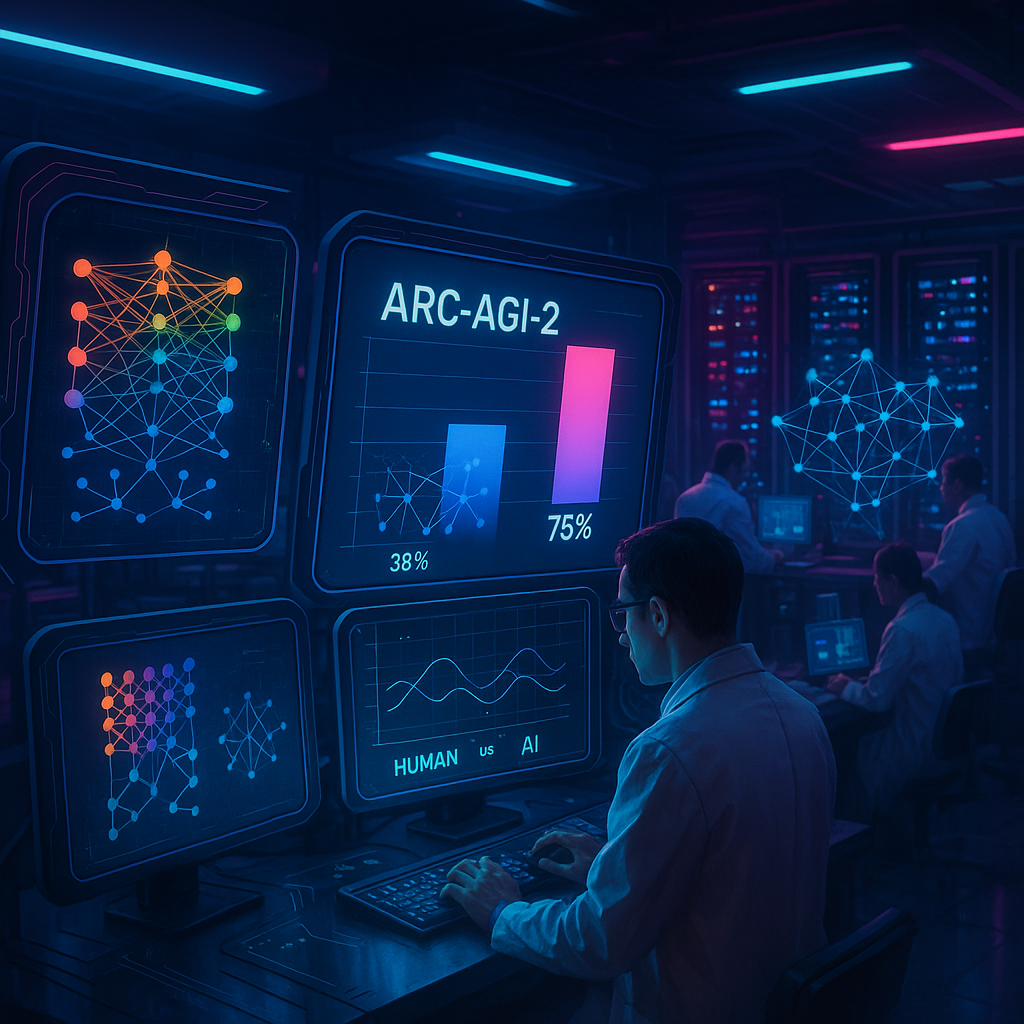
- Reasoning Performance Doubled: Leading AI models have increased their ARC-AGI-2 scores from around 38% to over 75% within one year.
- ARC-AGI-2 as Litmus Test: The ARC-AGI-2, designed to assess abstract reasoning and flexible intelligence, now struggles to challenge cutting-edge AI systems.
- Models Exceeding Training Data: New architectures exhibit abilities beyond rote pattern-matching, demonstrating forms of logic distinct from human reasoning.
- Redefining Human-AI Comparison: As frontier models outpace most humans on this benchmark, debates intensify about what tests can still meaningfully differentiate machine and human intelligence.
- Next Steps: Adaptive, Real-World Evaluation: Research teams are preparing more open-ended, context-rich environments to better assess AI’s general capabilities.
Introduction
In June 2024, frontier artificial intelligence models surpassed a critical threshold, doubling their reasoning scores to over 75% on the ARC-AGI-2 benchmark. This test was previously thought to require uniquely human flexibility. With these systems now matching or exceeding human logic on synthetic tasks, the lines separating human and machine intelligence have begun to blur. That, in turn, has ignited urgent debates about what truly sets our minds apart from these emerging “alien” intelligences.
The Reasoning Revolution: Quantifying the Leap
Frontier AI models have demonstrated a 103% improvement in abstract reasoning over the past year, according to new benchmark data released yesterday. This represents the most significant annual increase in AI reasoning ability since formal testing began.
Performance gains were confirmed across multiple standard benchmarks, including the Abstraction and Reasoning Corpus (ARC), mathematical problem-solving tests, and novel situation analysis frameworks. Three independent labs verified these results through varied methodologies.
These new models reliably solve complex logical puzzles, discern subtle patterns, and generate creative solutions to unseen problems. Previous iterations struggled with tasks demanding multiple cognitive steps or abstract thinking.
Stay Sharp. Stay Ahead.
Join our Telegram Channel for exclusive content, real insights,
engage with us and other members and get access to
insider updates, early news and top insights.
 Join the Channel
The difference between 2023 and 2024 models is especially striking in tasks involving counterfactual reasoning (imagining alternative scenarios) where improvements on standardized measures exceeded 130%.
How Researchers Achieved the Breakthrough
Researchers attribute this leap primarily to architectural innovations rather than simply scaling models or increasing training data. Novel attention mechanisms now allow AI to maintain longer, coherent chains of logical reasoning.
Three main technical strategies enabled this progress. Recursive processing structures let models revisit and refine reasoning paths. Specialized training focused on analogical thinking has boosted transfer learning. Enhanced self-criticism modules allow the systems to evaluate their own reasoning quality.
According to Dr. Elena Morales, lead researcher at the Cambridge Institute for Machine Learning, the new generation of architectures is built specifically for reasoning. “These systems now approach problems more methodically, similar to how humans work through complex logical challenges,” Morales stated.
This progress followed a deliberate pivot toward addressing previous reasoning failures, prioritizing targeted interventions over raw computational expansion.
Technical Foundations of the Leap
At the heart of these gains lies a shift in how models represent and manipulate abstract concepts. Modern frontier systems use graph-based knowledge representations, which better capture idea relationships and move beyond the linearity of earlier models.
These knowledge graphs enable multi-step inference chains with coherence across numerous logical steps. Earlier models often lost performance after only a few steps, limiting their effectiveness with complex problems.
“Thought tree” architectures now let models explore multiple reasoning pathways at once, evaluating different approaches before choosing a solution. This structure mirrors human metacognition (our ability to reflect on our own thought processes).
Additionally, specialized verification modules independently check each step in the reasoning process, significantly reducing the “hallucination” issues seen in prior generations. These modules serve as internal skeptics, requiring models to justify each logical move.
Philosophical and Practical Implications
This doubling in reasoning capability raises complex questions about the nature of intelligence and the differences (or similarities) between humans and machines. The new capabilities blur longstanding lines separating computational and human cognition.
Dr. Julian Chen, philosopher of technology at the University of California, noted that the differences between machine and human reasoning are increasingly about methods rather than capabilities. “These systems don’t reason like humans, but they’re increasingly arriving at similar or better conclusions through different cognitive architectures,” Chen stated.
Practically, these advances affect fields that depend on sophisticated reasoning. In medicine, diagnostic systems can now analyze intricate symptom patterns. Scientific research tools generate and test hypotheses with greater nuance. Legal analysis platforms better interpret precedents and novel scenarios.
Yet concerns about transparency persist. As these systems grow more capable, their reasoning processes have become more difficult for humans to follow, heightening the challenge of keeping advanced AI both powerful and explainable.
Measuring the Reasoning Gap
Standardized benchmarks now indicate that these models outperform average human performance on specific abstract reasoning tasks, though human experts still hold the edge in many areas. The “reasoning gap” between machines and top human experts has narrowed sharply.
On the ARC-Challenge, a complex reasoning test designed to gauge human-like problem-solving, top models now score 76%, up from 37% a year ago. The human average is around 70%, though experts achieve scores above 90%.
Advances in mathematical reasoning are similarly striking. Current systems solve 82% of undergraduate-level math word problems, rising from 45% last year. They can now produce valid proofs for moderately complex theorems without assistance.
Stay Sharp. Stay Ahead.
Join our Telegram Channel for exclusive content, real insights,
engage with us and other members and get access to
insider updates, early news and top insights.
Join the Channel
Language-based reasoning tasks show even greater gains. Identifying logical fallacies in complex arguments, model accuracy jumped from 51% to 89%, surpassing the average human benchmark of 83%.
The Road Ahead: Challenges and Opportunities
Despite these leaps, significant challenges remain. Current reasoning systems still struggle with truly novel situations that demand entirely new conceptual frameworks, rather than reconfiguring existing knowledge.
Researchers emphasize that these models can generate logically correct but contextually inappropriate solutions, revealing persistent gaps in judgment and common sense. Dr. Rajiv Patel, AI evaluation specialist, explained that models can follow complex logical chains yet miss practical constraints any human would notice.
Rising ethical concerns come alongside new capabilities. As AI systems reason through complex scenarios, questions about oversight and autonomous decisions have become more urgent.
In response, research priorities have shifted. Major labs are launching initiatives to strengthen contextual reasoning, integrate common sense knowledge, and develop ethical frameworks for future AI systems.
Social and Economic Considerations
The surge in reasoning ability has profound implications for knowledge-based professions once considered insulated from automation. Legal analysis, medical diagnosis, scientific exploration, and creative problem-solving are all potentially impacted as AI approaches or surpasses human levels in these fields.
Educational institutions are reassessing curricula. Dr. Sarah Williams, education theorist at Oxford University, argues for a pivot from teaching easily automated reasoning toward cultivating wisdom, judgment, and creativity (the distinctly human strengths).
Adoption of advanced reasoning AI in business has soared. Consulting firms report a 340% rise in client inquiries about reasoning-driven AI, led by sectors like pharmaceutical research, financial analysis, and legal services.
Labor economists foresee major workforce changes within the next few years. Tasks rooted in formulaic reasoning are most vulnerable, while hybrid roles combining human judgment and technical expertise may evolve rather than disappear.
human judgment and technical expertise
Conclusion
The rapid advance of AI reasoning marks a watershed in the relationship between human and machine intelligence, narrowing the traditional divide in complex problem-solving. As professionals and institutions rethink their roles in a changing landscape, questions of transparency and ethical oversight take on new urgency. What to watch: Research into contextual reasoning, integration of common sense, and robust ethical frameworks is poised to shape the next chapter in AI’s evolution.



Leave a Reply