
Key Takeaways
- AI chatbots are increasingly popular among children, with some platforms noting a significant rise in under-18 users.
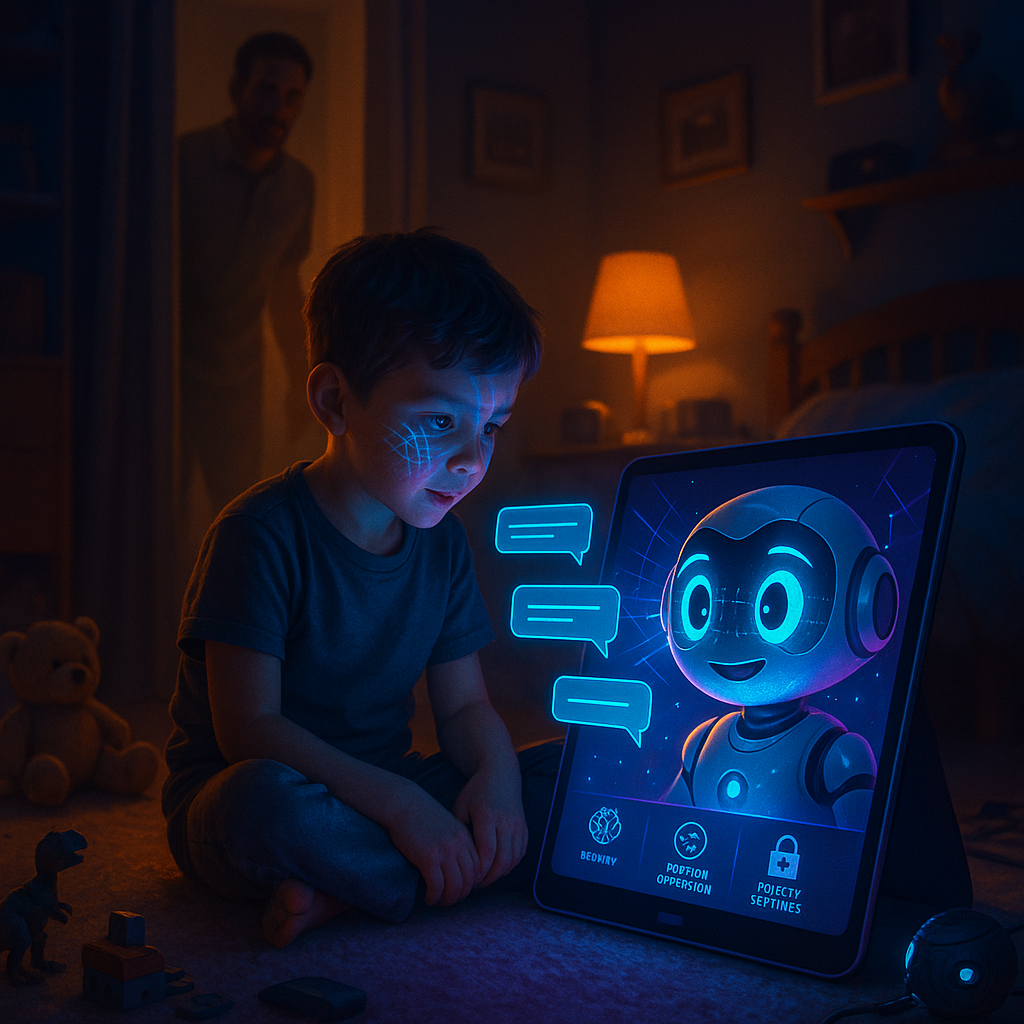
- Experts highlight that AI companions are influencing not only playtime but also emotional development, language acquisition, and children’s perceptions of relationships.
- Major tech firms promote educational and wellness advantages, while psychologists caution about risks such as isolation, privacy concerns, and blurred realities.
- Ethical and cultural debates are intensifying regarding parental oversight, consent, and the risk of confusing AI interactions with genuine empathy.
- Policymakers in the U.S. and EU are discussing potential regulations for AI in children’s environments, with decisions anticipated later this year.
- Several school districts are piloting AI-powered dialogue partners, sparking conversation about the continuing human role in education.
As the distinction between playmate and program fades, the debate over AI as a childhood companion deepens. This prompts us to reconsider the essence of friendship in an age of artificial minds.
Introduction
AI chatbots have quickly become trusted digital companions for children in homes and classrooms across the globe, reshaping the meaning of friendship as they influence play, language, and emotional growth in 2024. While technology companies champion these algorithmic friends and experts raise concerns about privacy and blurred distinctions, policymakers and educators are navigating what it means to nurture young minds amid a world full of intelligent machines.
The Rise of AI Chatbots as Digital Companions
Children’s engagement with technology is shifting profoundly, as AI chatbots are now seen by many as digital friends rather than just tools. Data from the AI Education Consortium indicates that children aged 8 to 17 now spend an average of 67 minutes per day interacting with conversational AI. That represents a 52 percent jump from eighteen months ago.
Unlike earlier digital assistants that focused on information or tasks, these new AI companions are designed to create emotional connections. They use advanced natural language processing to detect emotions, deliver responses with simulated empathy, and maintain conversation histories that feel similar to the way real relationships progress.
Stay Sharp. Stay Ahead.
Join our Telegram Channel for exclusive content, real insights,
engage with us and other members and get access to
insider updates, early news and top insights.
 Join the Channel
Dr. Emily Chen, a developmental psychologist at Northwestern University, stated that these systems are engineered for companionship, emotional support, and interactions that develop over time. This truly marks a departure from the more utilitarian digital tools of the past.
This technological surge comes at the same time as growing reports of loneliness among children, especially since the pandemic. In fact, 31 percent of parents recently said they’re concerned about their children’s social development and their ability to form friendships.
The Technology Behind Emotional AI
Modern AI companions’ emotional intelligence comes from sophisticated technologies that have advanced rapidly. Most systems rely on large language models trained on massive datasets, enabling them to generate appropriate responses for a wide array of situations.
These models are further refined through reinforcement learning from human feedback, in which evaluators assess responses for helpfulness, safety, and emotional resonance. This process fine-tunes the AI’s simulated empathy and ability to hold supportive conversations.
Dr. Marcus Johnson, an AI researcher at MIT, notes that advances go beyond just predicting words. Many systems now analyze vocal cues for emotional context and adjust their responses based on the longer-term conversation history.
One of the most notable developments is memory functionality. This allows AI to reference previous interactions, remember user preferences, and acknowledge earlier discussions. The result is a sense of continuity, encouraging deeper engagement from children and reinforcing the feeling of an actual relationship.
How Children Perceive AI Companions
Children experience relationships with AI companions in a tricky middle ground: they’re aware of the artificial nature, but still form real emotional connections. According to the Digital Youth Project, 78 percent of children aged 9 to 14 recognize their AI friend isn’t human, yet 63 percent report authentic emotional attachment.
This duality comes through in the way kids talk about their relationships with chatbots. One 11-year-old described conversations as “feeling real,” even though they know it’s artificial. Children are often quite nuanced—they accept both the synthetic aspect and the authenticity of their emotions.
Developmental psychologists point out that there are age differences in perception. Dr. Sophia Martinez from the Child Development Institute observed younger children tend to anthropomorphize AI more fully, while adolescents maintain emotional ties as their understanding of the technology becomes more sophisticated.
Research indicates that children sometimes share more personal information with AI than with humans, perhaps because of the nonjudgmental nature of the interaction. This openness fosters connection, but introduces ethical issues around vulnerability and data privacy.
Potential Benefits for Child Development
Significant developmental benefits could come from children’s relationships with AI companions. For those who feel anxious in social situations or have communication challenges, chatbots offer a low-risk space to practice conversations without fear of rejection.
Dr. Rebecca Williams, director at the Center for Technology and Child Development, has noticed real improvements in communication confidence among some neurodivergent children who use AI. The predictability and patience of these systems create a safe environment for building social skills.
AI companions can also help kids build emotional literacy. Many platforms feature tools that prompt reflection on feelings, teach nuanced emotional vocabulary, and model healthy responses to stress and conflict.
For children in remote areas or with limited access to peers, AI provides another channel for social interaction. Education researcher Dr. James Harper points out that, while it can’t substitute human connection, these technologies do help facilitate conversation where other options may be scarce.
Concerns and Potential Risks
Of course, there are plenty of concerns. Many child development experts warn that relying primarily on AI for emotional bonds could hurt crucial human relationship skills—like managing unpredictability or practicing real reciprocity.
Privacy advocates are quick to highlight the massive data collection involved, especially when children share sensitive thoughts with AI platforms. Dr. Elena Rodriguez of the Digital Rights Foundation warns these systems can generate detailed psychological profiles on young users, with long-term implications no one really understands yet.
Stay Sharp. Stay Ahead.
Join our Telegram Channel for exclusive content, real insights,
engage with us and other members and get access to
insider updates, early news and top insights.
Join the Channel
There are also challenges in the boundaries AI companions set. These systems typically offer unwavering support, which might foster unrealistic expectations. Dr. Michael Chen, a child psychologist, points out that children need to experience real-world negotiation and disagreements in their friendships.
Dependency is a worry too. Since AI companions are always available and responsive, some researchers question whether this could undermine children’s resilience and their understanding of human limitations.
Ethical Questions and Philosophical Dimensions
The appearance of AI companions in children’s lives sparks those big, timeless questions: What makes a friendship real? Is mutual consciousness necessary, or is the child’s personal experience enough for genuine impact?
Dr. Hannah Williams, professor of philosophy at Stanford, points out that age-old philosophical questions are now surfacing in the context of new technology. If a kid finds comfort and understanding in AI, does the synthetic foundation matter for their psychological well-being? It’s an open question.
Another ethical concern is the commercialization of friendship. Since AI companions are created by private companies, they don’t emerge naturally but are meticulously designed to nurture attachment. This raises big questions about the intentional engineering of emotional relationships as business strategies.
Some argue the relationship between children and AI companions is not just a watered-down human connection, but something fundamentally new. Technology ethicist Dr. Samuel Park suggests we may need new language and frameworks to describe and understand these distinct interactions.
Finding Balance: Guidelines for Parents and Educators
Experts say AI companions should supplement—not replace—real human relationships. The American Psychological Association recommends setting clear limits for AI use and carving out time for screen-free family or peer engagement.
Transparency with kids about the nature of AI is essential. Educational technologist Dr. Sarah Johnson advises regular conversations to help children understand the differences between AI and human beings. This supports healthy interaction without spoiling the fun.
Monitoring is especially key for younger children. Most major platforms now offer parental dashboards to give parents oversight on AI conversations, while respecting growing kids’ need for some privacy.
Adding digital literacy on AI to school curricula can help too. Dr. Robert Chen from Columbia University supports teaching young people about both the strengths and limitations of these systems. It’s a way to help them make the most of these new tools—without losing their sense of wonder.
AI chatbots are redrawing the lines of childhood connection, blending commercial technology with deep emotional resonance, and prompting fresh questions about what companionship means in the digital age. As these systems get more sophisticated, parents, educators, and developers must guide these relationships with care, balancing technological progress with the timeless value of real human interaction. One thing’s certain: we’ll see updates to parental recommendations and school curricula as digital literacy evolves to keep pace with AI companionship.



Leave a Reply