
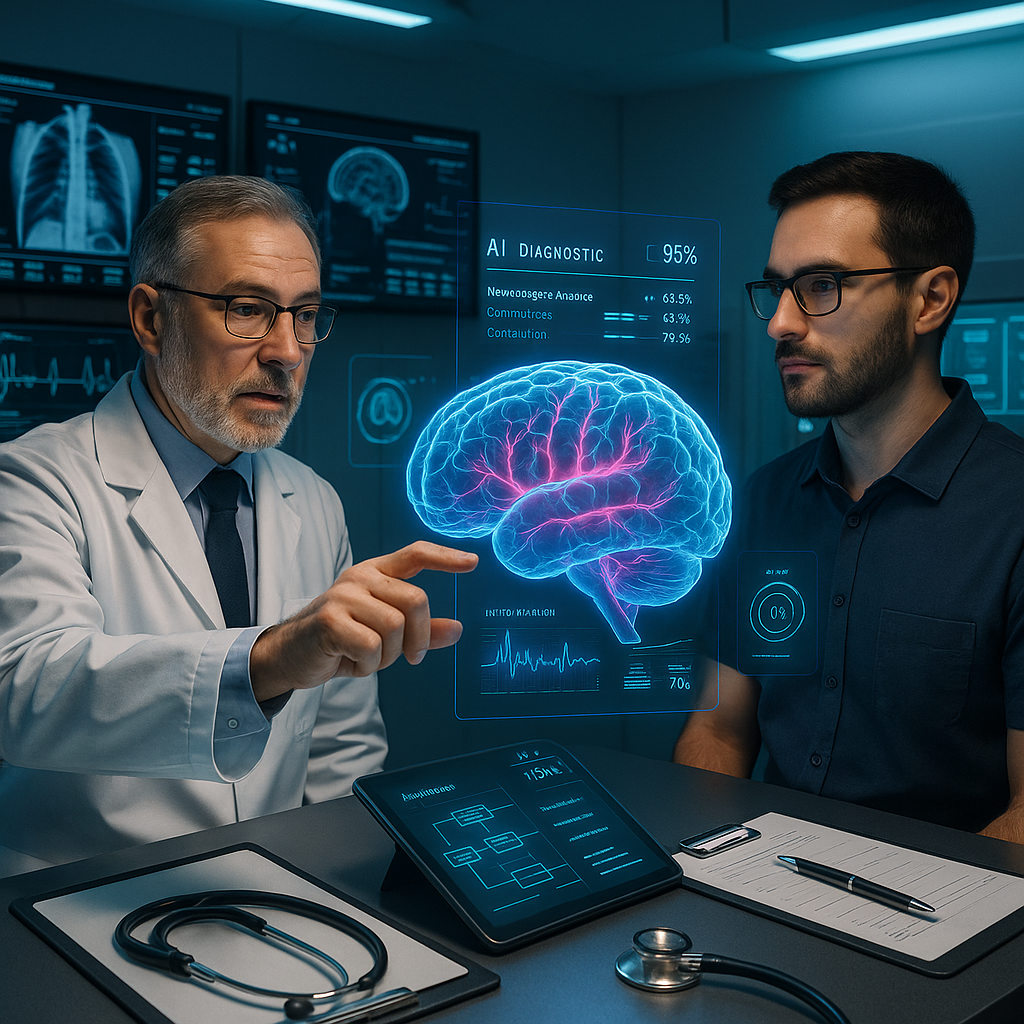
Key Takeaways
- AMA launches Center for Digital Health: The center aims to guide healthcare professionals through the integration of AI and emerging technologies in clinical settings.
- Focus on ethical implications: The initiative will address both the promise and societal risks of AI-powered care, including patient trust, data privacy, and algorithmic bias.
- Bridging old and new paradigms: The project addresses the growing tension between evidence-based medicine and algorithm-driven recommendations, challenging the foundations of medical expertise.
- Education as a core mission: The AMA will foster digital literacy among clinicians, emphasizing critical engagement rather than passive adoption of AI systems.
- Strategic partnerships anticipated: The center plans to collaborate with technology providers, research institutions, and policymakers to guide responsible AI integration.
- Upcoming events and policy guidance: The AMA will unveil initial digital health frameworks and convene thought leaders at its annual meeting next quarter.
Introduction
The American Medical Association (AMA) has launched its Center for Digital Health in Chicago, marking a significant response to the rapid emergence of artificial intelligence in clinical practice. By bridging traditional medical expertise with the evolving presence of AI, the center intends to guide physicians through new technologies, ethical dilemmas, and the shifting role of medical authority.
The Center for Digital Health: AMA’s Vision Amid AI Ascendancy
The American Medical Association has established its Center for Digital Health in direct response to the rapid integration of artificial intelligence in medical practice. Located in Chicago’s innovation corridor, the center will serve as both laboratory and forum. Here, physicians, technologists, and ethicists can work together to shape the algorithmic future of healthcare.
This initiative signals the medical establishment’s most substantial acknowledgment that AI has shifted from theoretical concept to practical reality in clinical environments. The center’s founding principles focus on augmenting, not replacing, physician judgment.
Dr. Jesse Ehrenfeld, President of the AMA, stated, “We’re witnessing a fundamental shift in how medical decisions are made. Our profession must develop frameworks that preserve human wisdom while embracing computational power.”
Stay Sharp. Stay Ahead.
Join our Telegram Channel for exclusive content, real insights,
engage with us and other members and get access to
insider updates, early news and top insights.
 Join the Channel
The center emerges as healthcare systems across the country contend with AI that increasingly matches or exceeds human performance in specific diagnostic tasks. The AMA characterizes its effort as a proactive philosophical engagement with technologies that think differently from human creators.
Guiding Physicians Through the Age of “Alien Minds”
A core concept of the center frames AI systems as “alien minds.” These are forms of intelligence with reasoning processes fundamentally different from those of human clinicians. This perspective recognizes that algorithmic decision-making often operates through patterns and correlations inaccessible to even seasoned physicians.
Medical educators involved with the center highlight the need for doctors to develop new interpretive skills, including the ability to discern when to trust AI recommendations and when to rely on traditional clinical judgment.
Dr. Katherine Sullivan, the center’s appointed director, commented, “We’re training physicians to collaborate with intelligence that processes information in ways human minds simply don’t. This isn’t about competition but about complementarity between different forms of knowing.”
This metaphor helps to sidestep both idealistic optimism and blanket resistance to technology. It suggests that medicine’s future rests in thoughtful alliance, where both human and artificial intelligence are respected for their distinct contributions.
Educational Initiatives and Clinical Frameworks
The center’s initial agenda emphasizes developing educational resources that build “AI literacy” among practicing physicians. Resources will include modular curricula for integration into medical school programs, as well as ongoing education for experienced doctors.
Creating practical frameworks for evaluating AI tools is another priority. These guidelines will help organizations assess which algorithms deserve integration into clinical workflows, based on rigorous standards for validation and transparency.
Dr. Ehrenfeld explained, “We need systematic approaches to distinguish between AI that genuinely advances patient care and flashy tools that add complexity. Our evaluation frameworks will set clear benchmarks for both performance and explainability.”
A key focus is physician leadership in technology assessment. The center seeks to replace passive adoption of externally developed systems with active, clinician-led evaluations. This is a departure from earlier phases of technology implementation, often criticized for imposing change on healthcare providers.
The Philosophical Underpinnings of Human-AI Collaboration
At its core, the Center for Digital Health addresses a vital philosophical question: What makes medical judgment uniquely human, and which elements could or should be delegated to machines? This inquiry moves beyond technical debates to examine the nature of clinical wisdom itself.
The center has assembled an interdisciplinary ethics council including philosophers, sociologists, religious scholars, physicians, and computer scientists. This group will explore the intersection of values-based reasoning and probabilistic computation in medical decision-making.
Dr. Alisha Mohan, an ethicist affiliated with the initiative, stated, “Medicine has always been both science and art. The challenge now is determining which aspects of clinical care require human empathy and moral reasoning, and which can be enhanced through partnership with these alien intelligences.”
The council will provide guidance for maintaining physician-patient trust in technology-mediated encounters. Their work acknowledges that trust remains essential to effective care, even as algorithms increasingly support decision-making.
Reactions from the Medical Community
Reactions from physicians reveal a profession adapting to swift technological change. Doctors in specialties already deeply influenced by AI, such as radiology and pathology, have expressed gratitude for the AMA’s decision to address these issues formally.
Dr. James Wilson, a radiologist at University Hospital, noted, “For years, we’ve been told AI would fundamentally change our practice with little guidance on how to adapt. The center signals that we won’t navigate this transition alone.”
Some in primary care and other generalist fields have voiced concerns about the potential for premature endorsement of unproven technologies. They urge the center to uphold rigorous standards before promoting specific applications.
Stay Sharp. Stay Ahead.
Join our Telegram Channel for exclusive content, real insights,
engage with us and other members and get access to
insider updates, early news and top insights.
Join the Channel
Medical students, meanwhile, have responded enthusiastically to the center’s educational focus. Student AMA chapters have organized events to discuss how AI might shape their careers and the skills necessary to navigate this shift.
Technologists have also responded positively. Several leading healthcare AI developers have promised cooperation with the center’s assessment framework, recognizing that physician engagement is critical to successful adoption.
Balancing Innovation and Caution
The center’s strategy steers between technological enthusiasm and measured skepticism. Rather than endorsing every AI advance, the initiative stresses evaluation based on each technology’s abilities, limitations, and suitability for specific clinical contexts.
This approach acknowledges that not all medical settings require the same degree of algorithmic influence. Emergency care, for instance, may benefit from timely AI input, while complex cases involving multiple conditions still call for human oversight.
Dr. Sullivan explained, “The question isn’t whether AI belongs in medicine, but where, when, and how it should be integrated. Some clinical scenarios will be transformed by these technologies, while others may remain primarily human domains for the foreseeable future.”
Leadership at the center affirms that effective integration of AI also demands consideration of healthcare’s social dimensions. Technology assessment will include impacts on health equity, reflecting concerns that training algorithms on unrepresentative data could deepen existing disparities.
For a broader perspective on how digital and algorithmic decision-making impacts trust, bias, and accountability across sectors, explore algorithmic bias in predictive policing and its societal implications.
Broader Implications for Healthcare’s Future
Looking beyond immediate practicalities, the Center for Digital Health represents medicine’s institutional response to sweeping technological transformation. The initiative makes clear that the profession aims to shape the role of AI rather than simply respond to external pressures.
This assertion of agency may serve as a model for other professions facing similar disruption. The center’s approach demonstrates how specialized human expertise can be preserved and enhanced, not simply replaced, in the age of intelligent machines.
Dr. Ehrenfeld commented, “We’re establishing a model for how professions evolve alongside artificial intelligence. The path we chart will show how human knowledge can be preserved and enriched.”
The center recognizes that artificial intelligence in healthcare poses questions transcending technical or ethical silos. Its collaborative structure brings together diverse perspectives, acknowledging the complexity and multidimensional nature of human-AI collaboration.
To explore philosophical debates on the boundaries between human intuition and artificial logic in decision-making, see human limits in AI collaboration and the nuanced roles of expertise in AI integration.
Medicine now stands at a crucial turning point, with algorithmic intelligence shaping more clinical decisions than ever before. Through the Center for Digital Health, the AMA has committed to ensuring that this transformation unfolds with physicians participating as active contributors to their profession’s future.
Conclusion
The AMA’s Center for Digital Health marks a decisive move for medicine in the era of AI integration. By prioritizing education and ethical reflection, the center seeks to ensure that technological advances strengthen rather than diminish the art of doctoring. What to watch: the upcoming rollout of AI literacy curricula and the publication of clinical assessment frameworks for AI tools in the coming year.
If you are interested in how data selection, fairness, and trust are maintained in AI-driven professional and public domains, consider the best practices in ethical data collection in AI.




Leave a Reply