
Key Takeaways
- AI Task Force Created: The executive order forms a dedicated group to address legal and societal challenges emerging from AI’s rapid advancement.
- Interdisciplinary Approach Mandated: Legal experts, technologists, ethicists, and government agencies will collaborate to navigate new legal territory shaped by AI.
- Copyright and Accountability in Focus: Key issues include intellectual property, authorship, privacy, and responsibility. These are areas where AI disrupts traditional legal concepts.
- Civil Rights Protections Spotlighted: The Task Force is charged with safeguarding fundamental rights as automated systems increasingly influence jobs, justice, and opportunity.
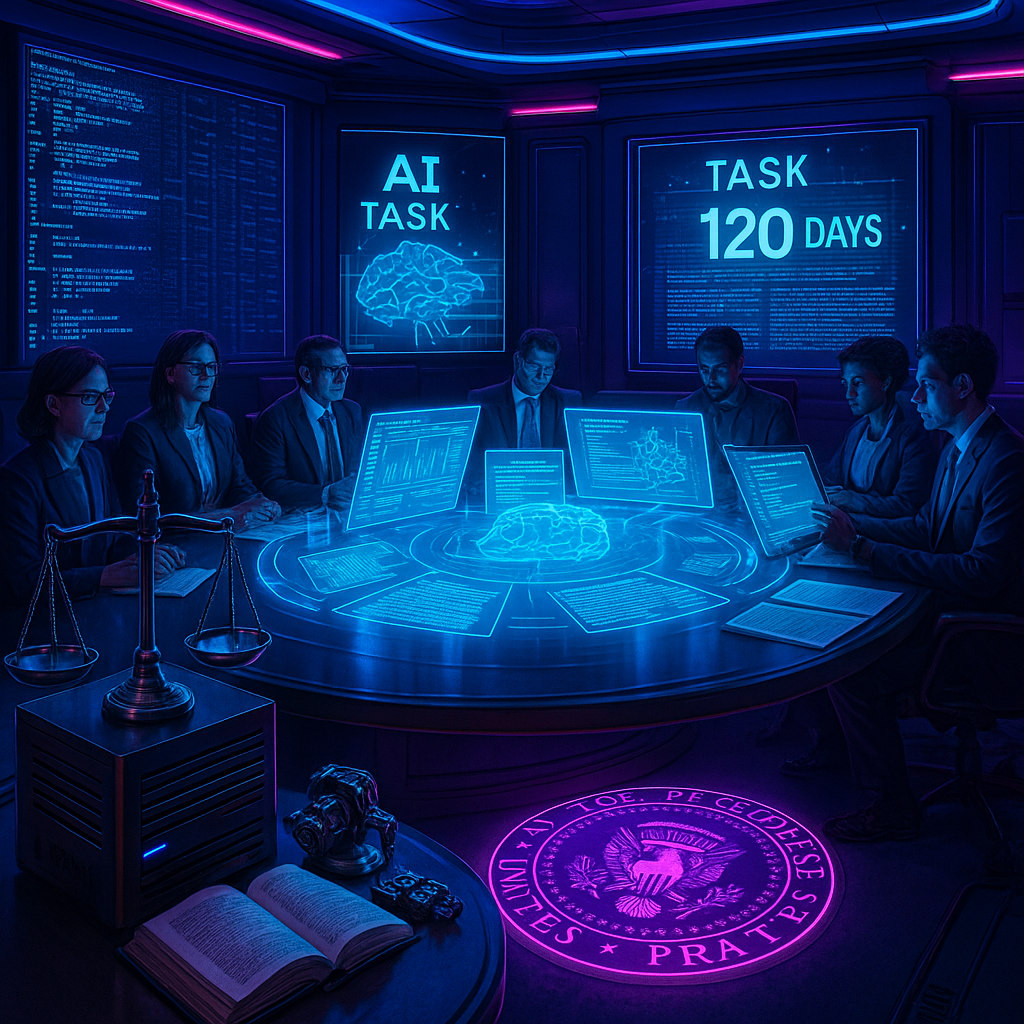
- Initial Recommendations Due: The group must deliver its first legal and policy recommendations within 120 days, creating a roadmap for future legislation and public debate.
Introduction
The White House has announced a sweeping executive order in Washington, D.C., establishing a federal AI Task Force tasked with addressing complex legal challenges posed by artificial intelligence. By uniting legal thinkers, technologists, and ethicists, the initiative marks a pivotal effort to reconsider fundamental rights and responsibilities in an era where machine intelligence affects everything from authorship to civil liberties.
Executive Order at a Glance
President Biden signed an executive order yesterday that creates a federal Artificial Intelligence Task Force focused on urgent legal and ethical questions arising from rapidly evolving AI technologies. The order establishes an interdisciplinary body authorized to examine AI’s impact across healthcare, employment, education, and national security.
The Task Force has three main objectives: formulate comprehensive legal recommendations for AI’s development and deployment, identify regulatory gaps posing immediate risks, and propose model legislation that achieves both innovation and protection of individual and collective rights.
White House officials described the initiative as “a necessary response to unprecedented technological change” that is outpacing current legal frameworks. The order explicitly states that existing laws designed for human decision-makers no longer suffice for regulating algorithmic governance.
Stay Sharp. Stay Ahead.
Join our Telegram Channel for exclusive content, real insights,
engage with us and other members and get access to
insider updates, early news and top insights.
 Join the Channel
Recommendations from the Task Force must preserve U.S. technological leadership while introducing safeguards aligned with democratic values and constitutional principles. Navigating this balance underlines the growing consensus that effective AI regulation requires nuanced solutions rather than simple choices between progress and restraint.
Who’s on the Task Force
The 18-member Task Force features a deliberately diverse group of experts from law, computer science, philosophy, civil rights, and business. Rather than prioritizing technologists, the administration has granted legal and ethical specialists equal influence with technical professionals.
Key members include Dr. Mira Patel (former Supreme Court clerk and AI ethicist) as chair, Dr. James Chen (MIT computer scientist) as technical director, and Professor Robert Gonzalez (constitutional law scholar) as legal counsel. Civil liberties are represented by ACLU technology fellow Aisha Washington, and industry perspectives come from smaller AI firms rather than only major tech companies.
The Task Force includes philosophers focused on ethics and technology, such as Dr. Sarah Keller from the Center for Technological Responsibility. Keller stated that questions about personhood, agency, and fairness are not just academic but are now design specifications for AI.
Public interest representatives make up one-third of the group, including advocates for disability rights, privacy, and racial justice. This composition underscores the administration’s view that AI governance is fundamentally about human values and social outcomes, not just technical considerations.
Untangling AI’s Legal Paradoxes
Authorship Without Authors
Copyright law faces major challenges from generative AI systems that produce original-seeming works without clear human attribution. The Task Force will examine whether AI-generated content is eligible for copyright protection and, if so, determine the appropriate rights holders. Is it the system developer, the user, or potentially no one?
Recent court cases have yielded conflicting outcomes on whether AI-created works qualify as “original works of authorship” under current law. For example, the “Monkey Selfie” case established that non-human creators cannot claim copyright, but this principle becomes uncertain when human actions indirectly shape AI outputs.
These questions are not merely academic. Creative industries such as music and visual arts now confront AI systems capable of generating vast content by drawing on existing works. Professor Jane Martinson, intellectual property expert and Task Force member, remarked that society faces a fundamental debate on whether copyright serves to encourage human creativity or simply maintains a functioning market for creative works, regardless of origin.
Beyond economics, the issue touches on cultural value and authenticity in an age when machines can convincingly mimic human expression. The Task Force is tasked with finding ways to protect and reward human creators while accepting new technological realities.
Accountability When Algorithms Decide
Liability questions become even more complex when AI systems cause harm. Think biased lending decisions, medical errors, or autonomous vehicle accidents. Traditional frameworks assume humans can be held accountable, but AI distributes decision-making across developers, users, and even data sources.
“Our legal system was built for human responsibility,” noted Task Force member and civil rights attorney Michael Coleman. When an algorithm discriminates, pinpointing responsibility is complicated.
The executive order specifically instructs the Task Force to examine algorithmic discrimination, which frequently occurs without intentional bias being programmed. AI trained on historical data can reinforce or worsen patterns of inequality, even if no single individual meant to cause harm.
The challenge is to develop accountability structures that do not chill innovation but still ensure real responsibility. This may require new legal concepts beyond the traditional bounds of tort and civil rights law.
Charting the Path Forward
The executive order gives the Task Force just 120 days to deliver initial recommendations. This tight timeline reflects the administration’s sense of urgency as AI adoption accelerates across society.
To solicit public input, the Task Force plans to hold six forums nationwide, inviting stakeholders from academia to affected communities. The first session, focusing on healthcare AI, will be held next month at Johns Hopkins University.
The Task Force is expected to produce a comprehensive legal gap analysis, model regulatory frameworks for agencies to implement immediately, and draft legislation for issues needing new statutory authority.
Stay Sharp. Stay Ahead.
Join our Telegram Channel for exclusive content, real insights,
engage with us and other members and get access to
insider updates, early news and top insights.
Join the Channel
White House officials stressed that these proposals are meant to inform, not bypass, Congress. “This isn’t about circumventing Congress,” explained Chief of Staff Maria Rodriguez. “It’s about establishing a substantive, evidence-based foundation for bipartisan legislation, free from speculation and lobbying bias.”
Why This Moment Matters
The launch of this Task Force goes beyond bureaucratic necessity; it signals a philosophical turning point in humanity’s evolving relationship with its own creations. As AI systems make consequential decisions with minimal human oversight, fundamental questions on autonomy, personhood, and social order become ever more urgent.
Legal systems have historically evolved alongside technology, from property rights in the industrial revolution to digital privacy. However, AI introduces entities that display decision-like capabilities without consciousness or morality.
“We’re not just writing new rules for a new technology,” stated Task Force chair Dr. Patel. “We’re potentially redefining what it means to be a legal person, the essence of human control, and the balance between individual rights and collective good as automation mediates more human experiences.”
This initiative acknowledges that technology is not value-neutral but embodies social choices. The resulting legal frameworks will not simply regulate machines, but will articulate what society values and wishes to safeguard as automation transforms fundamental human experiences.
Conclusion
The formation of the federal AI Task Force represents a pivotal step as U.S. leaders tackle the complexities of adapting laws and values in an age of algorithmic influence. By centering ethical, legal, and technical voices together, the initiative reflects society’s effort to create meaningful oversight for artificial intelligence. What to watch: the Task Force’s inaugural public forum on healthcare AI at Johns Hopkins University next month and the fast-approaching 120-day deadline for its recommendations.



Leave a Reply