
Key Takeaways
- Top story: Andrew Yang has warned that AI advancements could displace 40 million US workers over the coming decade, bringing significant change to traditional employment structures.
- Google has introduced SIMA 2, an agent capable of autonomous reasoning and decision-making in complex 3D environments, expanding the boundaries of machine cognition.
- A recent survey shows that 55% of Americans now use AI in their daily routines, reflecting normalization and evolving social habits.
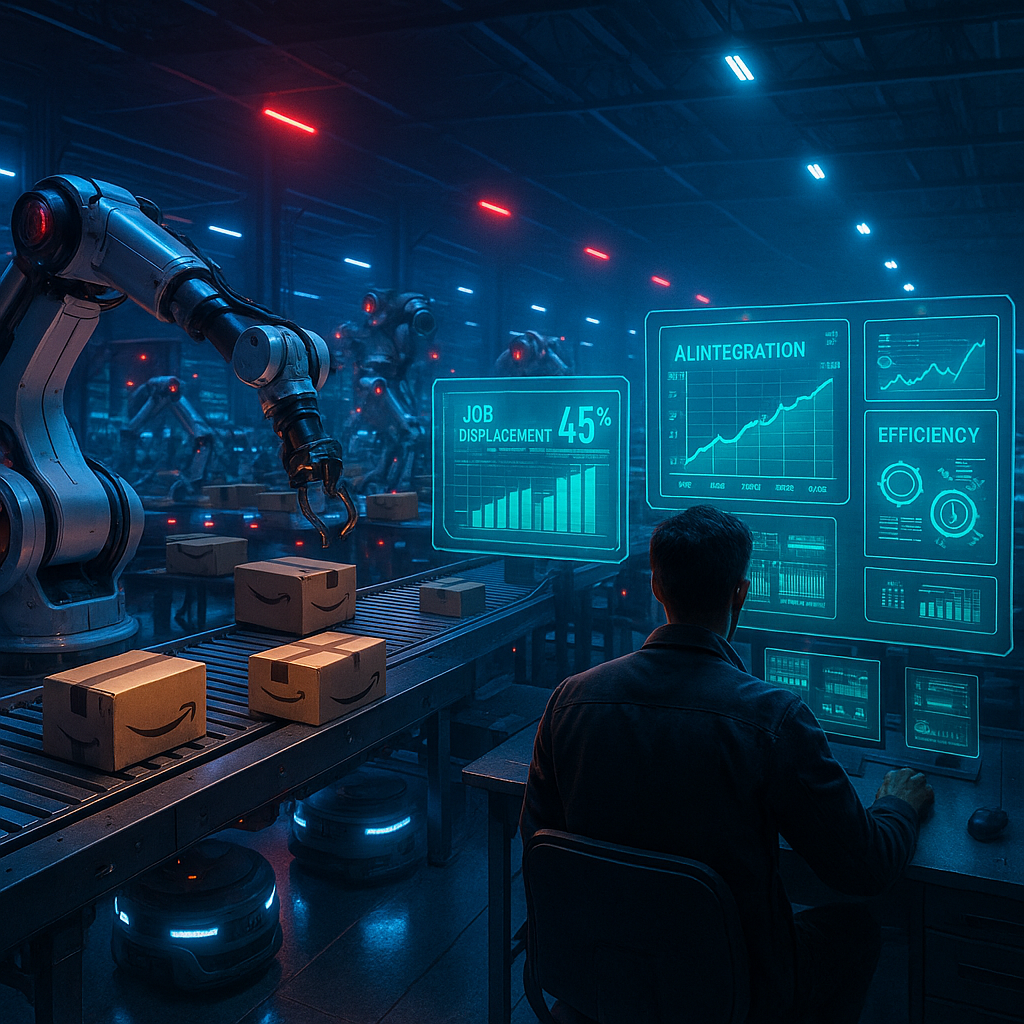
- Amazon aims for 75% warehouse automation, intending to avoid hiring 600,000 workers. This move intensifies debates on AI’s societal impacts in the labor market.
- AI society implications: These developments prompt urgent reflection on how meaning, purpose, and identity are redefined as human and machine lives increasingly intertwine.
Introduction
On 2 December 2025, Andrew Yang’s warning that AI could eliminate 40 million US jobs within the next decade highlighted automation’s human cost. At the same time, Amazon’s push toward 75% automation reinforces the broad AI society implications for labor, identity, and meaning. These themes are explored throughout this press review on the evolving relationship between humans and machines.
Top Story: Andrew Yang Warns of Accelerated AI Job Displacement
Key Facts and Figures
Former presidential candidate Andrew Yang warned yesterday that AI is eliminating jobs faster than previously predicted. Citing new research, he stated that 40% of current occupations could be significantly transformed or eliminated by 2030. This represents a 15% increase from projections made just 18 months ago, with mid-skill white-collar roles facing the highest risk. Yang presented these findings at the Economic Policy Institute’s Future of Work symposium in Washington, DC.
The most vulnerable sectors include customer service, data analysis, paralegal work, and entry-level accounting, according to a comprehensive study by Oxford Economics referenced by Yang. The research finds that AI systems can now perform complex tasks that were considered resistant to automation as recently as 2023.
Yang emphasized that new AI models now show unprecedented abilities in context understanding, creative problem-solving, and professional judgment. These are skills previously thought to require human intervention. He stated, “This isn’t just about efficiency. It’s about fundamental workforce restructuring happening at a pace society isn’t prepared for.“
Stay Sharp. Stay Ahead.
Join our Telegram Channel for exclusive content, real insights,
engage with us and other members and get access to
insider updates, early news and top insights.
 Join the Channel
Context and Significance
Yang’s warnings arrive as major technology companies continue to invest heavily in AI development while also announcing significant workforce reductions. Several Fortune 500 companies have already replaced 10–15% of their administrative and analytical positions with AI-powered systems over the past year.
The timing of Yang’s address coincided with the release of the Labor Department’s quarterly workforce transformation report. That report documented a 28% increase in job displacement claims related to automation. These claims increasingly affect college-educated workers in traditionally stable career paths.
Academic consensus is growing about the accelerating adoption of AI in workplaces. The Institute for Labor Studies has documented that the integration timeline for new AI tools has compressed from 24 to 36 months to just 8 to 12 months since the introduction of advanced large language models.
Expert Reactions and Perspectives
Economist Laura Martinez of the Brooking Institution challenged some of Yang’s conclusions, arguing that historical technological transitions suggest new job categories will emerge. She noted, “While displacement is real, the data show that economies typically adapt through the creation of entirely new professional categories that we cannot yet envision.“
Technology ethics researcher Dr. James Wong offered a middle ground. He acknowledged the displacement concerns while highlighting adaptive models in countries such as Singapore and Finland. Wong explained, “The key difference in this technological revolution is the compressed timeframe, which demands more aggressive policy responses than previous transitions.“
Labor representatives expressed strong agreement with Yang’s assessment. AFL-CIO Technology Impact Director Sophia Washington called for immediate policy action. She stated, “Without proactive measures, we risk creating a two-tier labor market that fundamentally undermines economic mobility.“
Also Today: AI Research Breakthroughs
DeepMind Announces Quantum-Inspired Neural Networks
Google DeepMind announced a new AI architecture yesterday that incorporates quantum computing principles to solve problems in materials science and drug discovery. The system, called QuantumNet, does not require quantum hardware but mimics quantum computational advantages in standard computing environments.
Initial tests indicate QuantumNet can model complex molecular interactions with 60% greater accuracy than traditional neural networks. This advancement could significantly accelerate pharmaceutical development timelines for previously challenging disease targets.
DeepMind CEO Demis Hassabis emphasized that this is a critical step toward bridging today’s AI capabilities and true quantum computing. He stated, “Rather than waiting for quantum hardware to mature, we’ve found ways to bring quantum advantages to today’s AI systems.“
OpenAI and Stanford Medical Center Report Healthcare AI Results
A year-long clinical implementation of specialized AI assistants in healthcare settings has produced promising preliminary results, according to a joint report by OpenAI and Stanford Medical Center. The study involved over 350 medical professionals using AI tools for documentation, diagnosis assistance, and treatment planning.
Key findings include:
- 32% reduction in documentation time
- 28% improvement in diagnosis accuracy for complex cases
- 41% decrease in burnout indicators among professionals using the AI assistants regularly
Dr. Rachel Chen, Chief Innovation Officer at Stanford Medical Center, noted that technology performed best as an augmentation rather than a replacement for clinical judgment. She explained, “The most successful implementations occurred where the AI served as a tireless background researcher and organizer, while physicians maintained decision-making authority.“
Also Today: Corporate AI Adoption Trends
Financial Sector Leads in Enterprise AI Implementation
Financial institutions have emerged as leaders in comprehensive AI adoption, according to a new industry analysis by McKinsey released yesterday. The report found that banking and investment firms have implemented AI across 73% of their core business processes, surpassing technology companies at 58%.
Risk assessment applications deliver the highest return on investment, as automated systems show a 40% improvement in fraud detection compared to previous methods. JPMorgan Chase recently disclosed that its AI fraud detection system prevented over $300 million in potential losses in the past quarter.
The analysis attributes this leadership to the sector’s data richness, established ROI measurements, and regulatory pressures for risk management. McKinsey senior partner Amanda Rodriguez stated, “Financial institutions have found the sweet spot where AI capabilities align perfectly with business imperatives.“
Manufacturing Sector Reports Mixed Results from AI Integration
A new survey from the American Production and Inventory Control Society reveals uneven results from AI implementation across the manufacturing sector. While 62% of large manufacturers report significant efficiency gains, only 24% of small and medium-sized manufacturers have reached their expected ROI.
Stay Sharp. Stay Ahead.
Join our Telegram Channel for exclusive content, real insights,
engage with us and other members and get access to
insider updates, early news and top insights.
Join the Channel
The difference appears tied to the maturity of data infrastructure. Successful implementations build on years of investment in sensors, IoT connectivity, and standardized data protocols. Companies lacking such foundations reported implementation costs averaging 3.5 times their initial projections.
Ford’s Michigan plant is cited as a case study for success, reducing unplanned downtime by 37% through predictive maintenance AI that uses data from more than 15,000 sensors along the production line. Michael Torres, Ford’s VP of Manufacturing Innovation, explained, “The key was viewing our AI strategy as the culmination of a broader digital transformation rather than a standalone initiative.“
What to Watch: Key Dates and Events
- Congressional AI Oversight Hearing (10 December 2025): The Senate Commerce Committee will question AI industry leaders about self-regulation efforts and safety protocols. Apple, Microsoft, and Google have confirmed participation.
- Stanford University AI Index Annual Report (12 December 2025): The annual analysis will provide updated metrics on AI progress, economic impact, ethics, and policy developments.
- Meta’s Quarterly AI Ethics Board Report (15 December 2025): The oversight body will release findings from its investigation into algorithmic bias in Meta’s recommendation and content moderation AI.
- BLS Special Report on Automation and Employment (18 December 2025): The Bureau of Labor Statistics will publish detailed data regarding automation’s impact on employment across major sectors.
Conclusion
Yang’s forecast emphasizes the complex AI society implications of rapid automation, challenging established concepts of job security amid widespread industry adoption. Experts continue to debate both the risks of disruption and prospects for adaptation, situating today’s breakthroughs within a broader discussion on work and technology. What to watch: Congressional hearings and major industry reports in the coming weeks will play a pivotal role in shaping public debate and policy on AI’s societal impact.
To explore deeper questions about how AI reshapes identity, meaning, and selfhood as human and machine lives increasingly intertwine, consider reading Generative Identity: How Mirror AI Shapes Digital Selfhood.
For further insight on neuroplasticity and how AI feedback systems might influence the brain’s adaptability in a rapidly changing labor market, see Neuroplasticity & Intelligent Feedback.
For philosophical exploration about the boundary between human and machine, consciousness, and the ethical consequences of AI integration into society, visit AI Origin Philosophy: Did We Invent Intelligence or Unearth It?.
To examine the emerging ethical questions of personhood and rights in the era of advanced synthetic intelligence, read Synthetic Beings Rights: Rethinking Personhood in the Age of AI.
For a forward-looking perspective on how cognitive, psychological, and regulatory frameworks might adapt in response to these unprecedented changes, consider AI Alignment Drift: Why Advanced Systems Lose Alignment Over Time.



Leave a Reply