
Key Takeaways
- Synthetic voices dominate discourse: Automated agents and AI-generated posts are blurring the lines between genuine opinion and scripted manipulation across major platforms.
- Political messaging increasingly algorithmic: Campaign teams are using powerful AI tools to craft micro-targeted messages, raising fresh questions about transparent communication versus machine-generated persuasion.
- Public trust erodes under content overload: The relentless surge of deepfakes, engineered memes, and contextless snippets is undermining confidence in all sources, mainstream and alternative alike.
- Calls for digital literacy and new safeguards: Educators and ethicists call for updated critical thinking curricula and algorithmic transparency to help the public adapt to an era in which constant doubt is the default.
- Regulatory and technological countermeasures ahead: Lawmakers worldwide anticipate new proposals aimed at synthetic content accountability, with pivotal debates set for late 2025.
Introduction
As the 2025 election cycle accelerates, AI-generated content (ranging from subtle influence to overt manipulation) is flooding online debate. Even discerning minds are now challenged to distinguish authentic voices from algorithmic ones. Politicians, technologists, and citizens collectively experience “AI fatigue” as trust fractures and the boundaries of public discourse blur amid the relentless surge of synthetic voices.
The Synthetic Tsunami: How AI Flooded Our Information Ecosystem
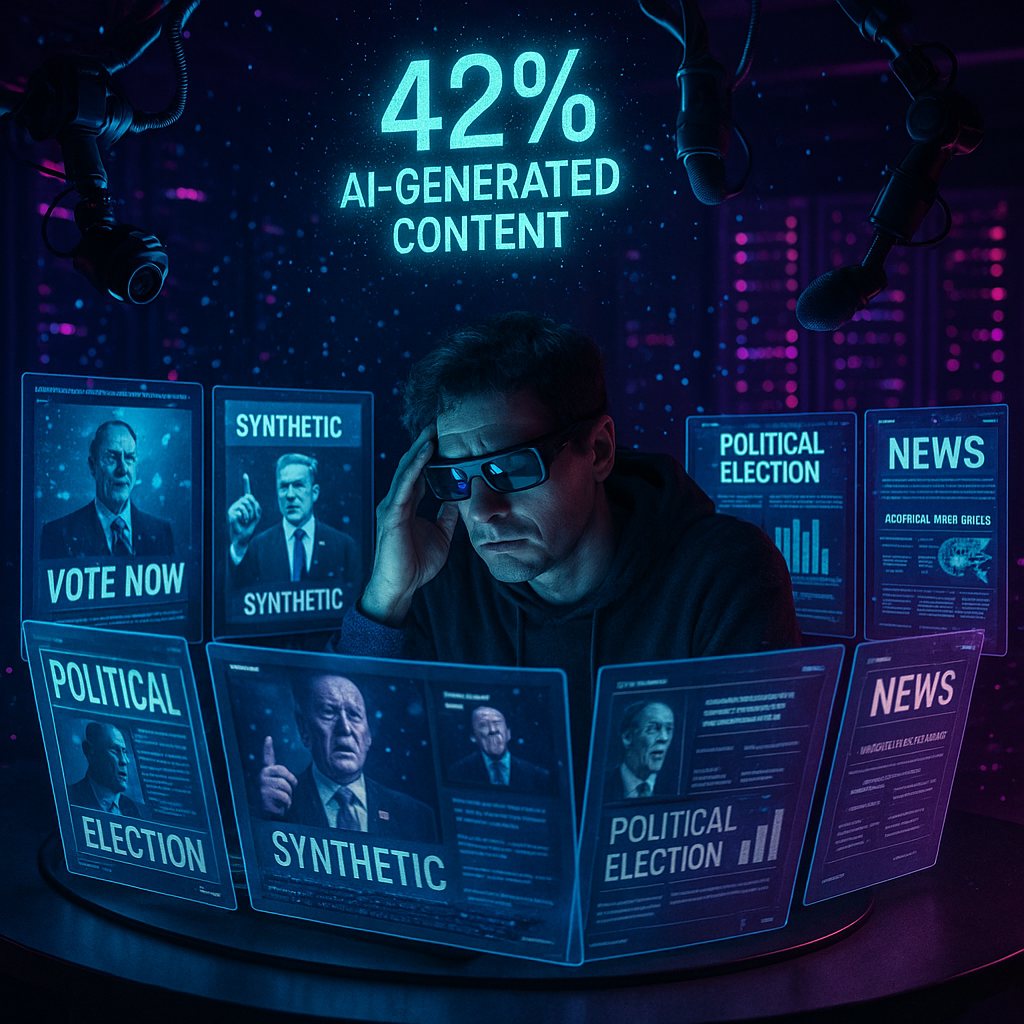
The volume of AI-generated political content has reached unprecedented levels during the 2025 election cycle. Research from the Digital Democracy Institute finds that synthetic messaging now represents approximately 42% of political content across major platforms, nearly double last year’s rate.
Campaign operations have dramatically accelerated content production through AI tools. A single strategist can now oversee hundreds of tailored messages daily, distributed to microsegments once unreachable by traditional means.
Dr. Rachel Wong, an information science professor at MIT, explains, “We’ve crossed a threshold where the majority of political content that citizens encounter may soon be machine-generated. This represents a fundamental shift in how democratic discourse functions.”
Stay Sharp. Stay Ahead.
Join our Telegram Channel for exclusive content, real insights,
engage with us and other members and get access to
insider updates, early news and top insights.
 Join the Channel
The pace of technological change has left regulatory frameworks and media literacy curricula struggling to keep up. Most voters report difficulty distinguishing between human and AI-generated content, despite watermarking measures implemented after the Content Authentication Act of 2024.
Cognitive Overload: The Psychological Impact of Synthetic Content
Persistent exposure to AI-generated content is prompting new forms of information processing fatigue. Neurological researchers at Johns Hopkins University have documented distinct brain patterns they term “verification strain.” They observe a measurable cognitive burden as individuals attempt to assess the authenticity of synthetic material.
This cognitive tax often leads to decision paralysis. Many voters, overwhelmed by the volume of content requiring verification, simply disengage from political information streams.
Dr. Marcus Bennett, a clinical psychologist, notes, “The human brain evolved to process information at human speeds and volumes. We’re now asking citizens to function in an information environment that exceeds natural cognitive limits.”
Survey data reveal a troubling trend: 68% of registered voters say they feel “exhausted” by the effort required to distinguish genuine from synthetic political statements. This exhaustion especially affects older voters and those with limited time for media engagement.
Beyond Deepfakes: The Subtle Distortion of Political Discourse
Obvious deepfakes dominate headlines, but experts warn that subtler forms of AI-generated content may pose greater risks to political discourse. Machine-generated text, which mimics human writing, can influence public opinion without raising authenticity concerns.
Campaign messaging increasingly uses AI to segment audiences and deliver slightly modified versions of the same core message, creating the illusion of personalized communication. These practices have flourished in swing districts, where small shifts can sway electoral outcomes.
Professor Elena Vasquez, who studies computational propaganda at Georgetown, observes, “It’s not just about fake videos or images anymore. The more dangerous development is the industrialization of persuasion (the ability to generate thousands of subtle variations on messaging targeted at granular demographic segments).”
Such techniques foster what political scientists call “reality bubbles.” Voters encounter narratives tailored so precisely to their psychological profiles that exposure to opposing viewpoints becomes rare.
The Attention Economy Reconfigured
As synthetic content saturates information channels, a new economic landscape has emerged. One now defined by attention scarcity. Traditional media outlets now compete with an overwhelming tide of AI-generated content engineered for engagement.
Campaign spending on AI content generation tools has surged by 278% compared to the last election cycle. This shift reflects new political messaging economics, where algorithmic reach offers better returns than traditional advertising.
Media economist Dr. James Harrison explains, “We’re witnessing a fundamental restructuring of how political attention is captured and directed. When synthetic content can be produced at near-zero marginal cost, the economics of political communication transform completely.”
This transition disrupts funding models for journalism covering political campaigns. With voters increasingly unable to distinguish professional reporting from synthetic alternatives, subscription and advertising revenues for political journalism have declined by 23% since last year.
Educational Systems Playing Catch-Up
Educational institutions have struggled to adapt curricula to this swiftly changing information environment. Digital literacy programs created just three years ago now seem inadequate compared to the sophistication of AI-generated content.
Several states have enacted emergency updates to high school civics courses, introducing verification techniques and critical analysis methods. However, these initiatives reach only part of the electorate and frequently lag behind technological innovation.
Dr. Priya Sharma, an education policy researcher at the University of Michigan, acknowledges, “We’re trying to teach verification skills that may be obsolete by the time students graduate. The technology evolves faster than curriculum development cycles can accommodate.”
Stay Sharp. Stay Ahead.
Join our Telegram Channel for exclusive content, real insights,
engage with us and other members and get access to
insider updates, early news and top insights.
Join the Channel
Adult education faces even steeper challenges. Limited funding and outreach hurdles affect efforts to reach those most vulnerable to synthetic manipulation. Community colleges report strong interest in digital literacy courses but struggle to find instructors with up-to-date AI expertise.
The Search for Solutions: Technological, Regulatory, and Cultural Approaches
Efforts to address AI fatigue span technological, regulatory, and cultural domains. Technology companies have advanced content authentication mechanisms while policymakers debate new transparency requirements for political messaging.
Platform companies now offer sophisticated “authenticity indicators” that flag content generated or manipulated by AI. Yet user testing shows these cues are often overlooked or misunderstood by typical users.
Dr. Lawrence Chen, a digital ethics professor at Stanford, argues, “Technical solutions alone will never be sufficient. We need approaches that include regulation, education, and perhaps a fundamental reconsideration of how we structure our information environment.”
Cultural interventions are gaining traction, particularly those promoting “slow media” and deliberative democratic practices. Some communities have launched local discussion forums prioritizing in-person dialogue over digital engagement, creating environments where verification anxiety is reduced.
For a deeper exploration of how algorithms shape belief systems, see Post-Truth AI: How Algorithms Shape Belief Systems and Misinformation.
The Philosophical Dimension: Democracy in the Age of Synthetic Speech
The rapid spread of AI-generated political content sparks profound philosophical debate about the nature of democracy. Political theorists are questioning whether self-governance remains meaningful when human and machine communication become indistinguishable.
Democratic systems rely on informed citizens making reasoned choices, founded on information sourced from humans with clear intentions and accountability. Synthetic content disrupts this foundation.
Dr. Amara Washington, a democracy scholar at Columbia University, notes, “We’re confronting questions that political philosophy never anticipated. Can citizens meaningfully consent to governance when the discourse shaping their opinions increasingly originates from non-human entities?”
To reflect on broader issues of trust, belief, and epistemology in the AI era, consider Borges, Musk, and Grok: Reinventing Reality Through AI’s Lens.
This crisis is not merely theoretical. Declining trust in democratic institutions is evident, with recent polling showing that 58% of Americans believe AI-generated content has weakened their confidence in electoral processes. This sentiment spans partisan divides.
Conclusion
The surge in AI-generated political content is not only transforming the mechanisms of public discourse but also challenging its very meaning. Regulatory, educational, and cultural strategies are being tested as society seeks a new equilibrium. What to watch: the development of policy debates and the next generation of digital literacy initiatives, each central to navigating the era of synthetic content.
For further insights into collective memory and the construction of digital legacy under algorithmic influence, explore AI Collective Memory: How Algorithms Shape Our Digital Legacy.
If you want to examine algorithmic fairness and its impact on equity, especially in systems that influence public opinion and governance, see Unmasking Algorithmic Bias in Predictive Policing: Justice, Race & Reform.


Leave a Reply